“Where are we ever going to use this?” “How does this ever relate to real life?” “None of this is going to be useful!” Questions like these are familiar to secondary mathematics and science teachers, reflecting a persistent challenge in STEM education: engaging students through relevance, confidence, and innovation.
A key factor influencing engagement is teaching efficacy, a teacher’s belief in their ability to teach effectively and inspire STEM learning. Rooted in Bandura’s Social Cognitive Theory (SCT) (1997), teaching efficacy and outcome expectancy shape instructional choices, student outcomes, and classroom climate. Although professional development can enhance efficacy, it is often inconsistent and lacks authentic, inquiry-based experiences that promote mastery and modeling.
Preservice teacher (PST) education offers opportunities to build efficacy and identity through inquiry-based, collaborative problem solving. Frameworks such as the NGSS (National Research Council [NRC], 2012) and task-based math and science frameworks (Stein & Smith, 1998; Tekkumru-Kisa et al., 2015) emphasize reasoning and investigation, while SCT highlights mastery and social learning as foundations for teaching efficacy and identity.
Few studies examine how CUREs support STEM PSTs, especially in math or interdisciplinary methods courses, making their potential contribution to PST development an important area of study. This study addresses the gap through the Peer-Inquiry Research Project (the Project), a capstone experience adapting the CURE model for PSTs to conduct original research and apply findings to teaching practice. The Project integrates mastery experiences, distributed leadership, and near-peer mentoring to scaffold inquiry and reflection. This study examines how participation in the Project influences PSTs’ teaching efficacy, outcome expectancy, professional identity formation, and technology beliefs as emerging STEM educators.
This study addresses the following research questions:
What are the impacts of the Peer Inquiry Research Project (the Project) on STEM preservice teacher development in mono- and interdisciplinary teaching efficacy?
How does the Project affect the professional identity development of STEM preservice teachers?
What is the relationship between teaching efficacy, teaching outcomes expectancy, and the factors that influence technology beliefs in preservice STEM teachers?
To what extent do teaching efficacy, teaching outcomes expectancy, and UTAUT constructs predict preservice STEM teachers’ intentions to use educational technology in the classroom?
This study employed a modified embedded experimental mixed methods design (Creswell, 2006; Creswell & Creswell, 2022) to examine how a CURE-based capstone experience influenced STEM PSTs’ efficacy, professional identity development, and technology beliefs. Quantitative data were collected using a pre/post quasi-experimental model, while qualitative data gathered during and after the intervention provided deeper insight into shifts in participants' perceptions and instructional practices. The integration of both data strands yielded a comprehensive understanding of the Project’s impact on emerging educators.
The sample consisted of 27 PSTs enrolled in methods courses at a regional public land-grant university in the northwestern United States. Four participants were secondary science candidates, three were secondary mathematics candidates, and 20 were elementary science candidates. Most were undergraduates, though several graduate students were pursuing certification.
The Project was implemented across three STEM methods courses over a 16-week semester. Designed as a capstone research experience, it engaged PSTs in conducting original research projects and then translating their findings into interdisciplinary lesson plans. The Project aimed to:
Strengthen STEM teaching efficacy through authentic research
Support the development of professional identity as educators and STEM professionals
Promote interdisciplinary collaboration across science and mathematics
Model and reinforce inquiry-based instructional practices
The Project asked participants to work in pairs or trios. The PSTs designed and carried out an original inquiry-based research study that culminated in written and presented deliverables. The Project unfolded across four phases involving question development, data collection, analysis, and dissemination through a written report, lesson plan, and presentation.
Because this study used a mixed-methods design, quantitative data were gathered through pre- and post-surveys, while qualitative data were derived from PSTs’ narrative reflections and co-constructed lesson plans.
Quantitative data were collected using the Teacher Beliefs and Attitudes Toward STEM (T-STEM) Survey (Friday Institute for Educational Innovation, 2012), administered pre- and post-Project, and the UTAUT instrument measuring technology beliefs (Venkatesh et al., 2003), administered post-Project only. Quantitative data were analyzed in SPSS v29 for descriptive statistics, paired sample t-tests, correlations, and a hierarchical regression test. Effect sizes were cautiously calculated; however, a one-way analysis of variance (ANOVA) was not considered due to the small sample size. Measured constructs include math teaching efficacy (MTE), science teaching efficacy (STE), math teaching outcomes expectancy (MTOE), science teaching outcomes expectancy (STOE) from T-STEM, and performance expectancy (PE), effort expectancy (EE), facilitating conditions (FC), social influence (SI), anxiety (ANX), attitudes towards using technology (ATUT), self-efficacy (SE), and behavioral intentions (BI) from the UTAUT instrument.
Qualitative data came from narrative reflections guided by four prompts grounded in prior work on science identity, SCT, and identity development (Bandura, 2005; Carlone & Johnson, 2007; Goodnough, 2010). Face validity was supported through expert review, triangulation, construct alignment, and theoretical grounding. Qualitative data were coded using open, in-vivo, and emotion coding (Benequisto, 2008; Saldana, 2013), followed by thematic analysis using MaxQDA.
Descriptive statistics and t-tests showed significant increases across all efficacy and expectancy measures (see Tables 1 & 2). Additionally, correlation tests (see Table 3) found that there were strong positive correlations between MTE and STE (r=.89), and STE with the SI aspect for using technology (r=.74). Moderate positive correlations were present between MTOE and SI (r=.58), STE and STOE (r=.63), and STE and SI (r=.59).
To predict BI in integrating educational technology in PST’s future classroom, a hierarchical regression test was conducted (see Table 4). It confirmed earlier research findings that PE was the highest and most significant predictor of use intention. Additionally, none of the covariates regarding teaching efficacy or teaching outcomes expectancy remained a significant predictor in the final model.
Table 1
Descriptive Statistics for Measured Constructs in T-STEM
Mean | Standard Deviation | |
Pre-Intervention | ||
Math Teaching Efficacy | 2.78 | .19 |
Math Teaching Outcome Expectancy | 2.78 | .19 |
Science Teaching Efficacy | 2.65 | .72 |
Science Teaching Outcome Expectancy | 2.29 | .37 |
Post-Intervention | ||
Math Teaching Efficacy | 4.10 | .40 |
Math Teaching Outcome Expectancy | 3.49 | .51 |
Science Teaching Efficacy | 3.88 | .67 |
Science Teaching Outcome Expectancy | 3.56 | .67 |
Table 2
T-Test Results
Pairs | t | df | p | Cohen’s d | 95% CI for mean difference |
1 (Pretest/Posttest Math Teaching Efficacy) | 10.74 | 14 | < .001 | 2.77 | [1.06, 1.58] |
2 (Pretest/Posttest Math Teaching Outcomes Expectancy) | 8.03 | 14 | < .001 | 2.62 | [0.96, 1.67] |
3 (Pretest/Posttest Science Teaching Efficacy) | 4.07 | 14 | .001 | 2.07 | [0.58, 1.87] |
4 (Pretest/Posttest Science Teaching Outcomes Expectancy) | 6.01 | 14 | < .001 | 1.96 | [0.82, 1.73] |
Note: Cohen’s d values reflect standardized mean differences using pooled standard deviation. N = 15. P < .05, two-tailed.
Table 3
Correlations Between UTAUT and T-STEM Constructs
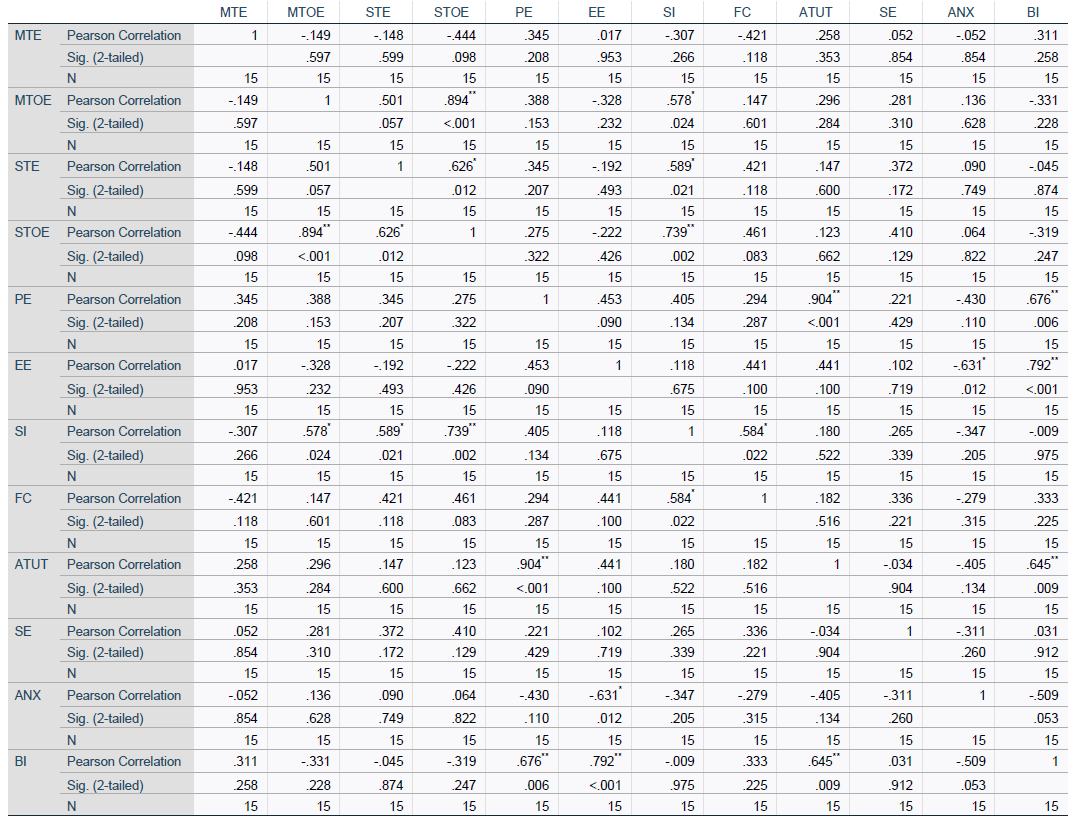
Table 4
Hierarchal Regression Test
Predictor | B | SE B | β | t | p |
Block 1: Teaching Beliefs | |||||
MTE | .83 | .85 | .42 | .98 | .350 |
MTOE | -1.11 | 1.32 | -.72 | -.85 | .418 |
STE | .11 | .44 | .09 | .24 | .816 |
STOE | .54 | 1.25 | .46 | .43 | .677 |
Model Summary (Block 1): | |||||
Block 2: UTAUT Predictors | |||||
PE | .99 | .30 | .80 | 3.38 | .015 |
EE | .19 | .21 | .20 | .91 | .397 |
SI | -.14 | .17 | -.16 | -.84 | .433 |
FC | .31 | .34 | .20 | .91 | .399 |
Model Summary (Block 2): | |||||
Qualitative analysis produced four themes (see Table 5), illustrated by representative quotes.
Table 5
Qualitative Themes and Quotes
Theme | Quote |
Theme 1: Perceived Threats to Professional Identity | “I had experienced a lot of stress for a while when we had a hard time figuring out what we wanted to research. This definitely changed over time once we had our research question prepared” |
Theme 2: Professional Identity Development | “[The Project] has contributed to my thinking about…key concepts of creating and planning a research experience investigation.” |
Theme 3: Motivation | “[I] was able to learn about myself when doing this to see how well my focus would be if I had a time limit to complete.” |
Theme 4: Preservice Teacher Attitudes on the Project | “this is overwhelming”; “proud of what we did” |
The findings regarding the Project indicated that participation supported significant growth in STEM PSTs’ teaching efficacy, outcomes expectancy, and professional identity. The Project engaged PSTs in authentic inquiry, social persuasion, and affect, which are essential in explaining how beliefs about capability are molded through mastery, vicarious experiences, peer collaboration, and reflective analysis, pillars of SCT (Bandura, 1997; 2005).
Qualitatively, the Project facilitated professional identity development for PSTs by positioning them as both learners and contributors of knowledge. Additionally, the finding highlights how NPMM functioned as a mechanism that operationalized SCT within the Project. The PSTs’ partners served as near-peers, who are accessible role models whose successes provided social validation and vicarious reinforcement. The partner dynamic strengthened their sense of belonging and identity as emerging professionals, supporting the initial emergence of the “teacher-researcher” identity.
Together, the overall results suggest that embedding authentic research within methods courses can build PSTs’ instructional confidence and professional identity, demonstrating the possibilities of CURE integration in teacher preparation.
 EdTech Archives