The rapid emergence of generative artificial intelligence (GenAI) has introduced transformative possibilities and ethical complexities across higher education. Its integration into online learning environments is redefining how students engage with content, manage cognitive load, and demonstrate academic integrity. While GenAI’s potential to enhance efficiency, personalization, and assessment is widely recognized, most discussion still centers on faculty concerns and cheating detection rather than student experience. This narrow lens obscures how learners themselves are adopting, adapting, reasoning through, and choosing to use these tools.
This study examined GenAI adoption among online undergraduate students, exploring how these technologies are leveraged to enhance engagement, autonomy, and learning efficiency. By presenting empirical data on patterns of use, motivation, and confidence, this research challenges deficit-based views portraying GenAI as a crutch for struggling learners and instead positions it as a catalyst for empowered, self-directed learning.
GenAI has evolved from technological novelty to a defining force in higher education. Scholarship increasingly frames GenAI as a catalyst for reimagining engagement, assessment, and learner autonomy in digitally mediated environments (Francis et al., 2025; Vieriu & Petrea, 2025). While these tools enhance comprehension, creativity, and productivity, they also raise enduring questions about ethics, authorship, and the authenticity of learning (Gillani et al., 2023).
Despite ongoing debate, the student perspective remains underexplored. Most existing studies emphasize faculty attitudes, policy, and integrity concerns (Darvishi et al., 2024; Wu et al., 2025), leaving limited insight into how students actually engage with GenAI. Recent reviews urge a shift from fear-based narratives toward examining the cognitive and motivational factors shaping learner adoption (Belkina et al., 2025). This shift is particularly urgent in online education, where autonomy, digital literacy, and self-regulation define success.
Emerging research suggests students use GenAI as a scaffold, not a shortcut. When guided by reflective pedagogy and clear policy, GenAI improves conceptual understanding, writing, and learner confidence without diminishing rigor (El Fathi et al., 2025). However, demographic and contextual factors such as digital literacy, workload, and prior experience still influence adoption patterns among adult learners (Koller, 2025; Nietzel, 2025). Institutions continue to struggle to balance integrity policies with legitimate pedagogical use (Francis et al., 2025). Addressing these gaps requires empirical evidence integrating behavioral, motivational, and ethical dimensions of GenAI use.
Three complementary frameworks inform the study’s analysis. The Technology Acceptance Model (TAM) explains adoption through perceived usefulness and ease of use, aligning with findings demonstrating that students view GenAI as efficient and accessible (Davis & Granić, 2024). Self-Directed Learning (SDL) situates GenAI use within learner autonomy, showing how motivated students employ GenAI tools to extend understanding and self-regulate progress (Lan & Zhou, 2025). Digital Agency captures the ethical and reflective dimensions of student behavior, emphasizing confidence, competence, and critical judgment in technology use (Stenalt, 2021). Together, these frameworks interpret GenAI adoption as an expression of motivation, digital fluency, and responsible autonomy rather than remediation or dependency.
This study used a quantitative, cross-sectional, correlational design to examine relationships between academic performance, skill confidence, and GenAI use among online undergraduate students. The dependent variable was self-reported GenAI use in coursework; independent variables included GPA, confidence in reading, writing, mathematics, and technology, plus weekly study, work, and family commitments. Data was collected through a researcher-developed online survey, pilot-tested for clarity and ethical compliance, and participant anonymity.
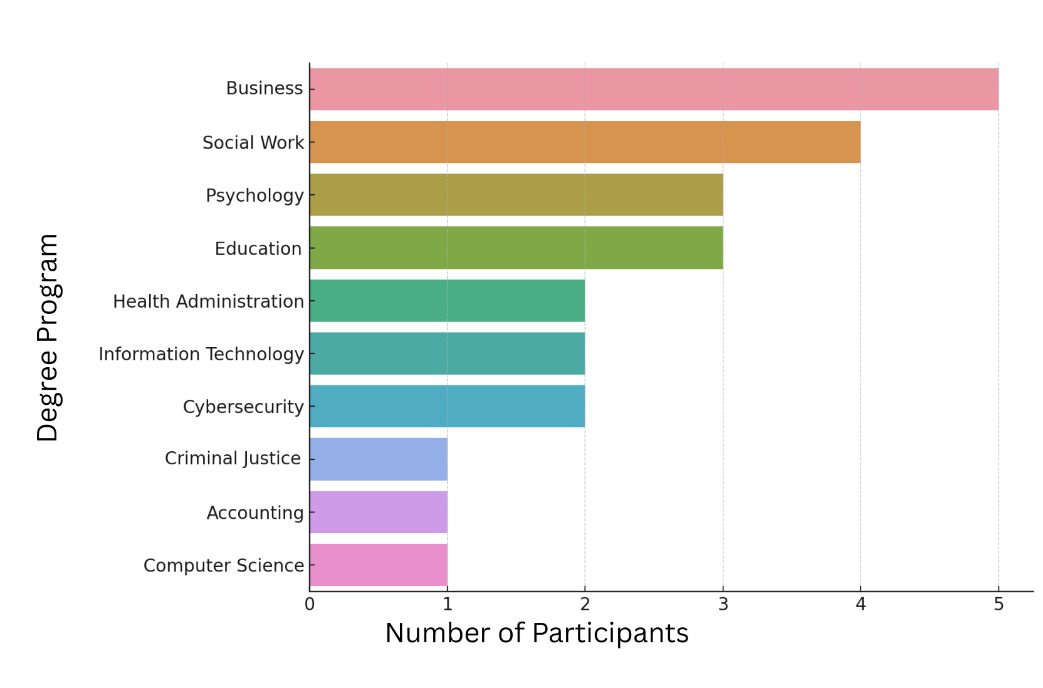
The sample consisted of 491 undergraduate students who had completed three out of five foundational general education courses: English Composition I, Critical Thinking in Everyday Life, Quantitative Reasoning I, Psychology of Learning, or Elements of Health and Wellness. Participants were adult learners balancing full-time employment and family responsibilities. The majority were financially independent and identified as parents or caregivers managing multiple commitments alongside their studies. This demographic context situates the findings within the lived realities of non-traditional, working adult learners, consistent with national online learning and non-traditional learner trends (Nietzel, 2025). Figures 1 and 2 summarize participant age and field of study distributions, showing a majority in the 35–44 age range and representation across disciplines such as Business, Psychology, and Social Work.
Figure 1
Participant Age Distribution
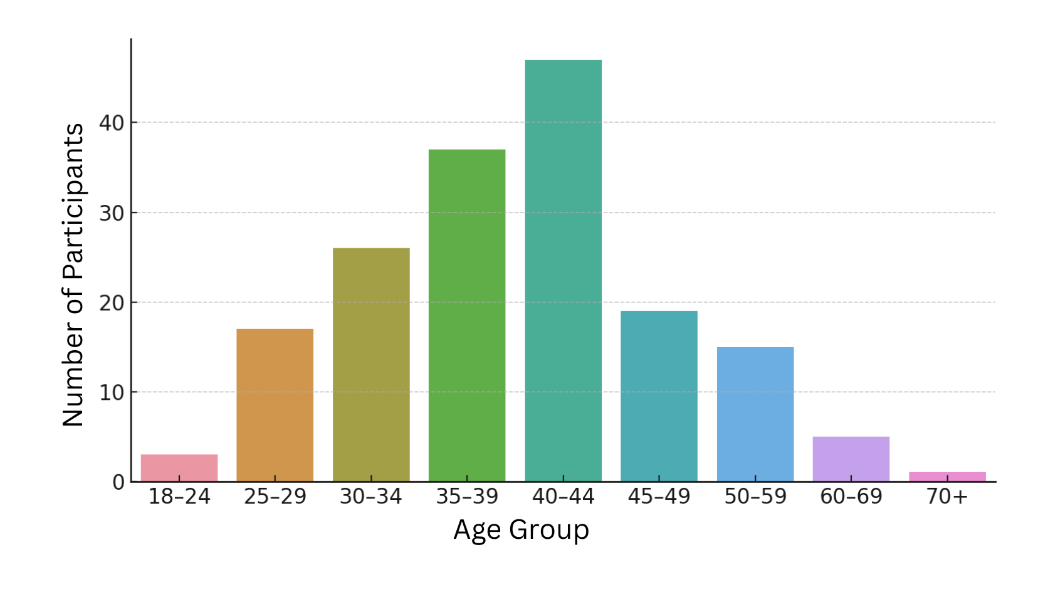
Figure 2
Participant Field of Study Distribution
Data was cleaned and analyzed using Python-based statistical software. Descriptive statistics summarized participant characteristics, and multiple linear regression was conducted to identify significant predictors of GenAI use, isolating the variables most strongly associated with adoption behavior.
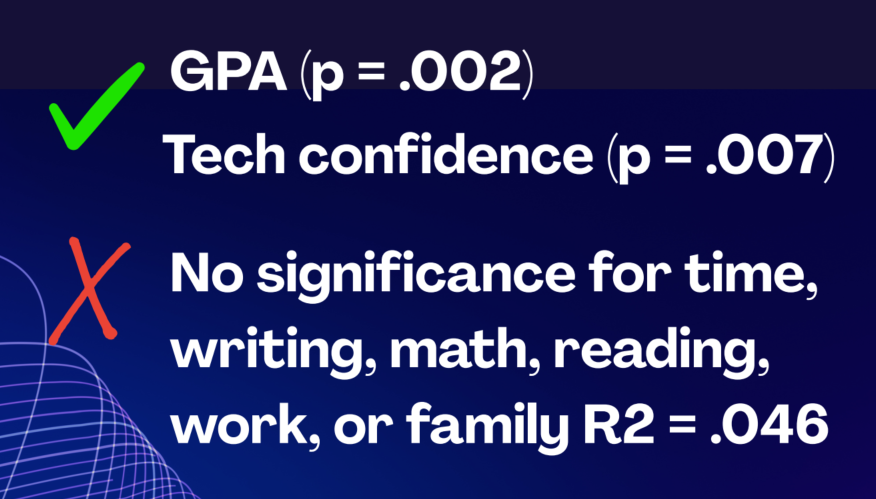
Of the study’s 491 undergraduate participants, only 43.2% (n=212) reported using GenAI tools (e.g., ChatGPT, Microsoft Copilot) during their coursework. Multiple linear regression identified two significant predictors of GenAI use: confidence in technology (β = .13, p = .007) and GPA (β = .15, p = .002). The model accounted for 4.6% of variance (R² = .046), modest but meaningful in behavioral research. Confidence in reading, writing, math, or time-related factors such as employment and family commitments showed no significant relationship. These results suggest GenAI adoption correlates more with academic performance and digital fluency than with remediation or time constraints.
Figure 3
Quantitative Results
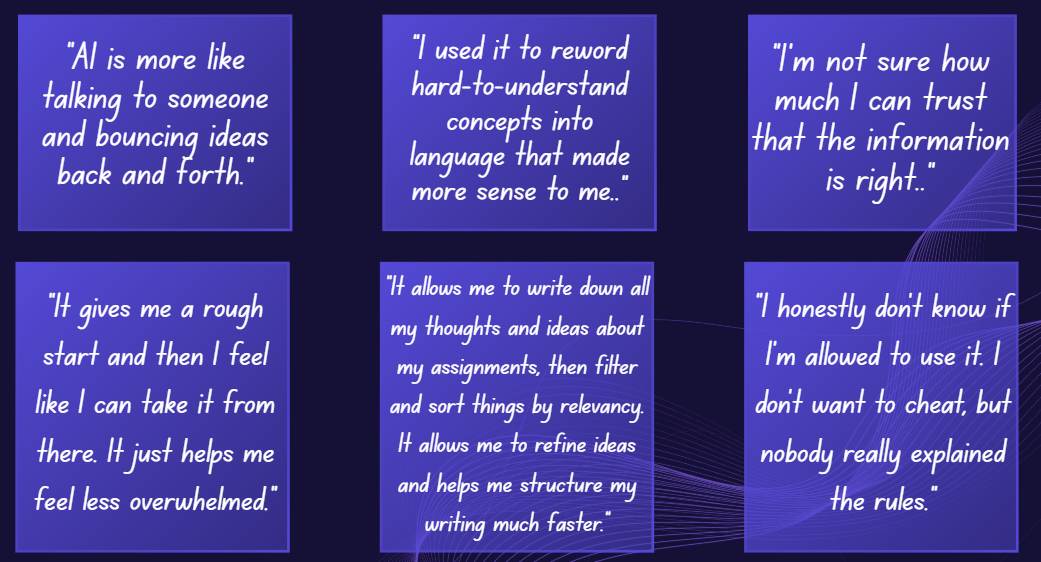
Open-ended survey responses revealed how students engage with GenAI. Three main themes emerged: (1) improved understanding of complex concepts, (2) GenAI as a “thinking partner,” and (3) efficiency and productivity. Students described using GenAI to clarify instructions and unfamiliar material, consistent with Self-Directed Learning and Digital Agency frameworks. They viewed GenAI as a supportive, nonjudgmental collaborator, enhancing creativity, reflection, and independence rather than replacing cognitive effort. Participants also noted efficiency gains, especially during early writing stages.
A subset of students expressed concerns about accuracy, authorship, and integrity. Some feared losing their academic voice or violating unclear institutional policies. These comments reflect developing ethical awareness and align with the construct of Digital Agency: critical use paired with reflection on responsibility. Figure 4 illustrates student reflections within the cognitive and ethical dimensions of GenAI use, capturing how learners perceive the technology as a supportive “thinking partner” while also voicing uncertainty about trust, authorship, and institutional expectations.
Figure 4
Student Reflections on GenAI Use
Study results challenge deficit-based narratives about GenAI in higher education, showing online undergraduate use with confidence and support, not remediation or time pressure. Interpreted through the TAM, students viewed GenAI as both easy to use and beneficial, valuing its ability to increase efficiency, organization, and understanding. The SDL framework further explains this behavior as high-achieving, self-regulated learners used GenAI to clarify assignments, stimulate thinking, and extend learning beyond course requirements.
Findings also support the construct of Digital Agency, as students recognized GenAI’s limits and ethical implications. Student engagement reflects empowerment rather than dependence, positioning GenAI as a scaffold for higher-order learning. However, the link between digital confidence and GenAI use reveals potential equity issues. Students with limited access or lower self-efficacy risk exclusion if institutions fail to address digital disparities. Table 1 summarizes how study findings align with the three guiding frameworks.
Table 1
Theoretical Framework Alignment to Study Findings
Framework | Core Constructs | Aligned Findings |
Technology Acceptance Model (TAM) | Perceived usefulness, ease of use |
|
| ||
Self-Directed Learning (SDL) | Learner autonomy, goal setting, self-regulation |
|
| ||
Digital Agency | Digital confidence, competence, ethical decision-making |
|
|
Institutions must move beyond reactive or prohibitive approaches and establish clear, enforceable GenAI policies. Effective policy should balance innovation and integrity, defining expectations for transparency, authorship, and attribution while affirming GenAI’s pedagogical value.
Leaders should invest in digital equity initiatives, expanding access to GenAI tools and training, especially for students with limited digital confidence. Digital literacy programs and onboarding workshops can reduce disparities and apprehension about GenAI use. Faculty and staff development must center on ethical GenAI integration, embedding a culture of transparency, experimentation, and accountability where innovation and integrity coexist for modeling and encouraging student use.
Faculty shape responsible GenAI use through intentional course design. Rather than banning GenAI, educators can design assignments promoting reflection, critique, and accountability. Embedding GenAI literacy across disciplines ensures students learn to evaluate GenAI outputs, preserve their voice, and work within ethical boundaries.
Assignments may require students to document and analyze GenAI use. For example, comparing AI-generated drafts with personal revisions can strengthen cognitive awareness and ethical reasoning. Faculty training in adult learning and human-centered design principles and personalized learning aligns GenAI use with equity and learner autonomy.
Ethical reflection must be central, not peripheral. Institutions should sustain evidence-informed dialogue about GenAI’s evolving role, grounding decisions in transparency and shared responsibility. Embedding AI ethics and digital agency into general education and professional development will ensure GenAI enhances creativity and critical thinking rather than replacing them.
This study reframes GenAI as a learning catalyst, not a shortcut. Online undergraduates who were high-achieving and digitally confident used GenAI to enhance clarity, efficiency, and engagement while maintaining academic independence. Adoption correlated with motivation and digital fluency, not remediation. Institutions must now prioritize ethical literacy, equitable access, and faculty readiness so GenAI strengthens rather than supplants learning. Embedding reflective GenAI use in policy and pedagogy will ensure generative tools reinforce academic integrity, critical thinking, and student empowerment across higher education.
 EdTech Archives