Maker Education has become a movement tied to encouraging growth in science, technology, engineering, and mathematics (STEM). Maker Education emphasized hands-on practice with technology. The STEAM education expands the STEM interdisciplinary learning, which integrates Science, Technology, Engineering, Mathematics, and Art, serving as a practical application of new media art education. In Taiwan, the new media art curriculum emphasizes three learning dimensions: expression, appreciation, and practice, enabling students to create interdisciplinary artistic works by operating digital hardware and software (Ministry of Education, 2018).
The 3D printing course is one of the methods for implementing Maker Education and the STEAM curriculum through hands-on instructional activities. It integrates 3D modeling and printing technology, allowing students to transform digital 3D graphics on computer screens into physical objects (Lipson & Kurman, 2013). 3D printing can then be used in artistic or design applications. Shih and Chen (2021) indicated that students performed better at presenting three-dimensional objects using 3D modeling software and operating 3D printers than in hand-drawing activities. Previous studies on the application of 3D printing in elementary and middle schools have found that 3D printing instruction also enhances students’ creativity (Chien & Chu, 2017), self-empowerment (Leinonen, Virnes, Hietala, & Brinck, 2020), and spatial abilities (Shih & Chen, 2021).
Most current materials for 3D printing in schools are primarily thermoplastics such as ABS (Acrylonitrile Butadiene Styrene) and PLA (Polylactic Acid) (3D printing lab, 2020). The heat-melting process can produce odors, so proper ventilation is required during production. The warm filaments may pose safety risks for elementary students. In contrast, ceramic 3D printing (also called clay 3D printing) uses ceramic clay as the printing material. Students create 3D models on computers, print ceramic pieces, and then combine them with hand-sculpted pottery. Then, the artworks could be glazed and kiln-fired. If remanufacturing is needed, unfired ceramic clay can be easily recycled. Hsieh (2020) indicated that current elementary visual arts curricula in Taiwan are primarily focused on flat, labor-intensive designs, with limited implementation of pottery programs due to equipment constraints and difficulty finding appropriate teachers. Students may have difficulties expressing their creative ideas in their clay works. Many teachers indicated that hand-sculpting or hand-throwing in pottery classes posed challenges for many students, especially for children. Using software to shape may help students combine emerging technologies with hand-sculpting, enhancing diversity in pottery creation and design. There have not yet been developed 3D ceramic printing courses in elementary education in Taiwan. Research on 3D ceramic printing was rare.
The purpose of this study was to conduct a pre-military study to implement the 3D ceramic printing curriculum in elementary schools and to explore elementary students’ acceptance.
This study adopted a questionnaire survey based on the Technology Acceptance Model (TAM). We developed the “3D Ceramic Printing Acceptance Questionnaire,” which included two external variables: attitudes towards 3D modeling (5 questions) and competencies in ceramic creation (5 questions). The internal construct of the TAM model included the perceived ease of use (4 questions), perceived usefulness (3 questions), learning attitude (4 questions), and learning intention (4 questions). The questionnaire was reviewed and revised by two pottery teachers. The overall reliability (Cronbach’s α) was .96.
The participants of the study included 107 students from two fourth-grade classes and three fifth-grade classes at an elementary school in New Taipei City, Taiwan. Each class had one pottery lesson per week for a semester.
The teacher conducted 8 weeks of hands-on pottery lessons followed by 8 weeks of 3D ceramic printing lessons. The 3D ceramic classes included an introduction to 3D ceramic printing, 3D software modeling and modifications, and the implementation of ceramic printing. The questionnaire was administered to students after the courses.
1. The analysis results of the 3D Ceramic Printing Acceptance Questionnaire (see Table 1). Overall, students have a positive acceptance of the 3D ceramic printing courses. Boys’ acceptance of 3D modeling in ceramic printing is significantly higher than that of girls, with no significant differences in other dimensions. Fourth graders perceive the usefulness of 3D ceramic printing significantly higher than fifth graders, with no significant differences in other dimensions.
Table 1
The results of two-way ANOVA (Gender x Grade) analysis on 3D Ceramic Printing Acceptance Questionnaire
Dimension | Gender | Grade | Gender x Grade |
Overall | 1.01 | .33 | 2.07 |
Attitudes towards 3D modeling | 5.25* | .01 | 1.11 |
competencies in ceramic creation | 0.99 | .05 | .57 |
perceived ease of use | 0.50 | .15 | 2.06 |
perceived usefulness | 1.25 | 4.83* | .85 |
learning attitude | 0.35 | .01 | 2.02 |
learning intention | 0.52 | .15 | .04 |
* p<.05
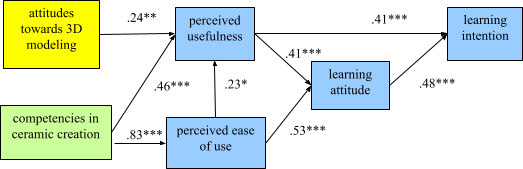
2. Predictive relationship among the acceptance of 3D pottery learning and external variables (attitudes towards 3D modeling, competencies in ceramic creation
The results showed that students’ ceramics creation competencies positively predict the perceived ease of use of 3D ceramic printing. Students’ 3D modeling attitudes and ceramics creation competencies positively predict the perceived ease (see Figure 1).
Figure 1
Results of Regression Prediction Analysis on the Acceptance Model of 3D Ceramic Printing Learning
This study is a preliminary study to implement 3D ceramic printing in the elementary school curriculum. The research findings indicate that elementary school students exhibit a high degree of acceptance towards 3D ceramic printing courses. Due to limitations in school equipment, the participants in this study had a relatively small sample size. Future research could expand the sample size and compare differences in creative products between students’ handmade pottery and 3D-printed works. This would help promote STEAM education and pottery education, fostering innovative ceramic creation.
 EdTech Archives