Intermediate Accounting is a historically challenging gateway course that impacts students’ performance in subsequent courses and retention in the accounting program (Carrington, 2012; Sargent et al., 2022). Despite extensive attempts to address this issue, interventions such as introducing proficiency exams and tutoring as preemptive measures (Sargent, 2013) did not fully resolve it, as evidenced by a persistently high DFW rate (a grade of D or F or withdrawal). This example highlights the persistent difficulty of this course.
Accounting education literature ascribed the cause of this issue to a variety of factors, ranging from learner age (Eikner & Montondon, 2006), cumulative GPA (Turner et al., 1997), motivation (Burnett et al., 2010; Maksy & Zheng, 2008), to course delivery method (Lillie & Liu, 2023) and course scheduling (Carrington, 2010). Of all the contributing factors, this study focused on intervening to enhance student motivation, with the expectation that increased motivation would improve academic performance. To achieve this, we redesigned an Intermediate Accounting course by incorporating several game elements.
The focal course was a fully asynchronous online Intermediate Accounting course delivered in the Canvas learning management system at a Midwestern public university. We incorporated three game elements in our course design: an incentive system, customizable learning pathways, and an additive grading system. The choice of these gamification strategies was grounded in theoretical evidence on factors that impact motivation. For example, Self-Determination Theory suggests that learner autonomy, or the sense of control of one’s learning, is critical in fostering intrinsic motivation and engagement (Deci & Ryan, 1985), while Social Cognitive Theory (Bandura, 1977, 1986) emphasizes the importance of task difficulty and self-regulation (e.g., monitoring one’s learning progression) to task self-efficacy. Additionally, the Expectancy-Value Theory (Wigfield & Eccles, 1992) posits that the value one places on a task influences one's motivation and engagement with the task.
We hypothesized that the three game elements could provide students with a sense of control over their learning, increase the perceived value of the learning tasks, and make the tasks more manageable through an array of options at various difficulty levels. We expected that these game elements combined could lead to enhanced motivation and increased engagement, which, in turn, could result in improved performance and outcomes. Figure 1 summarizes the design conjectures that informed these elements and the outcomes they were expected to influence.
Figure 1
Design conjectures, design elements, and intended outcomes
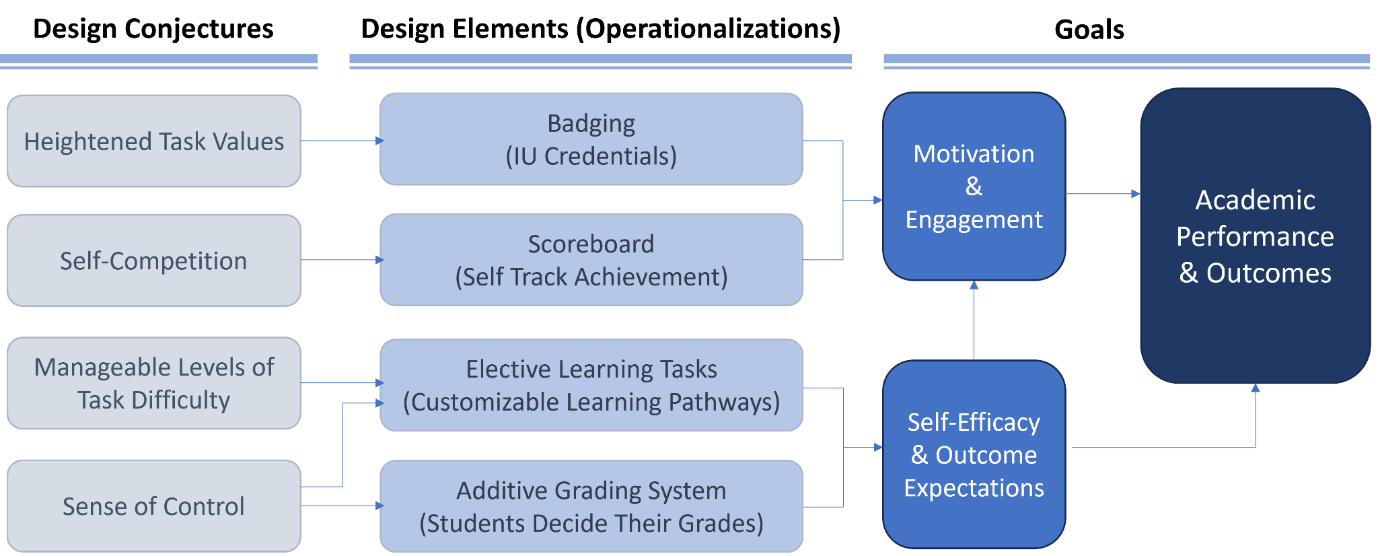
The incentive system included module-level badges, a course-level credential, a scoreboard displaying student progress under pseudonyms, and a performance-based exam waiver. Badges signaled proficiency in each module, and students who maintained high performance across modules could waive the midterm, the final, or both.
Learning tasks within each module were organized into three tiers, low, medium, and high, reflecting increasing levels of difficulty and cognitive demand. Students selected from multiple tasks within each tier, but were required to complete a minimum number from every tier to progress through the module. This structure allowed for meaningful choice while maintaining expectations for higher-order work.
The additive grading system reframes progress by starting students at zero and allowing them to build points throughout the term. Module badge levels corresponded to point ranges, and course grades were determined by the collection of badges earned. This structure emphasized growth and accumulation rather than point loss and was intended to reduce performance pressure while encouraging consistent engagement.
To investigate the effects and effectiveness of this gamified structure on students’ motivation and learning, we asked:
How did students respond to the course designs? Was there a difference between the gamified and non-gamified conditions?
Did students’ motivation change after their participation in a gamified course? Was it conditional on the gamified design?
How (differently) did the two design strategies affect student performance?
How did individual gamification elements affect retention-related outcomes?
This study collected two sources of data: surveys and final letter grades from an online accounting course offered in both a gamified and a non-gamified version. The non-gamified version, for comparison, shared the same content and assessments as the gamified version but lacked the game elements. From Summer 2023 to Fall 2025, a total of 229 students completed the course, 149 in gamified sections and 80 in comparison sections.
A pre- and post-course survey was administered to measure students’ levels of self-efficacy and interest in accounting, as well as their responses to the course design, including overall enjoyment and perceptions of individual game elements (the latter measures were only for the gamified condition). All items used a six-point Likert scale (1 = Strongly Disagree, 6 = Strongly Agree). We included three open-ended questions in the post-survey to elicit additional comments on the course structure and its impact on motivation and learning.
All the scale measures were unidimensional and had a Cronbach’s alpha of above .80. Descriptive and inferential statistics (including independent-sample and paired-sample t-tests, and chi-square test of independence with a post hoc test using Bonferroni correction) were used to answer RQs 1-3. For RQ4, deductive and inductive coding were used to analyze the open-ended responses. Of note, the inconsistent ns in the statistical analyses were due to missing data. We have analyzed and reported only the findings from the 2023 open-ended responses.
RQ1. The gamified group reported significantly higher enjoyment of the overall course design than the comparison, t(73) = 3.12, p = .003, Cohen's d = 0.73, 95% CI [0.25, 1.19]. See Table 1.
Table 1
Descriptive Statistics of Course Enjoyment Ratings by Condition and Independent t-Test
Condition | n | Mean (SD) | t-value | p-value (two-sided) |
Gamified | 41 | 5.27 (0.85) | 3.12 | 0.003 |
Conventional | 34 | 4.59 (1.03) |
RQ2. We did not observe significant change in self-efficacy for either group, likely due to a ceiling effect. Conversely, while interest declined significantly over the term for the comparison group, t(33) = -2.58, p = .014, interest remained relatively stable for the gamified group, t(25) = 0.26, p = .80. See Table 2.
Table 2
Descriptive Statistics of Pre- and Post- Self-Efficacy and Interest Ratings by Condition and Paired-Sample t-Tests
Condition | Pre Mean (SD) | n | Post Mean (SD) | N | t | df | p |
Self-Efficacy | |||||||
Conventional | 5.36 (0.61) | 44 | 5.34 (0.67) | 34 | -1.39 | 33 | 0.17 |
Gamified | 5.23 (0.68) | 30 | 5.36 (0.84) | 41 | 0.78 | 25 | 0.45 |
Interest | |||||||
Conventional | 5.36 (0.65) | 44 | 5.18 (0.89) | 34 | -2.58 | 33 | 0.014 |
Gamified | 5.34 (0.67) | 30 | 5.20 (0.87) | 41 | 0.26 | 25 | 0.80 |
RQ3. There was a significant association between the course design and final letter grades, Pearson's χ2(5) = 27.75, p < .001. A post hoc test with a Bonferroni correction showed that a larger proportion of students in the gamified sections earned A grades, whereas a larger proportion in the comparison sections earned B grades.
Students in both semesters described the structure as more engaging, motivating, and effective than conventional formats. Many reported that the mix of badges, task options, and progressive challenges helped them stay focused and made the course feel less repetitive. Several students also noted that this was their most enjoyable course in the program. Students reported that customizable pathways increased control and helped them focus on what they needed to learn. Badges and the scoreboard encouraged steady participation, while the additive grading structure reduced test-related stress and supported a more positive learning experience.
Findings suggest that a carefully designed gamified structure can improve students’ experiences in a challenging online accounting course and may support stronger performance among those who complete it. The design did not dramatically increase self-reported motivation, but it appeared to avoid the potential dampening effect of a conventional class design and to stabilize interest.
From a design perspective, the results highlight the importance of aligning game elements with underlying motivational constructs. Customizable pathways supported autonomy and a sense of control. Badges and the scoreboard made progress visible and reinforced competence. The additive grading system and exam waiver elevated the value of consistent engagement over time rather than isolated high-stakes performances. Together, these features created a structure in which students could see a clear connection between effort and concrete outcomes.
An important practical implication is that gamification does not require adding entertainment or complex technologies. In this course, we did not introduce new content for the sake of novelty. Instead, we reorganized existing activities and assessments to create meaningful choices, clearer feedback, and more transparent progress markers.
Future work could extend these analyses by incorporating additional cohorts and by conducting interviews with students in both conditions. This will allow a closer look at how students with different backgrounds and goals experience the design elements and at how similar structures might be adapted for other gateway courses in accounting and business.
 EdTech Archives