With the aim of deriving meaningful online learning experiences, the Community of Inquiry (CoI) framework has been adopted as a reciprocal relationship among teaching presence, cognitive presence, and social presence (Garrison et al., 2001). Within this framework, cognitive presence (CP) represents the process of practical inquiry where students continuously shift between abstract reflection and concrete application. This process unfolds in four phases: (1) triggering events - students initiate questions and identify problems; (2) exploration - students engage in divergent thinking, exchanging ideas and perspectives; (3) integration - ideas begin to converge as students apply them to real-world contexts; and (4) resolution focuses on proposing solutions to be tested and evaluated.
Previous research has shown that CP is related to various student outcomes, including perceived learning, satisfaction, and engagement (e.g., Caskurlu et al., 2022; Kucuk & Richardson, 2019). Even though research is limited, it has explored the relationship with motivation; however, the findings remain inconclusive. For instance, Polat (2013) did not find a significant correlation between CP and motivation, whereas other studies, such as Kim (2015) reported a significant relationship. In particular, given the CP’s focus on higher-order thinking, reflective discourse, and critical thinking, previous research has highlighted connections to metacognition, as these are also crucial factors in metacognition (e.g., Garrison, 2022; Kilis & Yildirim, 2018). Yet, past research primarily focused on the indirect measures of CP and metacognition, which capture perceived indicators rather than direct measures of motivation and CP. Therefore, this study aims to bridge the gap by exploring how different elements of motivation occur in online course discussions in an interplay with individual phases of CP. The following research questions were posed:
RQ1. How do students form epistemic networks that link cognitive presence and motivation during online course discussions?
RQ2. How do indicators of motivation co-occur with each phase of cognitive presence during online course discussions?
This study analyzes 41 discussion board posts from 19 in-service teachers enrolled in a fully online course on critical consciousness toward machine intelligence. The data comes from a module on encoding intelligence, in which students engaged in a discussion reflecting on questions such as: “How would you compare human intelligence to artificial intelligence?”
To prepare the data for analysis, students’ posts were first arranged at the sentence level and then aggregated either by paragraph or shared contexts. This led to a total of 226 message chunks. The data were coded using CP indicators (Garrison et al., 2000, 2001) and motivation elements, including interest, utility value, relevance, sense of belonging, and metacognition. These motivation elements were identified in our previous work, some of which were informed by Eccles & Wigfield (2020) and Allen et al. (2021). To examine interactive relationships of CP and motivation, we conducted Epistemic Network Analysis (ENA) (Shaffer et al., 2016). We used the ENA1.7.0 Web Tool to model the co-occurrence of in-service teachers' CP and motivation in discussion posts, highlighting differences in the most frequent elements of motivation between and within the phases of cognitive presence.
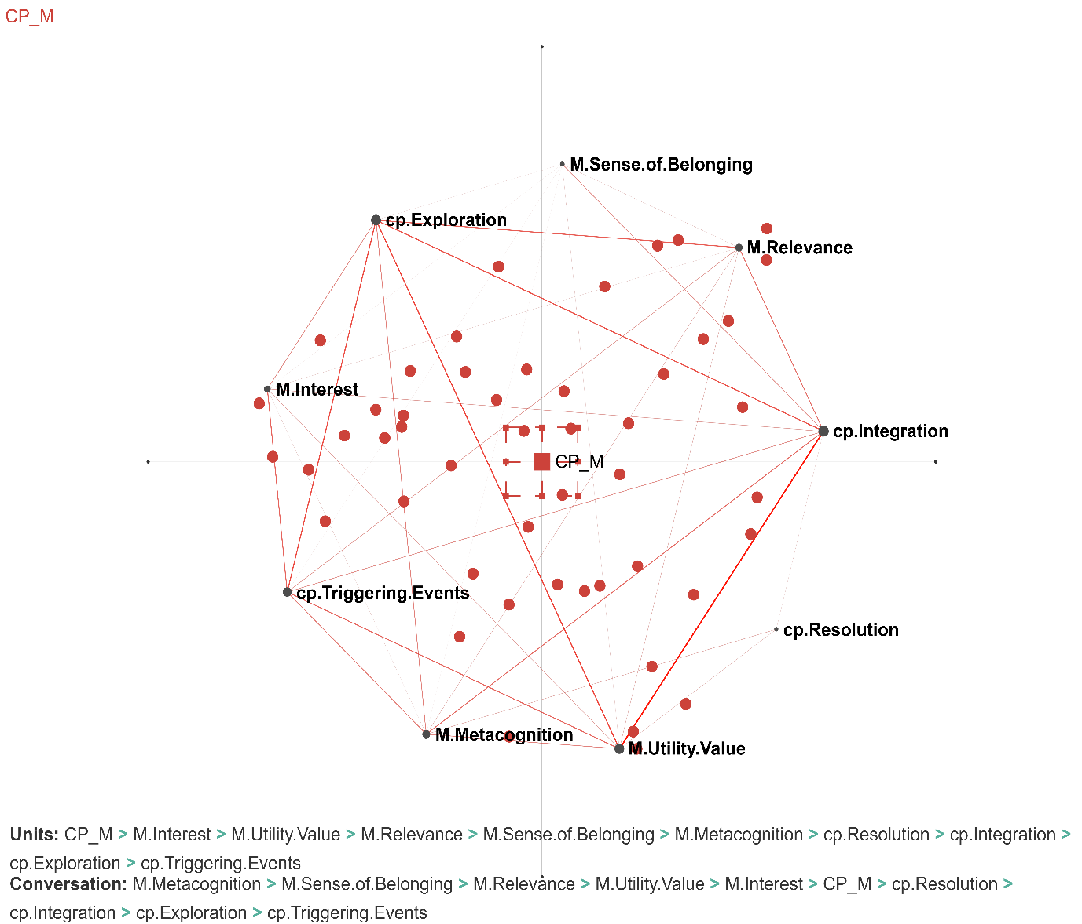
The first ENA result (Figure 1) revealed key co-occurrence patterns between CP and motivational elements. Utility value demonstrated the highest co-occurrence across CP phases, with the strongest connection found in the integration phase, followed by exploration. Relevance also showed strong connections with both exploration and integration. Although weaker, additional connections emerged between (a) metacognition and integration; (b) sense of belonging and integration; (c) interest and triggering events; and (d) interest and exploration. Notably, while there was a link between integration and sense of belonging, it was minimal.
Figure 1
Network Model of Cognitive Presence and Motivation in Online Discussions
Next, we examined the co-occurrence of motivation within individual CP phases (Figure 2). In the triggering event phase, interest and metacognition showed the strongest connections. During exploration, relevance, utility value, and metacognition showed the most prominent connections. In the integration phase, utility value, relevance, and sense of belonging were the most strongly occurring elements of motivation. The resolution phase was excluded due to the nature of the discussion prompts and the lack of explicable networks.
Figure 2
Network Models of Individual Phases of Cognitive Presence and Motivation (Upper left - Triggering events; Upper right - Exploration; Bottom - Integration)

Our findings from the epistemic network models highlighted connections among the phases of CP and elements of motivation related to task values. In particular, there was a strong co-occurrence between the integration phase and utility value. At this phase, the arguments were centered on students’ own concluding ideas drawn from exploratory discussions. The result implies that this was facilitated by positive expectations of the utility of the course topic. As in-service teachers, students have shown that their own implications with critical consciousness toward machine intelligence are inevitable in future scopes of teaching and learning. From the findings, it can be inferred that their trust in the utility of the topic emerged from the exploration to the integration phase, where they reflect on subjective meanings and practical applications.
For each phase of CP, the connection between triggering events and interest highlights the role of course materials and discussion prompts in inducing active engagement. These led to divergent ideas during the exploration phase, where perceptions of the topic's relevance to personal importance frequently emerged. Next, unlike the previous two phases, a strong sense of belonging was observed within the integration phase network. This is likely due to one indicator of integrative discourses in which students accommodate a peer’s idea and develop it into meaningful conclusions. Although relatively weak, the occurrence of metacognition during triggering events and the exploration phase implies students’ attempts to monitor the gap between their prior knowledge and current learning. The results may be extended to further studies that employ direct observation of students' self-regulatory processes across the phases of CP. In conclusion, this study may serve as a foundation for future research aimed at solidifying interactive patterns within the CoI framework and identifying sources of motivation in online learning.
 EdTech Archives