Generative AI is driving a technological revolution that reshapes knowledge production and dissemination, leading to profound educational changes. Future educational ecosystems will feature teacher-AI collaboration, presenting new challenges to teachers’ competencies (Kim, 2024). AI literacy extends beyond technical mastery, encompassing teachers' ability to understand, apply, evaluate AI, and maintain ethical awareness (Ng et al., 2021). Vocational education, closely linked to technological advancement, is particularly impacted, as vocational teachers’ development will inevitably be influenced by next-generation tools like ChatGPT. However, current research has yet to clearly define the dimensions, interrelationships, and developmental pathways of AI literacy among vocational education teachers in the generative AI era.
Bloom's Taxonomy classifies educational objectives into six levels according to complexity and abstraction: know, understand, apply, analyze, evaluate, and create (Krathwohl, 2002). This theory provides valuable insights into the analysis and modelling of the dimensions of AI literacy. Although AI ethics cannot be directly mapped to Bloom’s taxonomy, it is increasingly recognized as a crucial component of AI literacy in contemporary education. Researchers emphasize that conceptualizing AI literacy through a human-centered approach is essential for building an inclusive society and addressing issues such as fairness, accountability, transparency, and ethics (Memarian & Doleck, 2023).
The relationships and assumptions of the study variables are shown in Figure 1.

Figure 1
Theoretical model of the study
According to Bloom's taxonomy, teachers' AI literacy develops from basic to advanced levels.
H1: “Use & apply AI” mediates the relationship between "Know & understand AI" and "Evaluate and create AI". As teachers' understanding deepens, their use of AI increases, improving their evaluation and creation abilities.
According to Bloom's taxonomy, there may be a direct effect of "Know & understand AI" on "Evaluate & create AI".
H2: Teachers' deeper understanding of AI improves their ability to evaluate and create with it.
Wang et al. (2023) found that higher cognitive readiness helps teachers adhere to AI-related ethical standards, while higher levels of AI ethics foster innovation in teaching. Kwon et al. (2020) highlighted the importance of ethics in shaping AI usage.
H3: Teachers' understanding of AI enhances their AI ethics, boosting their evaluation and creation abilities.
H4: Teachers' understanding of AI, through AI ethics, influences their application of AI, enhancing their ability to evaluate and create with it.
The data were collected from a questionnaire survey on AI literacy among vocational education teachers in China, conducted from May to July 2024. Participants included teachers from 34 provinces and 20 major categories to ensure broad regional and disciplinary representation. A total of 915 valid responses were received.
The study examines AI literacy in four dimensions: Know & understand AI, Use & apply AI, Evaluate & create AI, and AI ethics. The first dimension is the independent variable, while Evaluate & create AI is the dependent variable, with the other two as mediators. A self-designed 5-point Likert scale was used (1 = Strongly Disagree, 5 = Strongly Agree). Cronbach's α for four dimensions ranged from 0.953 to 0.986, indicating high reliability. Structural validity was assessed with good fit indices: χ2 /df = 6.550, CFI = 0.967, TLI = 0.961, RMSEA = 0.078, SRMR = 0.028. All factor loadings were statistically significant (p < 0.001), confirming a good model fit.
The results indicate that vocational education teachers' AI literacy is influenced by factors such as gender, teaching experience, and work experience. Specifically, AI literacy is negatively correlated with teaching experience and positively correlated with industry work experience. Additionally, the dimensions of AI literacy are positively correlated.
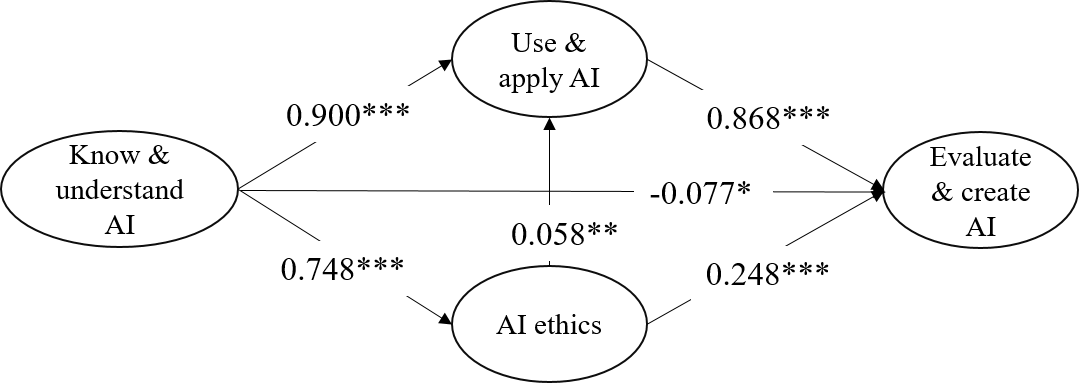
Figure 2
The Relationship Model Between the Dimensions of Teachers' AI Literacy
Using Mplus, we examined the dimensions of vocational education teachers’ AI literacy while controlling for location, gender, teaching experience, and industry work experience. The model fit was acceptable (χ2 /df =6.779, CFI=0.950, TLI=0.942, RMSEA=0.079, SRMR=0.062). As shown in Figure 2, aside from a significant negative effect between “Know & understand AI” and “Evaluate & create AI”, all other paths were significant and positive (p<0.05), and none of the control variables significantly influenced “Evaluate & create AI” (p>0.05), thereby refuting H2.
A bias-corrected percentile bootstrap method (10,000 samples) was then used to test the mediation effects of “Use & apply AI” and “AI ethics”. The total effect was 0.927, with a total indirect effect of 1.004, and a non-significant direct effect of -0.077. This indicates that the impact of “Know & understand AI” on “Evaluate & create AI” is mainly mediated by “Use & apply AI” and “AI ethics”. Specifically:
The mediation via “Use & apply AI” yielded an indirect effect of 0.781, accounting for 84.25% of the total effect.
The mediation via “AI ethics” yielded an indirect effect of 0.185, accounting for 19.96%.
A combined mediation via both produced an indirect effect of 0.038 (4.10%), which was not significant.
Thus, “Know & understand AI” exerts its influence on “Evaluate & create AI” through two separate mediation paths: one via “Use & apply AI” and the other via “AI ethics”.
This study provides novel empirical evidence on the multidimensional nature of AI literacy among vocational education teachers, addressing a critical gap in the field. Our SEM analysis, grounded in Bloom’s Taxonomy, reveals that teachers’ foundational understanding of AI enhances their evaluative and creative skills primarily through improved application and heightened ethical awareness. Notably, the significant negative direct effect suggests that theoretical knowledge alone may hinder advanced AI assessment and innovation capabilities unless complemented by practical experience and ethical guidance. These findings refine the theoretical framework of AI literacy, offer actionable insights for policy development, and underscore the importance of integrating technical and ethical training to drive effective digital transformation in vocational education.
 EdTech Archives