Micro-teaching remains one of the most significant pedagogical innovations in teacher education, bridging theory and practice through systematic reflection and communication. Originating in the mid-twentieth century, the method continues to cultivate reflective awareness, interpersonal competence, and technological adaptability among pre-service and in-service educators. Yam (1987) defines “micro-teaching as a valuable tool in teacher education programs”(p.160). Drawing inspiration from Leo Yam’s lifelong reflections on education, communication, and technology, this paper revisits the philosophical and humanistic underpinnings of micro-teaching in a rapidly evolving educational landscape. It examines how the approach integrates observation, feedback, and dialogue to strengthen professional growth, particularly within digitally mediated learning environments, and the importance of the computer's user interface and how underdeveloped design and functionality can make "being digital" so needlessly complicated. (Negroponte, 1995, p.92). By linking micro-teaching with interactive communication analysis and blended technologies, the discussion argues that reflective teaching remains central to meaningful learning. Micro-teaching thus functions as both a method and a philosophy, namely a process of continuous self-evaluation and collaboration that reaffirms the humanity at the heart of education.
The story of micro-teaching is deeply intertwined with the history of teacher education and the dedication of innovators who helped it flourish across global and cultural boundaries. Originally developed at Stanford University in 1963 by Dwight Allen, micro-teaching was designed as a systematic model to connect theory with real-world classroom practice. Yam (1998) discussed national-level collaboration in micro-teaching during a presentation with Dr. Dwight Allen. Through focused, short teaching sessions followed by observation and feedback, educators learned to refine their communication and self-awareness—skills that remain central to teacher preparation today.
Leo P. K. Yam, founding president of the Hong Kong Association for Educational Communications and Technology (HKAECT), played a crucial role in advancing micro-teaching in Asia. As one of the first scholars to introduce and elevate the model in China, Leo Yam collaborated with Professor Dwight Allen and participated in two milestone conferences in Yunnan and Beijing, where experts explored new directions for reflective teaching. Micro-teaching communication skills was effectively illustrated using video recordings (Yam, 1995–1999). These exchanges laid the groundwork for a lasting cross-cultural dialogue on communication, observation, and professional growth in teacher education.
In 1990, Leo Yam received the International Fellowship Award from Robert deKieffer in recognition of his contributions to educational communication, with appreciation extended to HKAECT for its support. In 1994, he was further recognized for his continuing contributions to teacher education and educational technology.
At the Chinese University of Hong Kong (CUHK), Leo Yam further expanded the scope of micro-teaching through extensive supervision sessions at the Faculty of Education, emphasizing its integration into various forms of instructional training such as public speaking, drama, interviewing, and communication skills. During these supervision sessions, he placed strong emphasis on non‑verbal communication, guiding teachers to observe and reflect on body language, gestures, posture, facial expressions, and eye contact as essential components of classroom interaction. He championed deep, reflective inquiry—encouraging teachers not simply to mimic techniques but to analyze both verbal and non‑verbal behaviours with critical awareness, fostering empathy and authentic communication in the teaching process (Ennis, 2007).
His experience at Teachers College, Columbia University, further shaped his approach, combining interaction analysis and reflective observation to enhance communication in teaching. Later, he applied these principles in a groundbreaking professional development initiative at the Po Leung Kuk Centenary School in 2000: the project “教師專業發展—建立同儕觀課文化” (Establishing a Peer Observation Culture among Teachers). This initiative promoted peer observation and micro-teaching-based supervision, highlighting the art and value of peer observation and feedback in professional growth. Leo Yam emphasized that teachers learn most effectively through mutual observation, constructive dialogue, and empathetic critique, where colleagues serve not as judges but as collaborators in reflection. The process transforms evaluation into a two‑way exchange—an opportunity to view teaching from another’s perspective, to listen, and to respond. This culture of collegial observation and meaningful feedback strengthens communication, nurtures reflective thinking, and deepens the sense of human connection that defines effective teacher development.
Yam’s (1995 – 1999) UGC‑funded video project Micro‑Teaching Communication represented one of the earliest attempts in Hong Kong teacher education to systematically merge video technology with reflective micro‑teaching practice. Leo Yam’s pedagogical framework continues to inform teacher education today. His model of seven questioning stages—opening, development, association, conclusion, application, review, and follow-up—captures a systematic yet flexible approach to developing higher-order thinking and classroom discourse. Complementing this framework is his FRISCO reflective scaffold—Focus, Relevance, Inference, Situation, Clarity, and Overview—which encourages teachers to balance analytical precision with contextual understanding. Tao Xingzhi’s philosophy of teaching emphasizes the clear setting of educational objectives.(Yam, 1987, p. 185). Central to his philosophy is the principle of 順應兼容 (accommodation) and the nurturing of positive emotional engagement, reinforcing the harmony between interpersonal communication and professional reflection.
Micro-teaching was conceived as a systematic and reflective approach to improve teacher performance through short, focused practice sessions that could be observed, recorded, and analyzed. Its design was grounded in the principle that effective teaching arises not only from content knowledge but also from (a) awareness of communication patterns, (b) responsiveness to learners, and (c) the ability to evaluate one’s own actions. This foundation aligns with both John Dewey’s belief in experiential learning and Confucius’s ancient emphasis on reviewing and learning anew.
Figure 1
Educational Feedback Loop: Theory to Practice
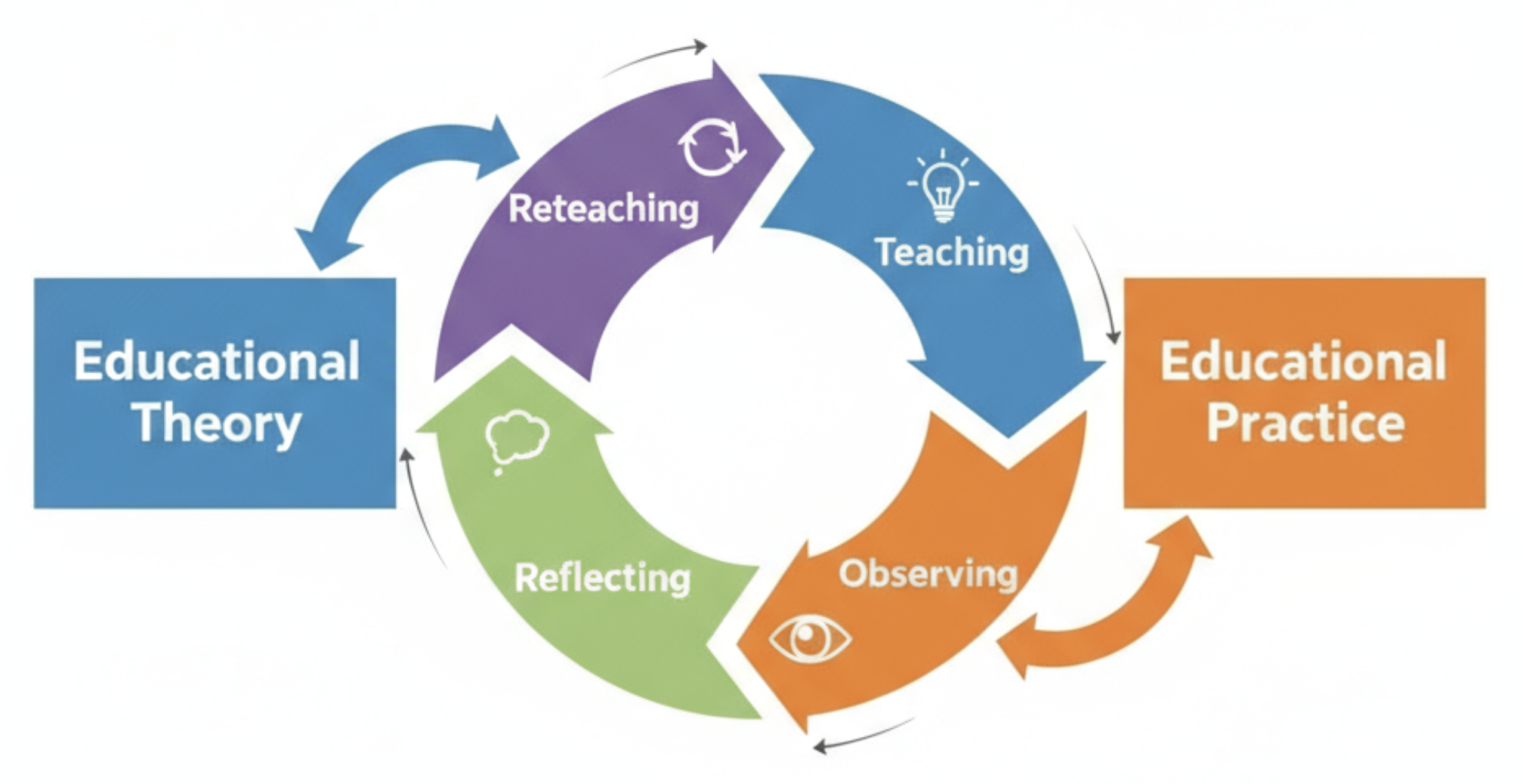
In a typical micro-teaching session, a trainee delivers a brief lesson segment while peers and supervisors observe and provide feedback. The cycle of teaching, observing, reflecting, and reteaching forms a feedback loop that links educational theory with practice. Within this iterative process, educators learn to deconstruct complex communication behaviors into observable elements—questioning, responding, turn-taking, interpersonal interaction—and to refine them through guided reflection. Each micro‑lesson is designed to integrate the cognitive, affective, and psychomotor domains of learning, enabling trainee teachers to combine analytical thinking, emotional awareness, and practical performance within a unified experience of professional growth.
This reflective cycle also fosters “learning by doing,” reinforcing Dewey’s pragmatic philosophy that education should nurture reasoning and problem-solving through experience. Within this process, trainees are encouraged to take the initiative in their own learning—observing, interpreting, and evaluating their classroom behaviors from multiple perspectives. They develop an analytical attitude that enables them to make independent judgments and formulate self‑directed action plans for improvement. Over decades, micro-teaching has proven an adaptable model for training diverse educators, from language teachers to STEM instructors, across cultural and institutional contexts.
Micro‑teaching connects curriculum and subject‑matter knowledge with the development of pedagogical skills. Each mini‑lesson is constructed around explicit learning objectives derived from course syllabi so that trainees can test how theoretical principles function in authentic content areas such as language, science, or social studies. This alignment between curriculum planning and communicative enactment ensures that the experience benefits trainees not only methodologically but also substantively.
At the core of micro-teaching lies reflection as both a cognitive and affective act. Reflection allows teachers to analyze their assumptions, identify strengths and weaknesses, and adopt new strategies based on evidence rather than habit. Through self-observation and peer dialogue, the process builds self-knowledge, a quality emphasized by Wang Yang-ming’s ideal of the Unity of Knowledge and Action (Wang, 1963).
Micro-teaching also transforms communication from a one-way transmission into a dynamic interaction, and it continues to play a significant role in teacher preparation with notable outputs (Yam, 2021). Using recordings and guided analyses, teachers gain insight into tone, facial expressions, eye contact, gestures, pacing, and other non‑verbal cues that collectively shape the classroom climate. These subtle elements often reveal emotional engagement and student responsiveness, enabling teachers to interpret both the affective and relational dimensions of instruction. A caring heart is central to Wang Anshi’s philosophy of communication, and it can be reflected by the heartfelt and interactive communication between teachers and students. (Yam, 1987, p. 87). The framework closely parallels Ned Flanders’s Interaction Analysis Categories (FIAC), which differentiate between direct teaching behaviors (such as lecturing and giving directions) and indirect behaviors (such as encouraging student ideas, accepting feelings, or facilitating dialogue) (Flanders,1970).
Figure 2
Reflective Learning and Communication
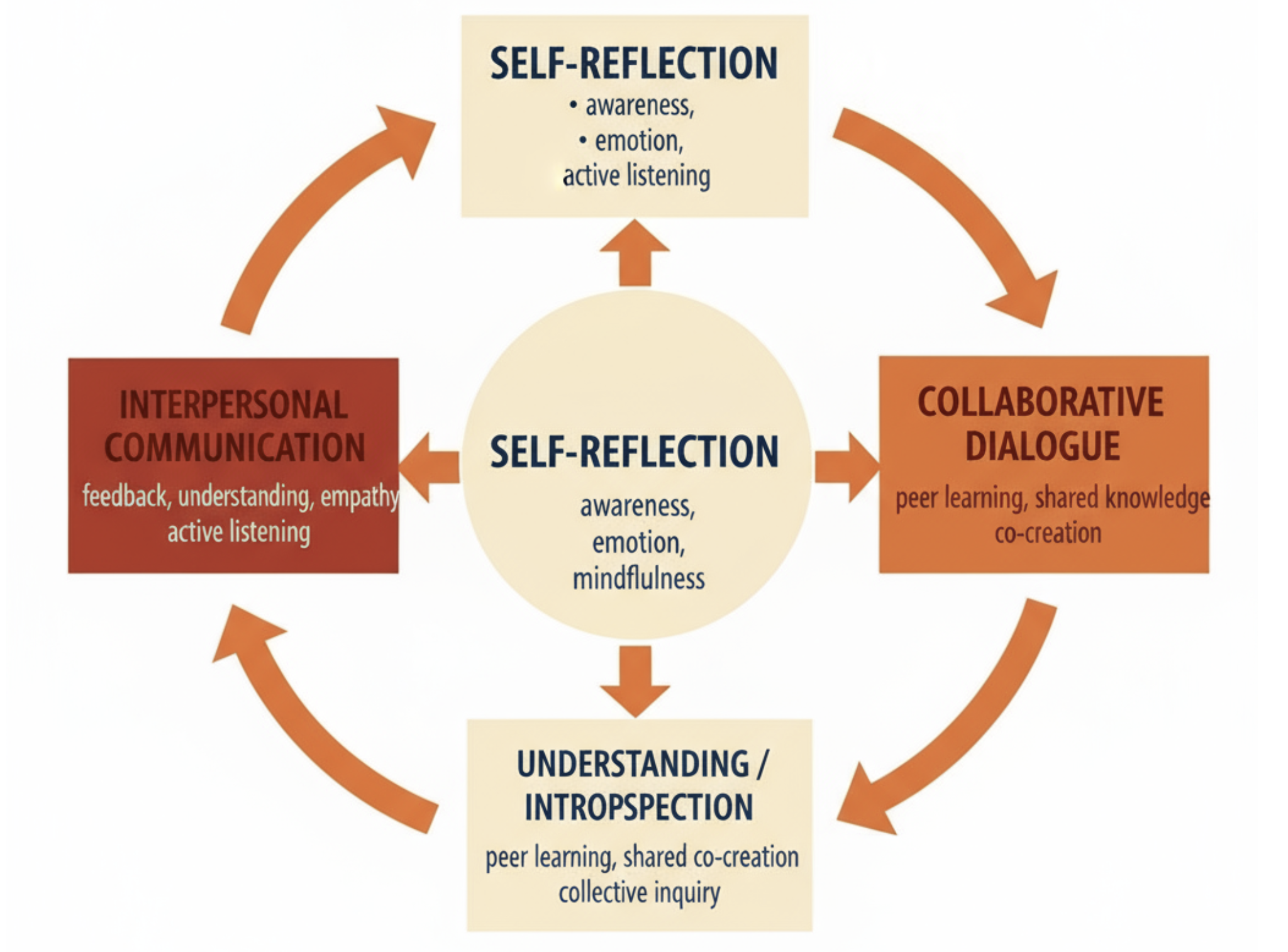
Balancing these behaviors represents the art of teaching communication. When educators learn to alternate between guiding and listening, directing and empathizing, they create what Freire (1970) called a dialogic space for co-construction of meaning. Micro-teaching provides a supportive laboratory in which these relational dynamics can be observed, practiced, and refined.
Technological advancement has expanded the tools available for micro-teaching—from early audiovisual recorders to digital meeting platforms and AI-assisted feedback systems. Video recordings—providing both audio and visual evidence—enable detailed analysis; trainees can replay sessions frame‑by‑frame to examine tone, body language, and interaction patterns. Yet, as Bill Gates (1995) once remarked, technology becomes meaningful only through human facilitation. The core purpose of micro-teaching remains the same: to develop thoughtful, reflective educators who understand both the potentials and the limitations of technological mediation.
In early implementations, videotaping was revolutionary because it provided teachers with objective evidence of their performance. Later, computer-based systems enabled immediate playback, data analytics, and remote supervision. In the current digital era, virtual and augmented reality (VR/AR) simulations can replicate authentic classroom scenarios, allowing teachers to practice decision-making in interactive environments.
Recent developments in artificial intelligence have introduced simulation‑based environments for micro‑teaching. Through AI‑generated student avatars and adaptive classroom scenarios, trainees can conduct “mini‑lessons” virtually, receiving immediate feedback on questioning strategies, speech tempo, and non‑verbal cues. Such AI simulations extend the reflective cycle beyond the physical classroom, allowing repeated practice and risk‑free experimentation while maintaining the human element of guided feedback.
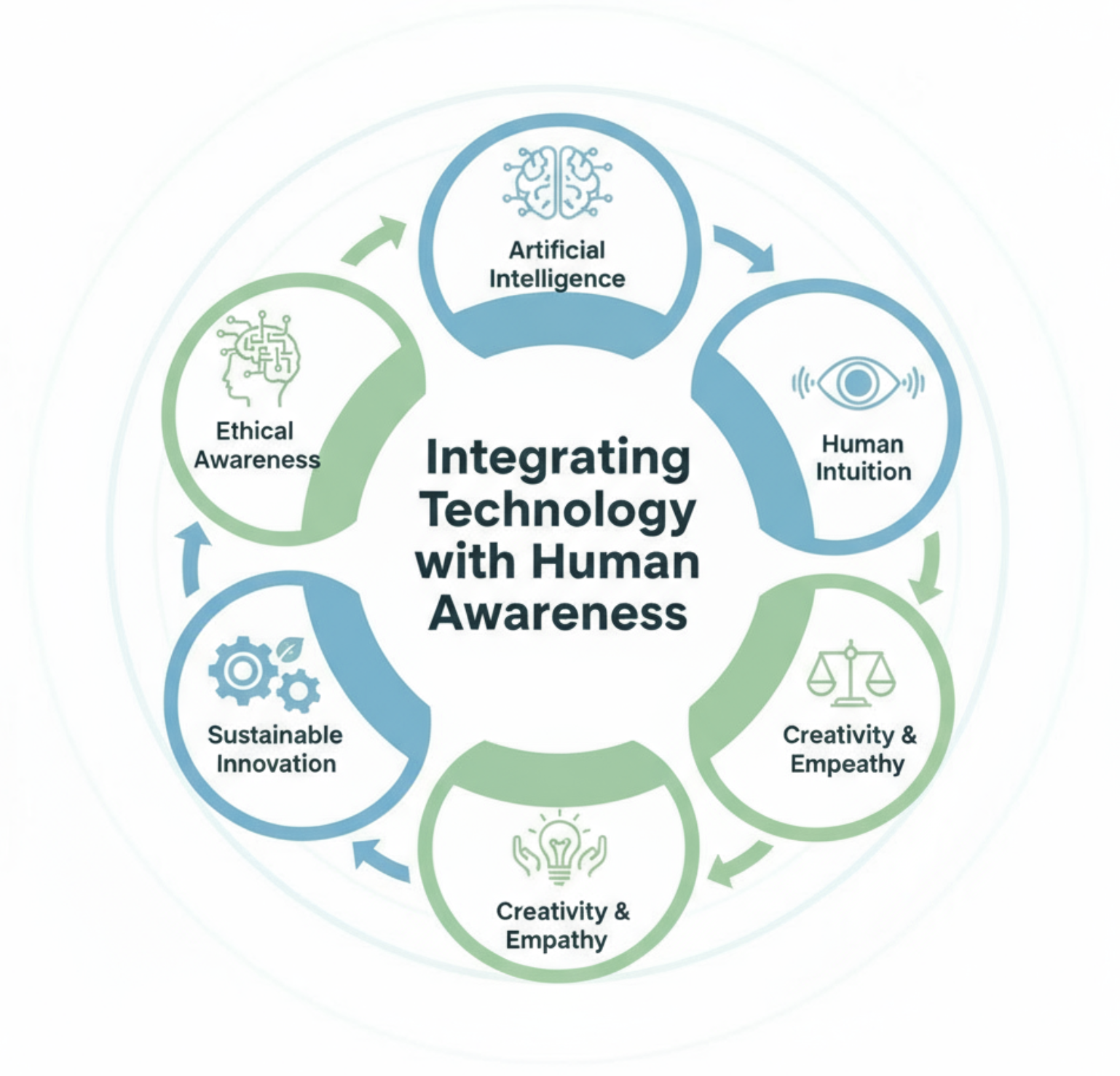
However, digital tools must serve as cognitive mirrors, not substitutes for reflection. Artificial intelligence can assist with speech recognition, gesture analysis, and automated summaries of classroom talk, but it cannot replace human judgment or empathy. As Nicholas Negroponte (1995) argued, true innovation requires humanism to guide technology. Within micro-teaching, therefore, each technological aid should enhance teachers’ capacity to perceive, analyze, and connect—never to mechanize the learning process.
Figure 3
Integrating Technology with Human Awareness
Micro-teaching endures as an invaluable approach for cultivating reflective, communicative, and adaptive educators. Significant changes in educational technology and communication practices have occurred in the last seven decades (Yam, 2024). Across decades of technological evolution—from audiovisual systems to artificial intelligence—the central philosophy remains unchanged: effective teaching begins with reflection and dialogue.
As teacher education enters the era of intelligent technologies, micro-teaching serves as a reminder that learning cannot be automated. Machines may offer data and analysis, but only through humane interpretation do those insights become wisdom. When educators engage reflectively with their own communication and practice, they reaffirm the humanity at the core of education.
In this sense, micro-teaching is not merely a technique but a philosophy of lifelong learning. It encourages teachers to listen, to observe, to empathize, and to act with awareness. As Leo Yam’s reflections conclude, “Humanity embraces the core value of the development of education, communication, and technology.” Micro-teaching embodies this belief, ensuring that in the pursuit of pedagogical excellence, technology serves humanity—and not the reverse.
The authors would like to express their sincere gratitude to all participants who attended the AECT 2025 session, “HKAECT: Reflection on the Development of Education, Communication, and Technology,” in Las Vegas, United States. Their thoughtful discussions and reflections have enriched and deepened the ongoing dialogue on the humanistic integration of education, communication, and technology.
 EdTech Archives