Online learning evolved from the foundational concept of distance education, which provides access to instructional materials—including textbooks, audio recordings, and videos—through correspondence (Palivia et al., 2018). With technological advancement, online learning embraces diverse learning modalities outside the traditional classroom (Broderick, 2020). Consequently, online learning presents a viable option that addresses the unique needs of adult learners (Knowles et al., 2005). Non-traditional or adult learners are individuals over the age of twenty-five who meet specific criteria: delayed enrolment in post-secondary education, part-time attendance, financial independence, full-time employment while studying, having dependents other than a spouse, being a single parent, and lacking a standard high school diploma (NCES, n.d.). Nontraditional students often juggle multiple responsibilities, including work, marriage, and parenting (Tannehill, 2009).
Ginder et al. (2019) reported that 15.4% of students were primarily enrolled in distance education courses, based on data from the National Center for Education Statistics (2017). In addition, 30% of college students in the U.S. are classified as non-traditional (NCES, 2022). Over the years, enrolment has significantly increased due to technological advancements that have shifted the focus from distance education. Fotiadou et al. (2017) indicated that online learning requires access to essential technologies to succeed in educational endeavours. Hence, many universities leverage tools such as learning management Systems (LMS), digital devices, and video conferencing platforms (Addae et al., 2025). Given the diverse backgrounds of nontraditional students, some of whom may face challenges like poor internet connectivity or limited digital literacy, it is important to examine their online learning readiness (Fotiadou et al., 2017). Therefore, online learning readiness describes learners' preferences for instructional delivery, confidence and competence in using the internet and electronic communication, and ability to engage in autonomous learning (Hoang & Hoang, 2023). However, Kara et al. (2019) identified stress, isolation, and disconnection to be linked to adult learners' digital competency. These challenges may be increased for learners in rural and remote areas, increasing the likelihood of dropout. In their previous research (Al Mamun et al., 2022; Wagiran et al., 2022), they highlight the online learning readiness of traditional students. To this end, this study seeks to identify the gap in the literature concerning online learning readiness of non-traditional students.
This study employed a systematic literature review, which involves a structured and transparent approach to identifying, selecting, and synthesizing relevant studies. The search for relevant literature was conducted across multiple academic databases, including ERIC, Google Scholar, and Scopus. A combination of keywords and phrases related to online learning readiness and its various aspects was used to conduct the search. Boolean operators (“AND, OR, NOT”) were also employed to refine the search results and ensure relevance. Example: ("online learning readiness" OR "distance education readiness") AND ("non-traditional students" OR "adult learners") AND ("higher education" OR "undergraduate programs"). To ensure the quality and relevance of the selected studies, specific inclusion criteria were applied, including papers published in peer-reviewed journals or reputable conference proceedings between 2015 and 2025. Studies were excluded if they (a) did not examine online learning readiness or its components, (b) focused on K–12 settings or educational personnel rather than students, or (c) lacked empirical data and theoretical depth.
The study employs the methods used in previous studies, adopting a qualitative approach. Data was obtained through a thorough literature review of online learning readiness studies. Step 1: Data were obtained by screening titles, abstracts, and texts. This was done by collecting all the studies in the search string in an Excel spreadsheet and naming them according to the database from which they were collected. Step 2: These studies were screened by their titles and further categorized or named in a separate sheet according to those that addressed online learning alone, addressed online learning readiness among undergraduates or traditional higher education settings, and those that addressed online learning readiness among nontraditional students.
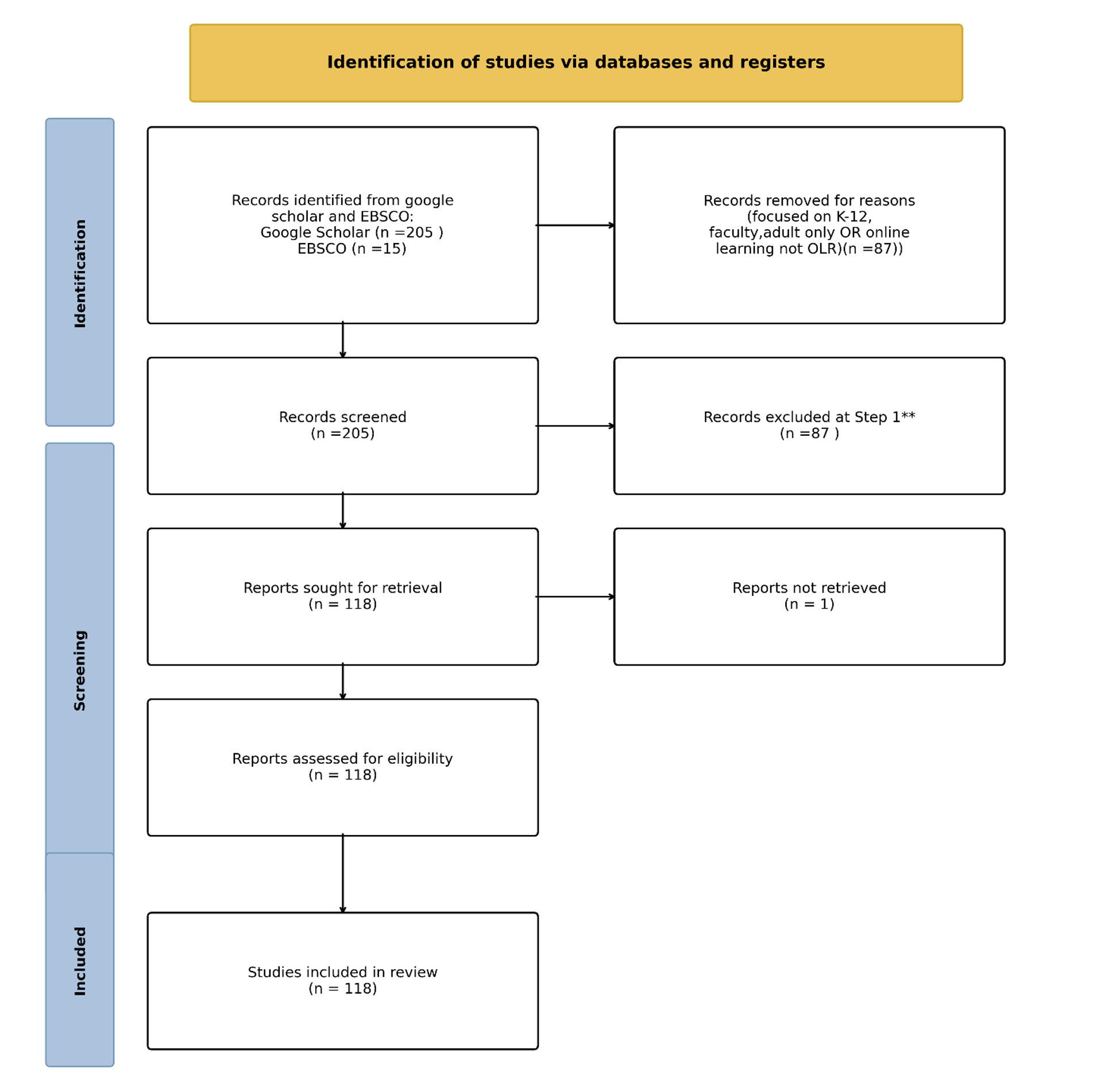
Other studies that address different components of online learning readiness, such as digital competency, digital literacy, technology efficacy, motivation, as well as studies that focused on other non-traditional institutions, such as vocational schools, community colleges, and ESL (English as a second language) learners, were also included. In addition, studies that used terms such as adult learners and postsecondary institutions were also adopted in this research. 205 studies were screened according to their titles and abstracts, while 87 studies were further excluded as they did not meet the criteria for this study (see Figure 1). In total, 118 studies were further examined by reading through each to check for their eligibility. A thorough screening process was necessary as some studies did not explicitly state which population of students they addressed. However, an in-depth examination of the work helped to identify which category of students was being addressed. In essence, a contextual analysis of each of these studies was carried out by reading through each of the selected papers to ascertain if the research addressed online learning readiness among non-traditional students and their related concepts. For more clarity, colour codes were assigned to studies according to the concept they addressed.
Figure 1
PRISMA Procedures and Guidelines for the Literature Review.
Out of the 118 studies examined, 18 studies focused on online learning readiness among non-traditional students, while 57 were conducted among undergraduate students in traditional institutions (see Table 1). In addition, 13 studies focused on both undergraduate and postgraduate student populations; five mentioned postgraduate students, while two were specifically conducted in two-year community colleges. Using descriptive statistics (see Figure 2), 50% of the studies examined in this research focused on online learning readiness among undergraduate students in a traditional 4-year college. On the other hand, only 16percent address the non-traditional student population. Similarly, more studies in this research adopt a quantitative or mixed methods research design, which also highlights the need for more qualitative studies among non-traditional student populations.
Table 1
Number of Online Learning Readiness Studies by Student Population Category
Population Group/Category | Number of Studies |
Non-traditional Students | 18 |
Undergraduate Students | 57 |
Undergraduate + Postgraduate | 13 |
Postgraduate | 5 |
2-year Community Colleges | 2 |
Unspecified | 23 |
Total | 118 |
Note. This table presents the frequency distribution of the population type of 118 online learning readiness studies. Undergraduate students represented the largest population of studies examined(n=57, 48.3%), followed by studies with unspecified student population(n=23, 19.5%)and non-traditional students (n=18, 15.3%) Combined undergraduate and postgraduate studies accounted for 11.0% (n=13), while postgraduate studies (n=5, 5.42%) and two-year community college students (n=2, 1.7%) represented smaller proportion.
Figure 2
Categories of Students Addressed in Online Learning Readiness Studies
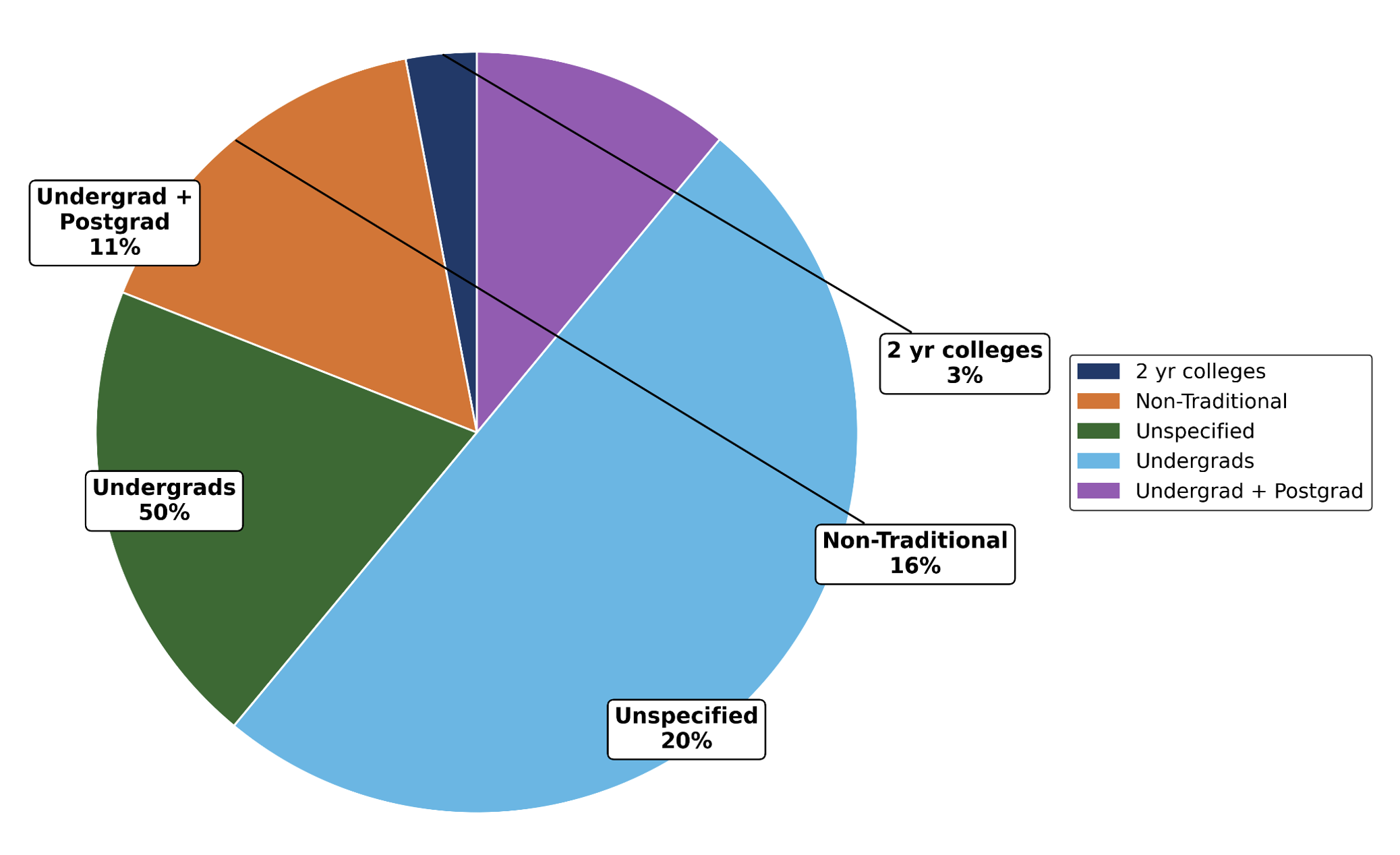
Note: This figure displays the distribution of student categories examined in online learning readiness research literature. The undergraduate category represents the largest proportion of studies at 50%, while unspecified student populations account for 20% of the research. Combined undergraduate and postgraduate studies comprise 11% of the literature; non-traditional students represent 16%, and two-year college students account for 3% of studies reviewed.
The literature review on online learning readiness provides a comprehensive and evidence-based analysis of the topic, highlighting the need for research among this population of students. The research shows that there is a dearth of research in online learning readiness among non-traditional students, many of whom are already in the workforce. Online learning has been rapidly evolving. embracing the same tools used in many organisations to train their employees, such as learning management systems. Similarly, the artificial intelligence (AI) revolution is shaping workforce needs, driving the increasing demand for online education. To this end, Bagdi et al. (2023) projected that the online learning sector is expected to reach $375bn by 2026. The data tells us that non-traditional students constitute a larger component of the population with online learning needs. Therefore, to help these students succeed, more studies are needed addressing their online learning readiness.
 EdTech Archives