Robotics is the study of designing and constructing programmable machines capable of performing specific tasks (Muñoz et al., 2020). Educational robotics involves designing, constructing, and using programmable robots to help students learn more effectively and improve their learning achievement (Muñoz et al., 2020; Coxon et al., 2018).
The Sphero Bolt robot is a ball-shaped programmable robot designed to encourage creativity and curiosity through coding and play (Sphero, 2020a). It helps students to easily learn programming, complete hands-on activities, and share their creations with the “Sphero Edu” learning community (Sphero, 2020a). “The robot is programmed with the Sphero Edu app, which is designed to empower anyone to program their robot regardless of their computer programming/coding abilities. Beginners or elementary students can drag-and-drop movement, control, or operation blocks to write programs for their robots (Sphero, 2020a). Advanced learners can program their robots using JavaScript or Python.
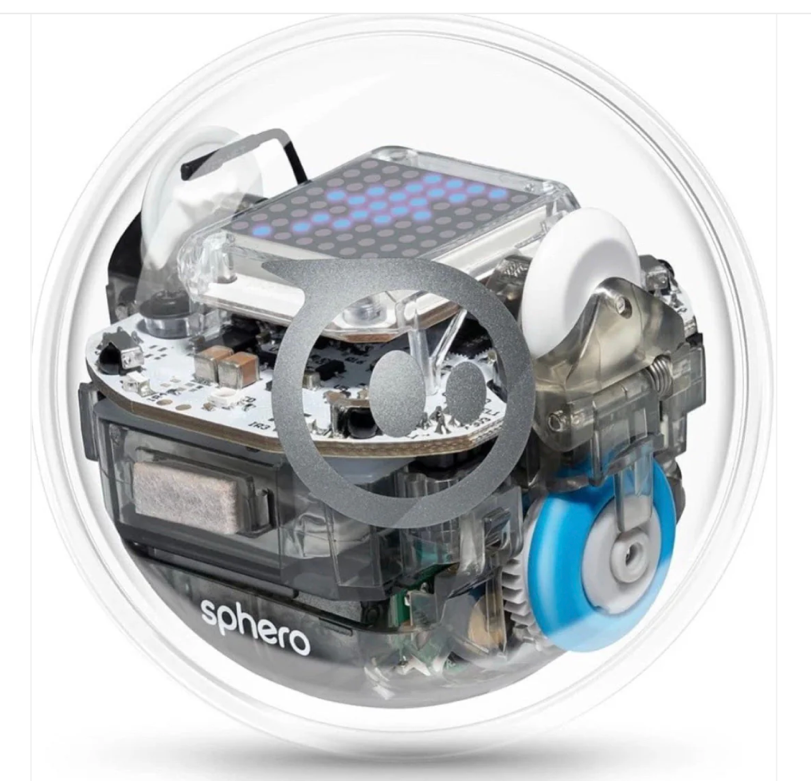
The robot has programmable sensors such as a gyroscope, an accelerometer, motor encoders, and colorful LED lights. These allow the creation of countless play experiences and coding conditions for all levels (Sphero, 2020a). The Sphero robot is designed to foster a love of robotics, coding, and STEM education. Sphero is made of a durable, UV-coated, waterproof, clear plastic shell that allows you to see all the mechanics inside (see figure 1). It comes with an inductive charging station, USB cord, maze tape, and 360-degree protractor.
Figure 1
Sphero Bolt Robot
Research findings show that the use of ER improves learners’ academic achievement in mathematics (Alfieri et al., 2015; Coxon et al., 2018; Muñoz et al., 2020). A quantitative study by Alfieri et al. (2015), involving 116 middle school students in the northeastern USA, found that the use of ER increased the percentage of correct responses and the number of problems attempted. They recommend that, for intervention in the use of robots in teaching mathematics, the focus be on a single mathematical concept rather than multiple concepts.
Also, findings from an experimental mixed-methods study by Ortiz (2015) indicated that students in the intervention group made significant progress in learning new concepts of ratio and proportion. The purpose of the study was to examine the impact of using LEGO robotics on students’ learning of ratios and proportions. Students in this study learned these concepts while programming LEGO robots. Participants in the study were fifth-grade students (n = 30) from an inner-city school located in a low-income area in the USA.
Moreover, Sáez-López et al. (2019) conducted a quasi-experimental study in Spain, in which 93 sixth-grade students participated. The aim of the study was to examine whether programming mBot robots would substantially help to improve students’ interest and achievement in computational thinking, mathematics, and science. Results showed that, in the experimental group, there were statistically significant improvements in mathematics achievement on the concepts of coordinates, integers, and negative numbers. This suggests that the use of robots to teach mathematics helped to improve students’ achievement.
Interest in a particular field or subject leads to meaningful learning, long-term knowledge retention, and motivation for further learning (Hidi, 1990). Research findings show that the use of educational robots in teaching and learning has a significant effect on students’ interest and motivation for learning (Arís & Orcos, 2019; Burack et al., 2019; Palmér, 2017; Şimşek, 2016). In their study with Swedish preschool children, Palmér (2017) found that students showed great interest in learning mathematics through programming Bee-Bot robots. They say, “the children participated enthusiastically in the programming activities, showing pleasure and joy” (p. 83). Contrary to Palmér’s (2017) study, Alfieri et al. (2015) reported that integrating robotics into mathematics instruction for 116 middle school students did not significantly increase students’ interest in mathematics.
Another study by Şimşek (2016) in Istanbul, Turkey, examined the effect of using an educational robot to teach mathematics on seventh-grade students’ (n = 28) attitudes toward mathematics. The study used a virtual robot called the 3D Mathematic Robot. Results showed a significant difference (z = 2.95, p < .05) between students’ pre- and post-intervention scores on the Mathematics Attitude Scale. Based on the results, he argues that the virtual mathematics robot has an important effect on students’ interest in mathematics.
The Sphero robot and the Sphero Edu App can be used to teach various topics in mathematics, such as geometry, coordinates, distance measurement, time, and speed. When you program the Sphero robot to move, the app sketches the way/route the robot is moving through. The Sphero Edu App is compatible with Mac and Windows computers, as well as tablets and smartphones running iOS or Android. You can download the app on your device or use the web-based app. You need to create an account in the app to program your Sphero robot and save your programs. Before your Sphero robot can run or execute a program, it needs to be connected (paired) with the app via Bluetooth by clicking the “Connect” tab in the top-right corner of the app screen.
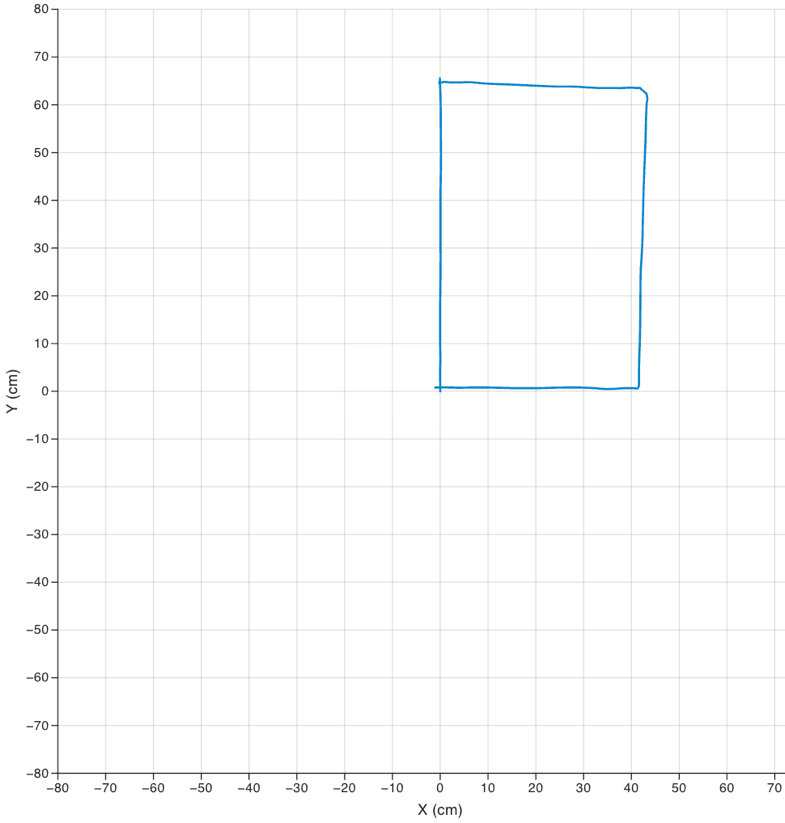
In the following screenshot (Figure 2), I programmed a Sphero robot to move in the shape of a rectangle. The left side shows the program in block code; the right side shows a JavaScript program at the top and a Python program at the bottom. Figure 3 is a screenshot of the rectangle sketched on the Sphero Edu App when the robot was running the program. Watch the following YouTube video to see the Sphero robot move and turn to create a rectangle: https://www.youtube.com/watch?v=ir251ZiHMEo.
Teachers can use Sphero robots' programming to help students clearly understand several geometric concepts, such as angles, width, length, perimeter, and area. Also, teachers can use Sphero robots' programming to teach graphs and coordinates. For example, after drawing a rectangle, a teacher can ask students to write the coordinates of the rectangle's corners. In addition to geometric and coordinate concepts, programming Sphero robots can help students develop computational thinking and learn programming languages such as JavaScript and Python.
Figure 2
Block, JavaScript, and Python Codes for the Sphero Robot to Draw a Rectangle
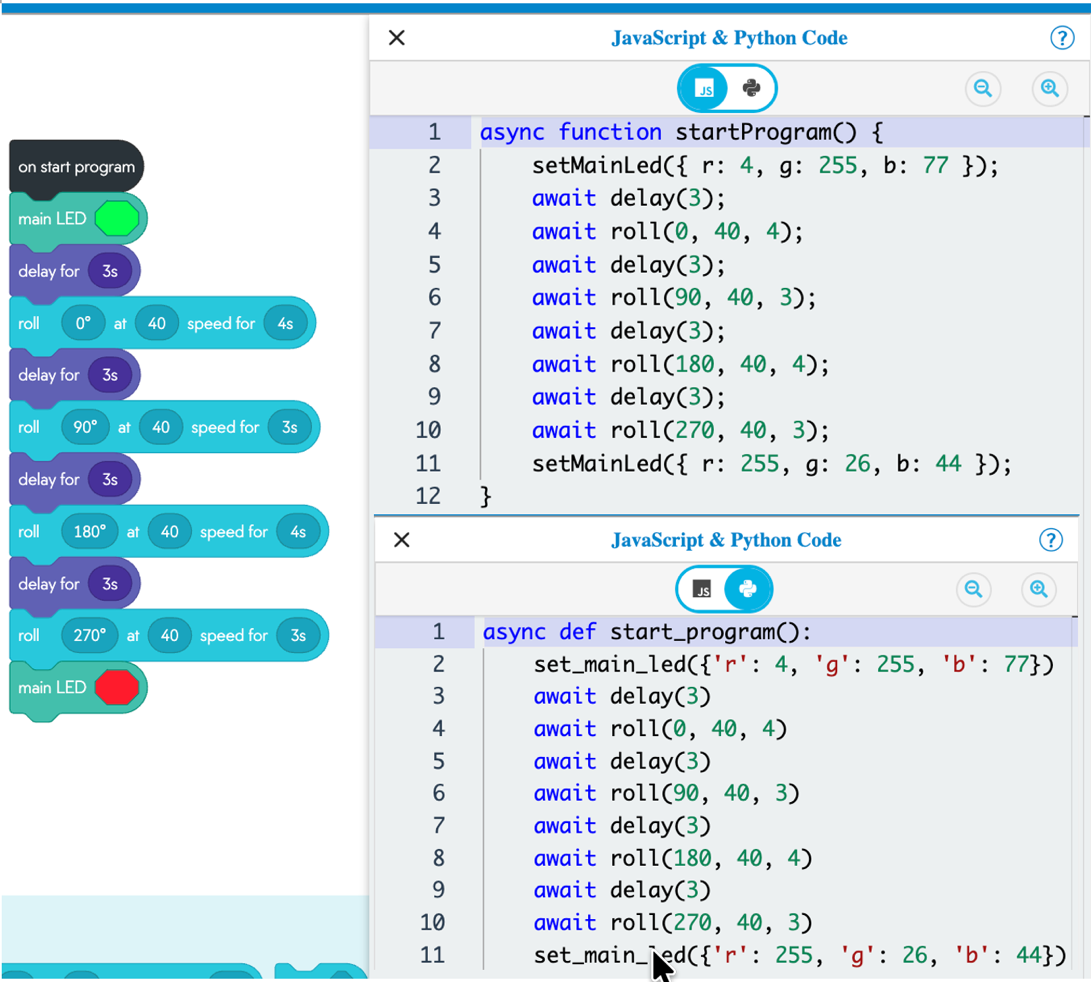
Figure 3
Screenshot of a Rectangle Sketch on the Sphero Edu App
The Sphero Edu App has an Artificial Intelligence (AI) Assistant that can provide an explanation of a program at basic, advanced, and technical levels. The explanation may not be perfect; it needs to be verified and edited if necessary. The following is the AI Assistant-generated basic-level explanation of the program in Figure 2; I edited the explanation by deleting “square” and replacing it with “rectangle”.
This program makes your Sphero robot move in a rectangle pattern while changing its light color at the beginning and end. Here's what happens:
- First, the main LED light on the robot turns bright green.
- The robot waits for 3 seconds.
- The robot rolls forward for 4 seconds.
- The robot waits for 3 seconds.
- The robot turns right (90 degrees) and rolls for 3 seconds.
- The robot waits for 3 seconds.
- The robot turns around (180 degrees from the start) and rolls for 4 seconds.
- The robot waits for 3 seconds.
- The robot turns again (270 degrees from the start) and rolls for 3 seconds.
- Finally, the main LED light changes to bright red.
When the program is done, your robot will have traveled in a rectangle shape and changed its light from green to red. This program uses simple blocks that tell your robot to change colors, move in directions, and wait between movements. The numbers tell the robot how long to move and how fast to go (Sphero Edu AI Assistant, 2025, “Explain My Program”).
The integration of educational robotics into mathematics instruction offers an engaging approach to learning. Research demonstrates that robotics can enhance students’ academic achievement, promote interest in STEM education, and foster computational thinking. By integrating Sphero robot programming in math education, teachers can create interactive lessons that connect abstract mathematical concepts—such as geometry, coordinates, and measurement—to real-world applications through coding and problem-solving. This hands-on experience not only strengthens students' understanding of mathematics but also introduces them to programming languages such as JavaScript and Python, preparing them to use modern technologies effectively in the digital age. While some studies reported mixed results regarding increasing interest in mathematics, the overall evidence suggests that robotics-based learning can motivate students and improve retention. Therefore, incorporating Sphero and other robots into math education represents a promising strategy for enhancing both conceptual understanding and engagement in today’s classrooms.
 EdTech Archives