ICT is important to people today because they need it to carry out many activities in their everyday lives. As a result, the International Computer and Information Literacy Study (ICILS) was introduced in 2013 (Fraillon et al., 2019). ICILS examines how eighth-grade students globally are obtaining the knowledge, attitudes, and skills that constitute computer and information literacy (CIL) (Fraillon et al., 2013). CIL comprises four strands and eight aspects (figure 1). Strands are broad conceptual categories, whereas aspects are specific content areas within a strand. The ICILS 2018 assessment framework aligns with the International Society for Technology in Education (ISTE) standards for students.
Figure 1
Computer and Information Literacy Strands and Aspects
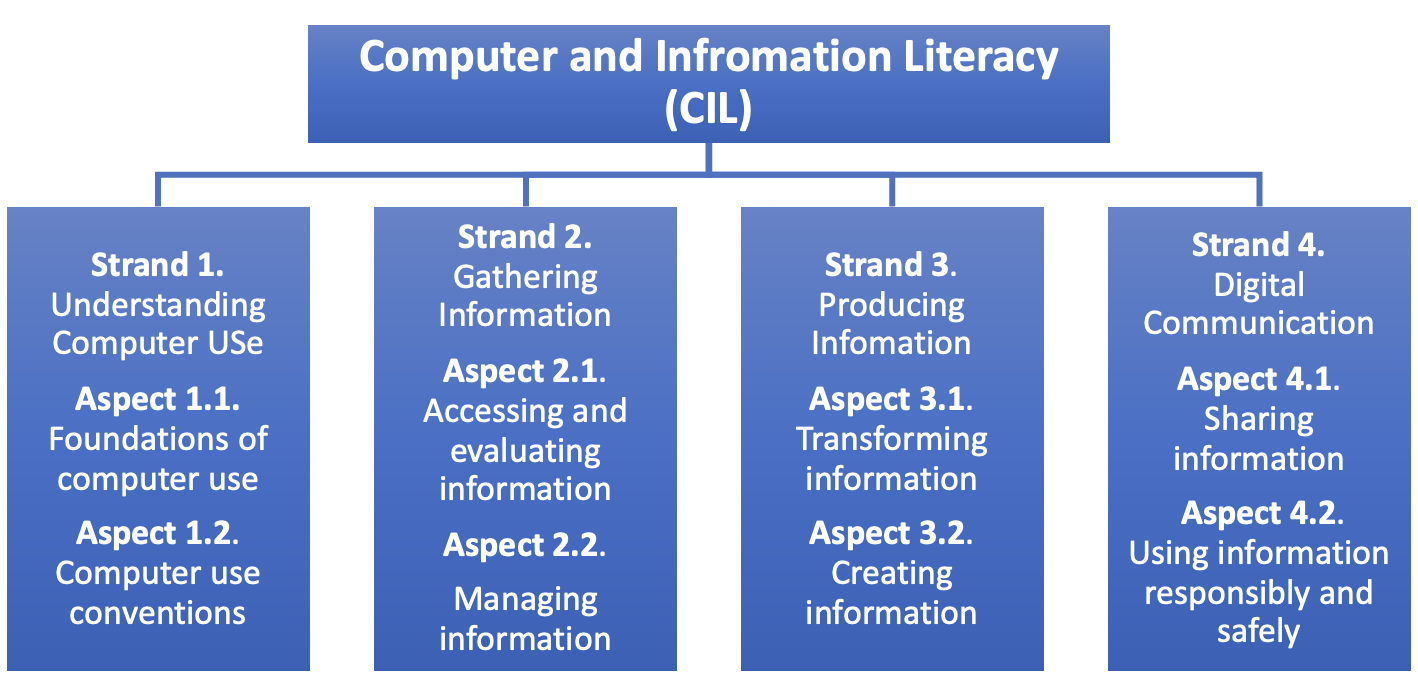
Note. Adapted from Fraillon et al. (2019).
In the 21st century, students’ ICT self-efficacy and ICT literacy play a significant role in students’ academic achievement. But there is a lack of consensus in the literature regarding the correlation between ICT self-efficacy and ICT literacy (Siddiq & Scherer, 2019). More research is needed to examine the correlation between the variables (Fraillon et al., 2020). Therefore, the purpose of this quantitative secondary data analysis study was to use the United States’ dataset from the ICILS 2018 to examine how 8th-grade students’ ICT literacy correlates with their ICT self-efficacy regarding the use of general computer applications (Microsoft Word, PowerPoint, and Excel) across genders, races, and school-level socioeconomic status (SSES).
The following question guided the study. How does students’ ICT literacy correlate with their ICT self-efficacy in using general computer applications across races, genders, and SSES? The research hypothesis stated that students’ ICT literacy positively and statistically significantly correlates with their ICT self-efficacy across races, genders, and SES.
ICT literacy is the ability to use computers to investigate, create, and communicate information successfully in different contexts - home, school, or workplace (Fraillon et al., 2013). In developed countries such as New Zealand, Denmark, Sweden, and the United States, ICT use is prevalent in education. Studies show that ICT literacy helps to improve students’ academic achievement and interest in STEM (Conrad et al., 2018; Lei et al., 2021).
Self-efficacy is a person’s belief in their ability to use their knowledge and skills to perform tasks or activities, such as learning activities (Bandura, 1986). ICT self-efficacy is simply one’s belief in one's ability to use ICT for various activities/tasks. Self-efficacy determines the amount of effort individuals apply to assigned activities and the extent to which they persevere when they face challenges. Students’ self-efficacy has been found to be positively related to students' interest and achievement (Hatlevik et al., 2018; Rohatgi et al., 2016). Hence, it’s important to know how students’ ICT self-efficacy relates to students’ ICT literacy across races, genders, and SSES.
This study used a correlational survey design to analyze the United States ICILS 2018 dataset. The correlational survey design is suitable for revealing the relationships among research variables, which was the purpose of this study.
The sampling process “involved multi-stage sampling, stratification, and cluster sampling” (Fraillon et al., 2020, p. 59). The sample comprised 6,790 students from 263 public and private schools. If the number of 8th-grade students at a school exceeded 25, a random sample of 20 students was selected. However, if the number of students enrolled was 25 or fewer, all students were included in the sample.
Two instruments were used to collect the data – the CIL test and the student questionnaire. The CIL test was computer-based; questions and tasks were presented in five modules. The duration for completing each module was 30 minutes (Fraillon et al., 2020). Every student completed only two randomly assigned modules. Each module consisted of several small tasks and one large task.
The student questionnaire collected information about students’ personal and home background, and their use of and experience with ICT to complete various tasks in school and out of school (Fraillon et al., 2020). Also, information about students’ attitudes regarding the use of ICT in society was collected.
The ICILS 2018 CIL test public-use data were obtained from the Data Repository of the International Association for the Evaluation of Educational Achievement, while students’ race and SSES data were obtained from the National Center for Education Statistics website.
This study examined two analysis variables and three grouping variables. The study's variables were students’ ICT self-efficacy in using general computer applications (Microsoft Word, PowerPoint, and Excel) and ICT literacy. The grouping variables of the study were students’ genders, races, and SSES.
ICT self-efficacy regarding the use of general applications was a scale (derivable variables) (Fraillon et al., 2020). The scale was derived from eight items in question 27, which asked, “How well can you do each of these tasks when using ICT?” (p. 173). Students were required to indicate their self-efficacy by choosing one of the following: “I know how to do this,” “I have never done this, but I could work out how to do this,” and “I do not think I could do this” (p. 173). Students’ scores on the CIL test determined their ICT literacy. ICT literacy was grouped into five levels: below level 1 through level 4. Scores below level 1 indicate the lowest level of ICT literacy, while scores above level 4 indicate the highest level.
For grouping variables, students identified their genders by choosing one option – female or male. Students identified their races by choosing one of the following: White, Black or African American, Asian, American Indian or Alaska Native, or Native Hawaiian or other Pacific Islander. SSES was determined by the percentage of students eligible for the free or reduced-price school lunch program in a school.
I used the International Database Analyzer (IDB Analyzer) and SPSS computer software to merge and analyze the data. And I used Pearson correlation to examine the correlations of the analysis variables because the data were continuous, normally distributed, and obtained from a random sample. To ensure unbiased results, I listwise deleted missing data and set the confidence level to 95% (p < 0.05).
The correlation between students’ ICT self-efficacy and ICT literacy by gender was similar for boys and girls. ICT self-efficacy was weakly positively correlated with ICT literacy among boys, r(2,944) = .38, p < .001; and girls, r(2,969) = .38, p < .001. Though the correlation was weak, it was statistically significant.
Among students across most races, ICT self-efficacy was weakly and positively correlated with ICT literacy. Even though the correlations were weak, they were statistically significant (p < .001) across the races. Among Black and Asian students, the correlation was moderate and positive: r(732) = .42, p < .001; r(270) = .41, p < .001. Among White students, the correlation was r(2769) = .38, p < .001. The correlation was lowest among Hispanic students (r(770) = .34, p < .001).
The correlations were higher among students from schools where 50 to 74.9% and 75% or more of students were eligible for free or reduced-price lunch, r(1,709) = .38, p < .001; and r(1,241) = .38, p < .001, respectively. The correlation was lower among students from schools where less than 10% or 10 to 24.9% of students were eligible for free or reduced-price lunch, r(476) = .33, p < .001, and r(770) = .33, p < .001, respectively.
The study results above support the hypothesis of the study, which stated that students’ ICT literacy positively and statistically significantly correlates with their ICT self-efficacy across races, genders, and SSES.
Among boys, girls, and SSES, the correlation between ICT self-efficacy for using general applications and ICT literacy was weak, positive, and statistically significant. The results align with findings from previous studies (Hatlevik et al., 2015; Rohatgi et al., 2016). ICT self-efficacy and ICT literacy were weakly but significantly positively correlated among students across most racial groups. The literature lacks studies examining the correlation between students’ ICT self-efficacy and ICT literacy across racial groups. Therefore, this study adds to the literature findings about the correlation between students’ ICT self-efficacy and ICT literacy that are disaggregated by race. The correlation between students’ ICT self-efficacy and ICT literacy was higher in schools located in high-poverty communities than in low-poverty communities.
One implication of the findings is that, because students’ ICT self-efficacy was positively and significantly correlated with ICT literacy, fostering ICT literacy may be used as a strategy to increase ICT self-efficacy, and vice versa. Due to the mixed results in the study, I recommend that researchers use other big datasets or the ICILS 2023 dataset, which became available in 2025, to examine the correlations between ICT self-efficacy and ICT literacy across genders, races, and SES.
This study investigated the correlation between ICT self-efficacy and ICT literacy across genders, races, and SSES of the United States’ eighth-grade students. Overall, the correlations between the variables were weak, positive, and statistically significant. The findings are valuable because they can be used to justify the development and implementation of policies and programs aimed at improving ICT self-efficacy and ICT literacy among student subgroups for which correlations were low. This can help in achieving educational justice and equity for all students. Also, the results can be used by educators to implement differentiated instruction to meet the needs of specific student subgroups.
 EdTech Archives