The practice of providing relevant and timely scaffolding to students is an integral part of a successful Problem-Based Learning (PBL) tutorial. This is because the quality and context of the instructor's scaffolds provide students with opportunities for deeper research and more intricate exploration of the related conceptual space. Scaffolding is also significant for meaningful learning, as appropriate scaffolding helps novices perform at a level closer to that of an expert (Brush & Saye, 2002). Tabak (2004) also emphasizes the importance of scaffolding in enabling novices to carry out a task that is originally beyond their capacity. In other words, scaffolds have been deemed one means of achieving the broader goal of successful learning through PBL; little research has examined how different types of scaffolding play out in the authentic context of teaching and learning. Thus, this study aims to investigate the real-life applications of scaffold best practices by examining videos capturing classroom interactions from two middle school PBL units: one history lesson and one robotics lesson. The video analysis will focus on identifying the organic interplay among different types of scaffolds and how this interplay contributes to the synergistic effect in a distributed scaffolding system. The authentic study of real-life applications of PBL is expected to provide empirical and lived experience of what a good scaffold should look like. Such findings will subsequently benefit the instructors practicing PBL and ultimately help learners gain the best learning experience.
The nature of scaffolding is generally assumed to be temporary and adjustable. Which means scaffolding should eventually fade as novices acquire sufficient expertise to learn independently (Graves & Avery, 1997). On a similar note, Woods et al. (1976) propose three critical characteristics of scaffolding: contingency, intersubjectivity, and transfer of responsibility. According to this framework, teachers should continue to assess students’ current capacity by questioning and observing what students can do to determine the just right amount of support. Based on this learner support, the notion of intersubjectivity and the transfer of responsibility posits that students should be able to recognize a good solution when they face one, enabling them to complete the task independently in the future (Woods et al., 1976). Another key component of good scaffolding is the design of its structure. Since scaffolds are provided to assist the learner in performing a task that would be impossible with one’s inherent capability, the instructor should not directly tell the learner what to do. Instead, the learner should be provided with a structured intervention that carefully leads to the intended learning outcome. Since learning through scaffolding entails complex cognitive tasks, a good deal of research has proposed frameworks for designing scaffolds. For example, Saye and Brush (2002) propose that scaffolding practice ultimately aims for authentic intellectual inquiry, which encompasses three angles of learning: helping students to use prior knowledge and experience to engage in guided inquiry, helping student share their learning gains in diverse ways, and ultimately to design solutions that could be useful beyond schoolwork. The study by Williams (1992) also explains how scaffolds should be designed based on the principles of cognitive apprenticeship and anchored instruction, stating that scaffolds should help students better understand the utility of knowledge and the conditions under which it can be used. Quintana et al. (2018) propose software-enhanced scaffolding guidelines and strategies based on the three core constituents of scientific inquiry: developing and testing a hypothesis, strategically controlling the inquiry process, and evaluating and articulating what has been learned.
A good amount of literature also touches on not only the theoretical aspects of scaffolding but also the empirical practice of designing and administering effective scaffolds. Saye and Brush (2002) analyzed how scaffolds are designed and developed in a historical inquiry class and aimed to contribute to the development of more robust and meaningful design practices. Grave and Avery (1997) proposed applying the underlying notion of structuredness in scaffolding and developed a scaffolded reading experience framework that includes carefully administering pre-reading, during-reading, and post-reading activities to students according to individual needs and reading skills. Keebaugh et al. (2009) studied the scaffolding strategies implemented by interdisciplinary instructors to teach research methods to undergraduate students with limited prior knowledge. It also seems that scaffolding has long been a popular topic of discussion in STEM education. For example, Lin et al. (2011) conducted a review of empirical studies documenting the use of scaffolding in science education and found that explicit, concrete scaffolds were frequently used to help students learn procedural skills. On a similar note, Belland et al. (2017) analyzed 113 empirical studies on the effects of computer-based scaffolding in STEM education, revealing that computer-based scaffolds led to significantly positive cognitive outcomes in STEM lessons. Scaffolding practices targeted to very specific subject domains were also proposed by Zhou et al. (2021), who proposed scaffolds to bridge the gap between machine learning and K-12 conceptual coding knowledge.
The literature on scaffolding in PBL conceptualizes it in various ways. Podolefsky et al. (2013) present explicit and implicit scaffolding based on how guidance in inquiry is presented in different formats. According to Podolesfky et al. (2013), explicit scaffolding typically consists of written or verbal directions to support student learning. On the other hand, implicit scaffolding is embedded into the design of the learning environment itself. Saye and Brush (2002) categorized scaffolding into two forms: soft and hard. Soft scaffolding refers to the diagnostic conversation and dialogue between the instructor and the teacher, which is administered to address the immediate learning difficulty at hand. Soft scaffolds appear dynamic because they result from continuous analysis of learners and manifest in forms such as teachers engaging in intensive, longer individual conversations with a struggling learner, analyzing group work, and providing guidance as needed. On the other hand, hard scaffolding is planned and prescribed in advance by anticipating the common learning difficulties. Hard scaffolds, thus, are in a more static format, including a handout that addresses multiple stages of inquiry, technology-integrated structured prompts, and guided hints (Ertmer & Glazewski, 2019).
Along with this approach of differentiating scaffold types based on diagnostic value, there are also attempts to explain the nature of scaffolds by focusing on how to design and use multiple interactive elements to support students’ needs. A notion of distributed scaffolding is presented (Tabak, 2004; Puntambeker, 2022), which refers to integrating a collection of different agents, artifacts, and participant structures to support deeper interdisciplinary learning. A system of distributed scaffolds is needed because individuals have different ZPD ranges and require varying levels of support in magnitude and complexity, which cannot be addressed by a single instructional support agent or structure. Puntambeker (2022) emphasizes that distributed scaffolding should be administered to support the needs of all children in the classroom by carefully integrating different units of support across technology, peer, instructor, and whole-classroom levels. Tabak (2004) also introduces differentiated and synergistic scaffolding approaches to explain how distributed scaffolding can manifest in different ways. While differentiated scaffolding addresses one need, the practice is to bring together multiple sources of scaffolding specifically designed to address a targeted cognitive domain. On the other hand, varying sources of activity, structure, and scaffolding agents can be distributed according to a synergistic approach, in which different types of support work together to address a single performance of a task or goal. Unlike designing and implementing a single scaffold that best addresses a specific student need, distributed scaffolding uses multiple scaffolds to address performance. For example, in a study conducted by Tabak and Reiser (1997), different scaffolds provided by a computer and a teacher worked in complementary ways to help students learn about natural selection. Students learned domain-specific strategic knowledge through the computer, and the subsequent teacher-student interaction directly enabled them to model the teacher’s performance to enact that specific strategy (Tabak & Reiser, 1997). Building on the concept of synergistic scaffolding, Van Zoest and Stockero (2008) also extended the understanding of what scaffolding looks like in a mathematics lesson and found that carefully designed synergistic scaffolding can support not only students but also the teacher's self-efficacy. When discussing how distributed scaffolding works, redundancy should also be noted. Redundant scaffolds are provided in various forms and formats but serve the same purpose: to address a single learning need (Tabak, 2004). Because redundant scaffolds are provided at different points of time in the instruction, some may never be used if students reach a certain level of expertise, and fading of scaffolding should take place to guide them to become independent learners.
Based on scaffolding frameworks and design guidance, this research aims to discuss what scaffolding looks like in PBL best practices, across the subject domains of history and robotics, using a video analysis approach. The video cases are accessed through the WISE (Web-based Inquiry Science Environment) practice online video repository, and the two lessons covering robotics in a science class and civil rights in a history class, respectively, were selected for analysis. The two video cases were selected after thorough consideration of what constitutes “best practice” in PBL. Both video cases were chosen as ideal because the lesson was sequenced to follow the traditional PBL tutorial. The lessons include the stages of making sense of the problem space, investigating the potential learning issues, and reconstructing the learned material through deep discourse with peers. Another reason for this selection was that the two tasks followed the form of open-loop PBL tasks, which allowed the greatest accessibility to free inquiry for students without the teacher providing explicit information and guidance that could, conversely, obstruct student-centered meaning-making. The last reason for choosing the two specific video cases in history and robotics is to compare how scaffolds appear differently across the subject domain, thus providing equitable reference points for practitioners. Through deeper investigation of the interactions among different agents, scaffold structures, and formats, such research may contribute to understanding what good scaffolds should look like to truly foster meaningful learning and would add another layer to the empirical study of scaffolds in lived classroom experiences.
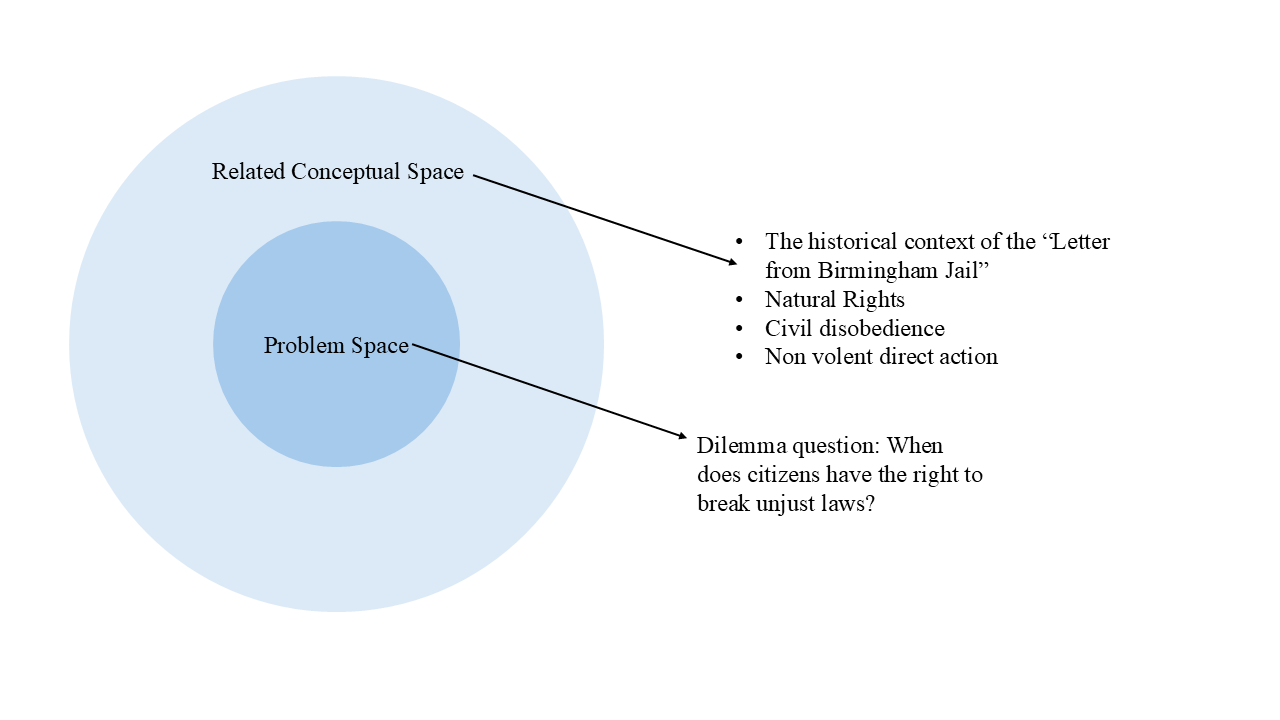
The history unit was a PBL lesson on civil rights. While the students were tackling the issue of civil disobedience throughout the semester, the problem space of this unit was framed as the specific question: ‘When do citizens have a right and responsibility to break unjust laws?’ To address this problem, the teacher used Martin Luther King’s Letter from the Birmingham Jail as a prompt to bridge the gap between reality and abstract reasoning, and conducted the PBL tutorial in a Socratic seminar format.
The success of a student’s engagement in a PBL tutorial depends on the student’s prior knowledge of the learning issues and prior experience with the PBL format. To address this reality, the teacher first conducted a mini-lesson on the concepts of civil disobedience, nonviolent direct action, and citizens’ natural rights. And then the teacher dived into the Socratic seminar.
Students were assigned readings before class and given three questions related to the specific reading excerpt. Students were required to consider their own answers to the interpretive questions before engaging in the Socratic seminar, since the seminar format would ask them to share their thinking about the key concepts embedded in the questions. Students were also required to answer one evaluative question that asked them to express their understanding of the idea, its advantages, and related moral issues. More importantly, since students were expected to expand their understanding of the text through the Socratic seminar, they were required to quote directly from the assigned reading when presenting their arguments. The problem space and related conceptual space for the history unit are presented in Figure 1.
Figure 1
Problem Space of History Unit
The robotics class was designed to introduce the engineering design process through students’ hands-on experience solving a client-defined design problem. The unit was structured with incremental stages. First, the students were introduced to the type of problem they needed to solve. Next, the group was given some time to explore what it is like to build a robot, during which the learning issues were identified. Next, a mini-lecture on the engineering design process was delivered, focusing on mapping and storyboarding. This followed a phase of client presentation, before which students were given time to prepare. The last phase of this unit was the whole-class discussion, during which the groups presented the artifacts they developed to the class. The format of this specific unit could be summarized to align with the following protocol: Introduction of the problem – Exploration of the problem space – Design and development of the prototype – Presentation to the Client – Whole class discussion
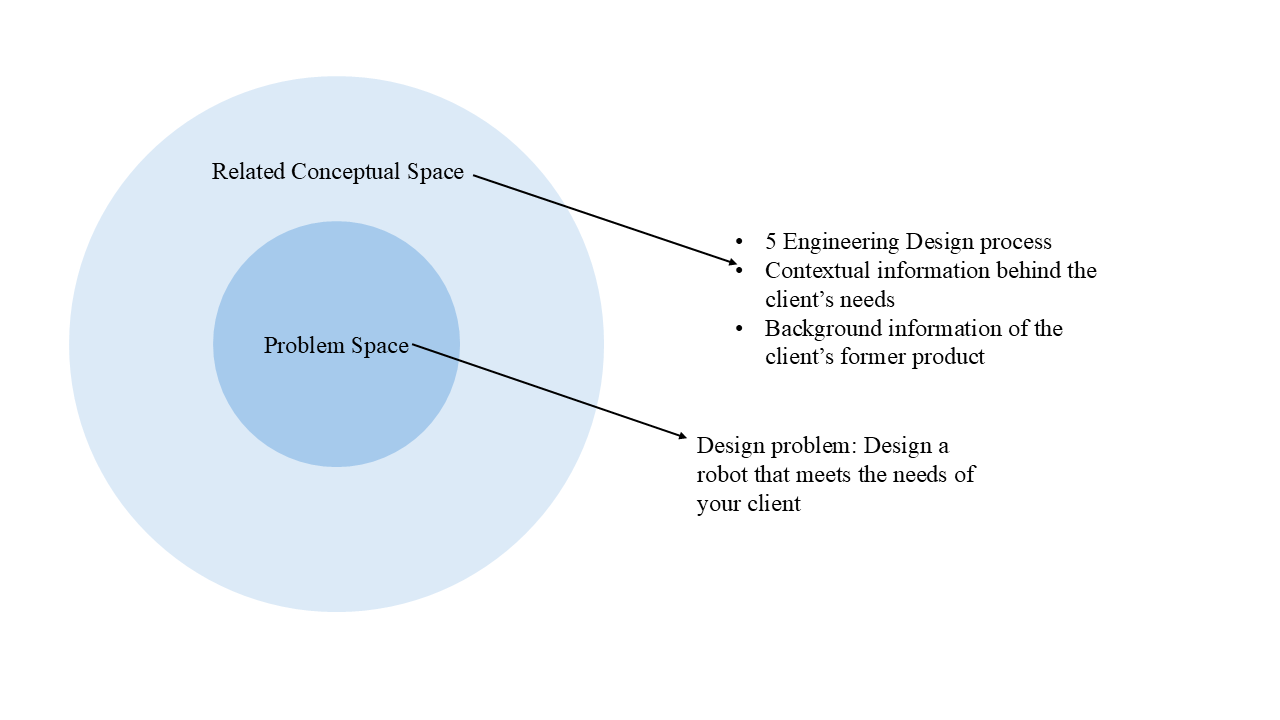
The robotics unit began with a whole-class discussion in which the teacher introduced the group norms and the potential difficulties of working together, as well as effective solutions for getting along. After introducing the group norms through explicit hard scaffolds, the teacher next introduced the problem space in general: “designing robots to help the clients in the challenges that they face.” Each group was given discretion to match themselves with the client they wanted to work with, during which the students were able to understand the parameters and the constraints of the problem they selected. Then, students engaged in iterative rounds of group discussion to hone in on the specific design problem, ultimately aiming to present the prototype they developed to the clients. The problem of space and related conceptual space is presented in Figure 2.
Figure 2
Problem Space of the Robotics Unit
Unlike the corresponding robotics unit, which is highly structured, the history unit follows the format of a Socratic seminar. Thus, the following findings examine how diverse components are distributed throughout the unit to achieve a specific goal.
One of the unit's instructional objectives was to help students become familiar with how the Socratic Seminar works. To meet this objective of preparing students for the classroom norm of the Socratic seminar, the instructor employs distributed scaffolding by utilizing different forms of guidance dispersed throughout each stage of the tutorial.
The very first step in the history unit was for the teacher to go over the class rules and the group guidelines for participating in the Socratic seminar. The teacher asks, “What is the rule of the discussion?” Students answer with “Don’t raise hands.” This is again followed by the teacher asking, “Why is that important?” By going through the guidelines of this discussion method one by one and, more importantly, by asking follow-up questions about why each guideline is important, this approach implicitly provides a hard scaffold that helps students internalize the rules of the discussion. The group seems to be on board with the rules and guidelines of the Socratic seminar, since they go around in circles to present their answers to the question without raising their hands and waiting for the teacher to call one out.
Another important scaffold employed to maintain the basic norm and structure of the Socratic seminar unit was the teacher’s drawings and notes. This hard scaffold is a pen-and-paper drawing of a circle with the students’ names on it, so that the teacher can keep track of which points each individual has made and whether everyone is getting a chance to participate. For example, at one point in the instruction, the teacher explicitly designates a student who hasn’t spoken so far to answer the question. So, this scaffold could be understood as a soft scaffold for managing the group dynamic and ensuring that every student contributes to the seminar. The teacher also intervenes at times to address overlapping talk, saying, “Paula, let Lisa speak for a second,” when the teacher decides to give a student who has not been very active in the discussion a turn.
An additional hard scaffold that plays an important role in sustaining the makings of the Socratic seminar is the worksheet, referred to as the ‘ticket’ in this case, which students are assigned to complete beforehand. The worksheet introduces students to the main point of discussion and, more importantly, serves as a guiding light to expand their knowledge of the problem space. This is a good example of how a student worksheet itself can function as an implicit hard scaffold, and how the later questions relate to and even facilitate further in situ discussion, ultimately resulting in the practice of synergistic scaffolding.
After the critical discussion, an evaluation was also done as a whole group in a seminar format. The teacher led the very last minutes of the lesson by presenting an explicit hard scaffold: “Did we achieve our goal of enlarging the understanding of our learning objective?” The teacher also fostered a higher level of meta-evaluation of the course design and the Socratic Seminar itself, not only focusing on evaluating individual students’ learning progress by asking, “Did you observe anything about the seminar that you would like me to know for the next time we do this?”
The next objective of the unit was to expand students’ understanding of the given text, “Letters from Birmingham Jail”. Scaffolds are distributed to accomplish this goal mainly through interpretive questions. After solidifying the group rules and rules for the Socratic seminar, the teacher next goes on to introduce the first interpretive problem to the classroom by asking “What did Dr. King wanted to accomplish through the letter?” The question was not designed to guide students to jump right into the center of the problem at hand, but this is intended to trigger deeper thoughts and comprehension of the given text. One student gives an answer to the very first question by saying:
"It seems like he is shaming everyone. He is putting out all the facts, and he is shaming everyone who is acting against what he is doing, because he is talking from a very religious standpoint. And he is making people feel bad by pointing out the church has been opposed to all the great things and great morals that he has been fighting for."
This response elicits another form of soft, implicit scaffold. The teacher then asks, “Does he shame only the ones who were against him, but also the ones who have been sitting on the sidelines?” This scaffold introduced another important concept in the history of civil rights: the notion of ‘guilty bystanders’ and the unit's core concept, ‘right for civil disobedience’. After a while of student discussion, the teacher also asks, “How does Dr. King distinguish between just and unjust laws that people have an obligation to break?” These questions consequently sparked another layer of discussion where the students went deeper into the question of if the bystanders are actually guilty or not. The teacher reports in the post-interview that she deliberately chose to intervene in the ongoing group discussion and decided to jump into the student group dynamic with a follow-up question because she felt it was necessary to take the discussion much deeper. The synergistic effect of the teacher’s initiating hard scaffold and the subsequent soft scaffolds, deliberately and in a timely manner provided to students, generates a collective learning impact that expands students’ understanding of the given text. One scaffold organically led to another point of discussion, and another scaffold helped create a student-supportive learning environment.
The third goal that overarches the instruction is to expand students’ knowledge of related conceptual ideas. This goal is also achieved through the instructor distributing varying forms of scaffolds throughout the unit. Due to the nature of the Socratic seminar, a good deal of soft scaffolding is used to flexibly adapt to the dynamics of the ongoing discussion, but among the different types of soft scaffolding, the most prominent example that fulfills this objective was the teacher's summary of the group discussion. At the end of each interpretive ticket question session, the teacher actively wraps up the discussion by summarizing the students' main points and connecting them to the reading. For example, the teacher says:
“So I am going to summarize where we are right now, and if any of you guys have other things that I didn’t touch upon, please jump in. This letter shows there is a purpose for nonviolent direct action, and that this is not random. He wanted to describe realities of what was happening without overstating and he wanted to reach a wider audience and show the people that he is coming from a religious standpoint; He is also shaming people who are doing nothing.”
The summary is delivered over 2 minutes, and the teacher actively refers to the notes she has been taking on the piece of paper to ensure she reviews every point the students make. She also uses body movements, such as pointing to the student who made a particular point while rephrasing that argument in the summary. This summary, delivered by the teacher, helps students revisit the important theoretical concepts of the Civil Rights movement. It also reconstructs their knowledge by reframing what they have discussed through a new lens, further expanding their understanding of the related conceptual space.
Another critical, differentiated scaffold that fulfills the third instructional objective is the use of clarifying questions as a soft, explicit scaffold. At some point of the instruction, when one student mentions ‘a status of things’, the teacher then asks a follow-up clarifying question by asking “So what do you think he means by that?” This clarifying question sparked students to share their idea of what an unjust law might look like. Students produced answers such as “I think that unjust law doesn’t follow in line with the constitution according to paragraph 16,” and “So you are oppressing helpless people who can’t do anything to help themselves. An unjust law is when people are forced upon it and are not given any other options.” This discussion culminates in one student mentioning the gist of just and unjust law by saying, “People have the moral responsibility to follow just laws just as much as they have the moral responsibility and right to disobey unjust laws, just to think about what you are doing and not following the masses.” As the teacher determined that students had a good understanding of what just and unjust laws are, she posed another question that shifted the discussion: “What does it (the text) say about the applications of law?” This is also a part of a synergistic scaffold that helps students expand their understanding of the next and build their knowledge towards natural rights and civil disobedience. This is also a soft implicit scaffold in that the teacher did not provide direct information on how unjust law is applied, but generated discussion so that the students could find information in the text themselves. The teacher then again uses a summarizing question to recap what she has just heard about this by saying:
“This moves us to question 3, I am going to recap two things that I heard. One has the moral responsibility to break unjust laws, and the right thing to do is not always legal and not always sanctioned by people. So why does he (Dr. King) believe that breaking the unjust laws should be openly, lovingly, with the acceptance of the consequences?”
The learning objective of this Socratic seminar was, on the surface, understanding the concept of civil disobedience, and this was achieved through students trying to solve a dilemma problem: “When do people have a right to break laws?” and “Where should we draw the line to determine what is unjust?” Because these were dilemma questions, the relevant content space could be very broad, sometimes leaving students confused and overwhelmed. However, to remedy this situation, the teacher limited the relevant content to Dr. King’s letter from the Birmingham Jail, and, from this constraint, students were able to develop and articulate their ideas based on a limited body of contextual evidence. Also, the summaries provided by the teacher at the end of every round of discussion and the timely soft scaffolds synergized to create a collective impact in assisting students in broadening their understanding of the related historical concepts.
The middle school robotics unit ultimately guided students in designing a robot prototype and presenting it to clients. The lesson was planned around the following sequence of stages: Introduction of the problem – Exploration of the problem space – Design and development of the prototype – Presentation to the Client – Whole-class discussion. While the instructor and the researcher in the video were successful in providing relevant scaffolds at the right moment during each stage, the following analysis organizes how different scaffolds interacted both within each stage and between stages, ultimately creating a system of distributed scaffolding.
The group activity phase of the robotics unit was designed to align with the core principles for successful collaborative learning. During the first phase, ‘Introduction of the Problem’, the importance of group dynamics was made explicit by the teacher when she said:
“You are going to have to depend on your other group members. And if you are not working in a group, you are not going to be successful in making your robot. This is a class designed for you to cooperate with one another and have more minds come together so that you can make decisions. Everything that has to be done in a group has to be positive, so ignoring people and being rude to other people is not a positive work environment.”
During the second stage of the tutorial ‘Exploration of the problem space’, students started the group work tutorial to investigate their problem space and explore the conditions and constraints. The beginning of the group work phase also involves planning as a group. However, the teacher discovered that one group was having behavioral issues and difficulty reaching a consensus. The teacher then intervenes with a soft scaffold and an explicit scaffold to guide students on what they need to do to be successful and collaborative as a group. As a result of this scaffold, the group was able to share their ideas with each other and reach actual unanimity.
0:00 “Look at me” (students still not responding for 10 seconds, background chattering going on, students’ fixed on the computer screen)
0:10 “I want you guys to look at me.”
0:12 – 0:40 “Your group was not working well because you were not sharing ideas very well. She (one of the group members) was very eager to get started but it wasn’t flowing for her, so I moved her so that she can advance to where she wants to be.”
0:50 – 0:55 “What I want you to do is decide on what robot you want to work on. I do want you to take this part seriously. So, keep yourself motivated and do this work.”
1:01- 1: 31 (Students talking to the teacher and pointing to the screen to show her what the group has done)
1:35 “Okay wait, who is the leader?”
During the third stage, ‘Design and Development of the Prototype’, the teacher introduced students to the practice of storyboarding. At this stage, another form of distributed scaffolding was introduced, focusing mainly on constructive group work. The teacher said, “But before you start doing the drawing and writing, you need to converse with everybody in your group to make sure everybody agrees on the idea.” and “Everyone should be contributing like the map, everyone’s voice should be heard.” During the same phase, distributed scaffolding on controlling the group dynamic also occurred with the question, “You guys need to have an idea of who is doing what.” This was followed by students reporting their respective roles in the group, such as “I am doing coding,” and “I think I am going to work more on design.” When one student problematized the group work, “They didn’t do a thing,” the teacher tried to manage this type of frustration through soft scaffolds: “Do you guys want to work on what you have been doing last time and give the people updates to it?”
Having students in a functioning group and ensuring that no one is left out is essential to students reaching the ultimate goal of developing a robot artifact. However, facilitating successful group work can sometimes be challenging when some students are unwilling to collaborate. To address this issue and achieve the objective of managing the productive classroom culture, the instructor employed various scaffolds in different forms. These distributed scaffolds stretched across the three phases of the unit, creating a synergistic effect greater than that of the individual scaffolds.
During the second phase, ‘Exploration of the problem space’, a good deal of scaffolding was provided to students to initiate the earliest stages of the learning process. The classroom seemed to have some students exhibiting behavioral issues, and the instructor noticed that, in some groups, unproductive work was occurring. Therefore, during this phase, the teacher provided the whole class with a hard scaffold with direct instructions such as: “I want you to think about what the robot should be able to do for the client to do what they want. Also, think about whether you want to work with this client, why or why not, and what ideas you have for that client.”
This second phase of instruction was also heavily scaffolded, as the teacher provided students with ideas (worked examples) for possible design problems. The worked examples presented in the teacher discourse were effective at jump-starting the performance of a relatively lagging, unmotivated group. For example, the teacher said:
“We don’t have that at junior high, so a robot that could provide a video feed would be very helpful to allow the police to have access to the building in an emergency situation. In an emergency situation, what the police need is an eye; they need to be able to see what is happening at school so that they can respond quickly and appropriately, they were thinking about drones that would fly above schools, but in our case, they would be rolling instead of flying. So that is a concern, a possible need that could be filled.”
Another component of the distributed scaffold that helped the teacher achieve the goal of initiating student learning was the teacher's direct intervention in the group’s computer workspace to get things going. During the third phase, ‘Design and development of the prototype’, the teacher works with the student’s computer to direct them to the page where they should be working. And during this phase, students sorted out the problem they were having with their Chromebooks and started writing on their worksheets.
4:55 Teacher: “So what do you think your robot should have to.. What features should it have to have, or what would it need to do to help people in a building in case of an emergency?”
5:10 Student: “Ummm, I don’t know. We haven’t’ really decided on what robot we want to, well actually we did, but she had all this information.”
5:20 Teacher: “Okay, so do you guys first want to have that conversation and then fill this worksheet out?”
5:22 Student: “Yes. Probably.”
5:24 Student to the group: “What kind of robot do you guys want to make?”
5:34 – 6:29 small group discussion goes on to decide what robot the group will be working on, and the teacher notices that the group came to an agreement to change the group project to a different direction from the initial idea.
Hard scaffold, soft scaffold, and the teacher directly intervening in the problematic situation in which students were experiencing a stalemate were observed during the second and third phases of the unit. Distributed scaffolds in various forms were employed to ensure that students could initiate their projects and get their work moving in a certain direction.
A scaffold that encourages students to sustain motivation towards their ongoing work was also provided through multiple components. The components of the distributed scaffold that achieve this specific objective were mainly discovered during the third phase, ‘Design and Development of the prototype’. Distributed scaffolds that met this goal were mostly soft scaffolds, flexibly and adaptively administered. On the other hand, explicit scaffolds that give students direct guidance on what to do next and implicit scaffolds that only hint at hidden cues are combined to generate a synergistic effect.
0:26 – 1:22 Teacher: “Do you think your client will really need this robot? Do you think the students need to have an emotional connection to the robot? Or do you think they will going to get in the way? So that is one thing that you need to think about.”
1:30 – 2:08 Teacher: “So will your robot have to have any emotional attention to the people using it, or do you think the robot should just give out information to the kid? Why or why not? So, what was your idea?”
2:08 – 2:20 (Students answering the question)
2:44 –3:01 Teacher: “Next, then think about what the robot should have on it, in order to make a connection so that the students would be emotionally connected, what features is it going to have?”
3:58 – 4:02 Teacher: “So is that a feature you think the robot needs to have?”
4:02 – 4:30 (Students responding to the scaffold by adding different elements on their work)
During the fourth stage of the unit ‘Client presentation’, the group presented their idea of a robot through presentation materials such as maps and storyboards. The group presented their ideas to the client and received constructive feedback on refining their artifact, followed by a brief opportunity to ask the client questions. This step was for the group to prepare for the final presentation by practicing their presentation skills and perfecting what they already had with feedback from the professional. After the client presentation, the class also has time to prepare for its final presentation. Distributed scaffolding to maintain and enhance students’ ongoing work also takes place here, as the teacher subtly introduces ways to make the presentation more convincing and professional. She says, “What are you going to say to your clients when you push the button, but nothing seems to be working?” This question was designed to prompt students to develop additional plans and ideas to defend their artifact during their whole-group presentation, thereby helping them stay on track with their ongoing work.
One of the critical conceptual frameworks and theories that the students were expected to master was the design cycle. The engineering design cycle was first introduced through direct instruction in a mini lesson during the third phase, ‘Design and Development of a prototype’. Then the specific aspects of this design cycle were broken down into smaller parts and addressed through hands-on activities, demonstrating how distributed scaffolding comes into play. The teacher introduced another important aspect of engineering design: mapping. From the video incidents, it was clear that the teacher wanted not only for the students to successfully build a specific robot to meet their goal, but also for them to gain sufficient professional knowledge of the design and production process of an artifact. This learning goal was demonstrated and made explicit when the teacher introduced the concept of ‘mapping’ to the entire class. After students worked in groups to develop ideas for a robot they wanted to build, the teacher spent 3 minutes explaining to the whole class what mapping is. This was delivered with one of the artifacts that the student group made. To introduce this topic, soft scaffolds such as “how might mapping be important for what we are trying to do with our clients? How might this mapping be useful for design ideas that we want to communicate with our clients?” and “What features should your map include?” were implemented.
The important concept of mapping was conveyed directly with the instruction: “We should make sure that when we do our maps, we should be giving as much detail as possible so we deliver as much of what we are thinking to our clients.” During this mini lecture, the whole class was given grid paper to make a map of their thinking. Another important design concept, ‘storyboarding’ was also directly introduced by the researcher, and the students were asked to produce two types of storyboards: one that is used to perceive and communicate what the problem is by mapping out a scenario, and another one that shows how they are going to design a solution to solve the problem.
There were some cases where the teacher did not give the group explicit guidance on the next step of their work, but some scaffolds were given to foster deeper thought and to connect students to the related content space related to the engineering concept:
4:48 Teacher: “Why did the light work then?”
5:34 Teacher: “So what is so weird is that the light is not coming out on this side, but it is on the side you are working. So why would the light come up if the other won’t?”
5:42 – 6:00 (Students responding to the question by explaining positive negative charges)
This exercise, in which students connect their hands-on project to conceptual ideas, demonstrates that problem-based learning is not only effective for applying knowledge and solving real-world problems but also beneficial for deeper conceptual understanding. Also, the various ways the teacher introduces important core concepts, both related to engineering design theory and foundational engineering knowledge, reveal how different types of scaffolds work together to produce a synergistic effect that facilitates students’ deeper understanding of the core concepts and key knowledge.
Scaffolds that encourage students’ metacognitive thinking and self-reflection were also provided during the last phase of the unit, ‘Whole group discussion.’ The teacher showed students the video of themselves presenting to the client and asked questions such as “What do you think you could have done better?”, and “What can you do a little bit differently to show them that you guys are really interested?”
Distributed scaffolds on students’ metacognitive thoughts were also provided in the form of explicit, hard scaffolds. During the last phase, the teacher took notes on the whole-class group presentation. And when encountering one group, she read through the paper to give explicit feedback on one group member's contribution to his last presentation, saying, “Aiden is being professional in this, using eye contact and resources to present his ideas, providing reasoning behind his decision-making.” When the student questions how he was being professional, the teacher adds, “You were able to give reasoning behind your choices of coding, your design, and why you made your choices you did.” This explicit guidance and focus on helping students objectively evaluate their work prompted the group to think metacognitively and to judge and evaluate what they did well and what they did not. While the distribution of scaffolds meeting this end was comparatively limited compared to other goals, the combination of hard and soft scaffolds resulted in a classroom climate that valued metacognitive thinking.
This study underscores the vital role of scaffolding in project-based learning (PBL), demonstrating how the distribution of timely, contextually relevant scaffolds can enhance students' ability to engage in deeper research and critical exploration through their synergistic effect. By analyzing videos of classroom interactions in both history and robotics lessons, this research highlights the complex and synergistic effects of different types of scaffolding in real-world PBL settings. The findings emphasize the importance of a distributed scaffolding system, where various forms of support work together to help students perform at levels closer to those of experts. Through this empirical investigation, the study provides valuable insights into the practical application of scaffolding and offers guidance for PBL instructors. Ultimately, the research aims to improve teaching strategies and optimize the learning experience for students, ensuring that scaffolding practices are effectively tailored to enhance both individual and collaborative learning in PBL environments.
 EdTech Archives