Learning can take place in multicultural environments, where learners’ home culture can frame and shape their learning experience, engagement, and success (Gay, 2018). Yet many mainstream design models, such as ADDIE or Gagné’s Nine Events, offer little guidance on operationalizing and integrating multiculturalism (Heaster‑Ekholm, 2020). When home culture and multicultural perspectives are neglected, learners’ motivation, self‑regulation, and ultimately achievement can be impacted (Gay, 2018). Several decades of scholarship on culturally responsive pedagogy (CRP) and self-regulated learning (SRL) theory have found that integrating aspects of a learner's home culture and focusing on facilitating and fostering classroom agency can help mitigate learning risks (Ladson‑Billings, 1995; Zimmerman, 2000). However, these frameworks, along with many notable instructional design frameworks, do not always translate multicultural integration into actionable processes or steps. This gap may pose challenges for instructional designers less familiar with international or multicultural learning contexts. Consequently, instructional designers may benefit from a framework that synthesizes existing theories (e.g., CRP, SRL, iterative ID) and centers on culture while remaining flexible to support numerous learning experiences.
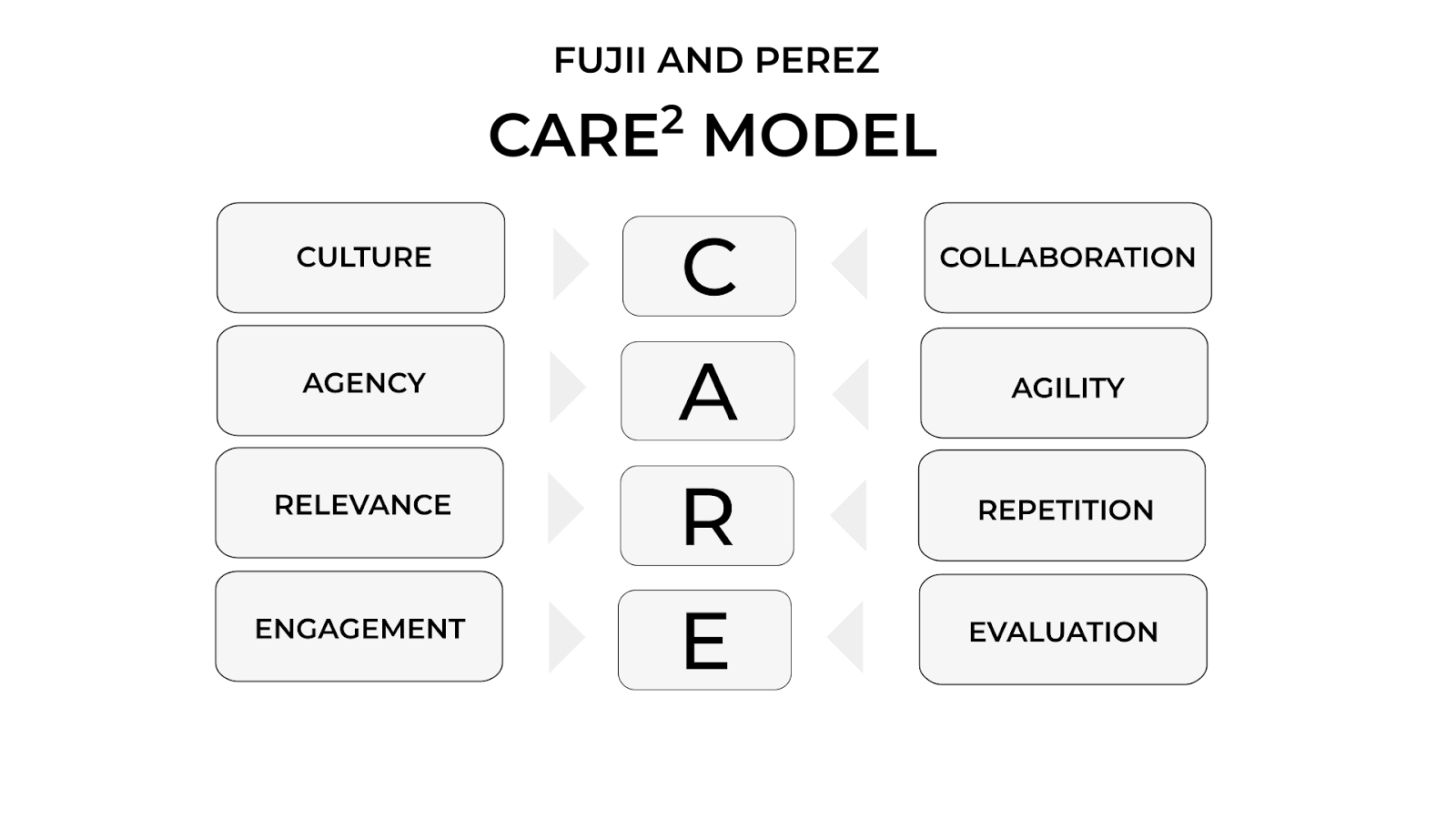
To address this need, this study introduces the CARE2 model as a practitioner-oriented framework to guide culturally responsive instructional design. The CARE2 model is designed to be practical and flexible, grounded in instructional design literature and informed by a single case study. The model integrates key concepts from the Culturally Responsive Pedagogy (CRP), Self-Regulated Learning (SLR), and iterative design theories. It is organized by four dyads and eight interdependent constructs, including: (C) Culture & Collaboration, (A) Agency & Agility, (R) Relevance & Repetition, and (E) Engagement & Evaluation (refer to Figure 1).
Figure 1.
The Fujii & Perez CARE2 Model
To support the introduction of the model, starts by highlighting relevant literature on culture, learning, and instructional design. We then present a case study that illustrates the model in action, showing how it can be applied to support the needs of international and multicultural learners. Based on this example, we provide recommendations to help instructional designers build their own cultural competence to integrate the CARE2 model into their practice. The article concludes with implications for future research and recommendations for model development.
Culture is conceptualized as a dynamic, multilayered construct encompassing learners’ home cultures, host/national cultures, and the emergent global classroom culture (Leung, Ang, & Tan, 2014). Many factors can influence international students attempting to learn in a host country, and we view culture as a core factor. For instance, international students face the task of assimilating into new cultural environments, which might not always be an easy transition (Hofstede, 2021). Global learners who are less familiar with the culture of their higher education institution might struggle to learn non-instructional classroom elements that extend beyond course content. These may include new cultural processes, such as external cultural values and social norms, as well as internal classroom culture expectations (Sharif & Gisbert, 2015). Aside from learning and adjusting to environmental and cultural norms, language, which is closely connected to culture, can pose another layer of challenges or barriers to overcome for international learners when attempting to engage in activities such as comprehending course lectures, engaging in classroom discussions, and communicating their understanding of course material (Andrade, 2006).
For international learners, learning culture includes not only intimate knowledge of classroom oral or written communication (Paige, Jorstad, Siaya, Klein, Colby, Lange, & Paige, 2003) but also social interaction (Andrade, 2006), negotiation of classroom behavior or etiquette norms (Mori, 2003), external cultural norms, (Yeh & Inose, 2003), among other factors. Since international learners can experience challenges between home and host cultures, instructional designers should determine how to support this learner population.
Research on international learners and culture within the instructional design context primarily focuses on relationship-building. In Gay’s (2010) canonical work on culturally relevant pedagogy, she argues that integrating activities that foster meaningful connections in the classroom is key. Gay’s study suggests that incorporating relationship-building activities can help develop sociopolitical consciousness, aiding learners' understanding of broader social or political contexts that may affect their lives.
While some research has been conducted on international learners, culture, and instructional design, these studies primarily offer strategies for classroom activities. Still, there is less guidance on integrating or addressing culture from an instructional designer lens. How should instructional designers account for international learners' needs when designing instructional design processes? While not addressing international learners per se, Cook-Sather (2006) argued that one of the most responsive ways instructional designers can create learning experiences is through learners' voices and agency.
By engaging with learners and gaining a more profound, richer sense of how they perceive their educational experiences, Cook-Sather (2006) argued that designers could produce materials that yield the most excellent value for learners. In a different study, Tran (2013) examined how international learners can experience transformative learning as they navigate cultural and educational transitions in new environments. Tran (2013) argued that instructional designers can support learners' transition process by integrating strategies that allow them to reflect and share their cultural experiences, explore alternative or different worldviews, and encourage them to integrate their identities into their learning experiences.
In a different study, Leask (2015) found that incorporating instructional technologies to facilitate learners’ critical reflection of their cultural assumptions and biases is vital for promoting intercultural understanding of domestic and international ways of being, thereby enhancing global competencies. While integrating learners' voices and agency, along with critical domestic and international reflection and discussion, are seemingly valuable classroom activities, there is a lack of design-based frameworks that illustrate how instructional designers can systematically build learning experiences for international learners and multicultural learning environments (Cook-Sather, 2006).
Studies focused on international learners, culture, and instructional design reinforce the idea that culture is essential but can also serve as a barrier to learning outcomes. Most instructional design frameworks emphasize the importance of “knowing your learners” to help designers make informed, purposeful instructional design choices that support compelling learning experiences. However, we argue that when designing learning experiences for a global learner population, instructional designers must not only “know their learners” (Perez, 2024) but also “know their cultures.” We believe that integrating culture as a core element in an instructional design framework can support international learners’ experiences and better help learners adjust to new cultural environments.
The CARE2 model builds upon cultural-centered frameworks, like the Culturally Sustaining Instructional Design model (CSID; Smith & Staudt Willet, 2023), but extends them in three ways: 1) by defining and integrating culture across three levels: national, institutional, and emergent classroom cultures, 2) by emphasizing to importance of instructional agility, and 3) by integrating intentional spacing and repetition to support durable learning. The CARE2 model contains four dyads and eight interdependent constructs, as shown in Table 1.
Although the CARE2 model synthesizes several theoretical principles and offers insight into culturally responsive instructional design, it is essential to operationalize culture, as it is a key concept within the model and this study. Using Hofstede’s (2021) definition of culture, this study defines culture as shared values, beliefs, practices, and norms that shape how people interpret and engage in the world. However, within the context of learning, this study defines a learning culture across three levels: a learner’s home culture, shaped by their traditions and former experiences (Gay, 2018); an institution's national culture, shaped by the wider social and educational norms of an institution (Hofstede et al., 2021); and, a classroom’s culture, shaped by the integration of diverse backgrounds to create new and shared global understanding (Deardorff, 2009). The following section presents a single case study to demonstrate the model’s use in supporting international learners.
Table 1
The CARE2 Model Details
Dyads | Constructs | Details |
C | Culture | Integrates learners’ home culture and local examples (Gay, 2018) |
Collaboration | Builds community norms with respect and shared authority (Ladson‑Billings, 1995) | |
A | Agency | Positions learners as knowledge contributors and values cultural knowledge (Ladson‑Billings, 1995) |
Agility | Responsive teaching respects learner needs and perspectives (Gay, 2018) | |
R | Relevance | Uses culturally familiar examples to scaffold abstract concepts (Gay, 2018) |
Repetition | Revisits concepts and examples across modules (Ghazi-Saidi & Ansaldo, 2017) | |
E | Engagement | Employs appropriate humor and storytelling to build rapport (Neff & Dewaele, 2023) |
Evaluation | Invites learner voices in assessing learning experience, while also evaluating learner knowledge (Cook-Sather, 2006) |
This section demonstrates how the CARE2 model was implemented in a first‑year marketing course at a private business college in Copenhagen, Denmark. The study is a single-site case study that highlights lessons learned from applying the CARE2 model. We also issue suggestions for designers to build skills that develop their multicultural competence.
A private business college in Copenhagen, Denmark, provides instructors with a U.K.-accredited curriculum. The curriculum, based on the U.K. culture, is taught to an entirely international learner population from Nepal, Bangladesh, and India. While the curriculum is rich in marketing concepts, it was developed for U.K. learners and implemented without adaptation to the Copenhagen context or international learner cultures.
Instructors observed that many of the 240 first-year students struggled to connect with the materials, particularly with case studies focused on U.K. brands. In addition, other challenges observed included digital literacy and communication challenges. Despite their diverse strengths, learners demonstrated low engagement with course concepts and uneven performance on assessments.
The core design challenge faced by the instructor was determining which revisions to a prefabricated curriculum would best support international learners in achieving course competencies.
Multiple feedback mechanisms were embedded in the course to identify learners' pain points better. Tools used to obtain feedback and insight from learners included: Kahoot quizzes captured recall and conceptual understanding; Padlet provided anonymous learner reflections and critiques; instructor observations tracked engagement patterns and classroom dynamics; institutional surveys offered summative evaluation of satisfaction and learning outcomes. The tools enabled continuous iteration during the course rather than waiting until the end to make adjustments.
Within the first few weeks, four key “pain points” were identified from learner feedback. The learner feedback included the following:
Misaligned technological literacy expectations
Limited interest in marketing concepts
Low engagement within the classroom; lack of collaborative activities
Lack of familiarity with U.K. brand examples
Wide variation in communication proficiency
Once the insights were identified, the CARE2 model was used as a guiding framework to connect the observed challenges with responsive design solutions.
Multiple strategies were used to implement the CARE2 Model. To implement the model, observed challenges were identified and linked to each dyad and instructional techniques. Table 2 details the challenges and strategies used to implement the CARE2 model.
Table 2
CARE2 Model Implementation
CARE2 Constructs | Observed Challenges | Instructional Strategies Implemented |
Culture | Learners struggled to connect with U.K. brand case studies | Replaced U.K.-focused examples with culturally familiar brands (Nepal, Bangladesh, India) and added global case studies; encouraged learners to share consumer practices from their home cultures |
Collaboration | Learners tended to work in isolation; limited cross-cultural peer learning | Designed peer-to-peer tasks (case discussions, group projects); encouraged learner-instructor partnerships; facilitated collaborative problem-solving |
Agency | Learners showed low confidence and limited autonomy | Gave learners choice in project focus; enabled anonymous Padlet reflections; fostered mutual respect in class dialogue |
Agility | Prefabricated curriculum did not align with learner needs | Iterative weekly redesign of lessons; scaffolded digital skill-building; adapted tasks in response to immediate feedback |
Relevance | Marketing concepts felt abstract and disconnected from learner realities | Localized cases and examples; tied theories to social and cultural contexts; connected marketing ideas to learners' lived experiences |
Repetition | Learners struggled with longer-term retention of key ideas | Implemented spaced repetition (weekly reviews, Kahoot, iterative application of cases); reinforced core concepts across activities |
Engagement | Participation and critical thinking were limited at the start | Used interactive tools (Kahoot, Padlet); integrated humor; designed small-group collaboration activities |
Evaluation | Limited insights into ongoing learning challenges | Embedded formative assessments; analyzed institutional surveys; captured observational notes; triangulated multiple data sources |
Two types of data-collection approaches were deployed to gain insight into the learning
experience revisions: observations and summative final exams. The results are presented in the following sections.
After the curriculum revisions were implemented, instructor observations were conducted, followed by the collection of qualitative data from learner feedback via Padlet. The observations revealed eight core themes, each with several sub-themes. The themes, sub-themes, and details are found in Table 3.
Table 3
Observation Themes and Sub-Themes
Themes | Sub-Themes | Details |
Cultural Context | Learner’s home culture | Learners’ backgrounds shape expectations, behavior, and navigation of new national cultures. Instruction that integrates home culture supports learning |
Institution’s national culture | Recognition that the host country norms and institutional expectations may differ from learner's home culture | |
Classroom as global culture | An emergent multicultural classroom emerged that integrates institution and learner cultures | |
Collaborative Learning | Learner-to-learner partnership | Peer interactions support problem-solving, deeper relationships, and a positive global classroom culture |
Instructor-to-learner partnership | Instructor guidance fosters trust and productive collaboration | |
Collaboration as a process & outcome | Collaboration is continuous and can result in meaningful co-learning | |
Learner Empowerment | Behavioral self-management | Clear ground rules and agreed-upon consequences promote autonomy and engagement among learners |
Social knowledge & engagement | Awareness of classroom norms can enhance learner participation | |
Mutual respect and trust | Support for learner confidence can foster classroom community | |
Adaptive Instruction | Instructor modification of learning | Flexibility in methods and content addresses learners’ evolving needs is important to learning |
Observation & instructional iteration | Continuous monitoring of the learning experience enables responsive adjustments | |
Meaningful Learning | Socially/culturally familiar content | Connecting content to learners’ experiences helps engagement and learning interest/motivation |
Learner co-creation | Involving learners in content creation helps with learner participation and peer-to-peer support and connection | |
Content Repetition | Material spacing & repetition | Spacing and revisiting content helps with concept recognition |
Active Engagement | Learner behavior | Direct involvement with peers and activities can enhance learning |
Instructor engagement & humor | Feedback, facilitation, and humor can foster enjoyable and interactive learning | |
Continuous Improvement | Eliciting feedback | Early and ongoing feedback identifies areas for improvement and guides content revision |
At the end of the semester, two core assessments were used to measure learner performance and were compared across all first-year marketing courses. All courses used the same prefabricated curriculum. The CARE2 model served as the intervention group, as its course was the only one designed according to the model’s principles. In contrast, two other marketing courses were taught without using the CARE2 model and used the conventional prefabricated curriculum with lecture-driven instruction. While the groups covered identical content and shared the same learning objectives, the control courses were taught by different instructors, allowing a comparison between the CARE2 model and traditionally taught cohorts.
Learners across all courses were given the same two final assessments. The analysis of final assessment results showed significant differences among groups (Kruskal-Wallis H = 29.4941, p < 0.0001). Since the two control groups violated normality assumptions (Shapiro-Wilk: M, p = 0.0045; B, p = 0.0050), non-parametric tests were used, with parametric analyses confirming the same pattern of results. The CARE2 group significantly outperformed both control groups (Mann-Whitney U: p < 0.0001), with large effect sizes (Cohen’s d = 0.71 and 0.75). On average, CARE2 students scored 15–16% higher (M = 67.79, SD = 12.71) than the Control 1 (M = 59.21, SD = 11.33) and Control 2 (M = 58.26, SD = 12.53) groups. Notably, the two control groups showed no significant difference between them (p = 0.2823; Cohen’s d = 0.08), despite being taught by different instructors. The results suggest that learners in the CARE2 intervention group demonstrated higher learning competency levels than those in the control group.
Overall, the results from classroom observations and the final summative exams complement each other and suggest the benefits of using the CARE2 model when designing for multicultural audiences. While the study focused on a single case study, its lessons might be valuable to a broader design audience. In all, the results suggest that promoting and preparing designers for cross-cultural learning experiences can support international or multicultural learners.
While the CARE2 model offers a framework for responsive instructional design, particularly within cross-cultural contexts, the case study revealed that cross-cultural learning experiences rely on a designer’s ability to design for broader audiences. However, this may pose challenges for instructional designers who typically design for specific institutional or regional contexts and may lack experience in developing international or multicultural learning experiences. Without adequate preparation and an understanding of deeper cultural nuances, designers risk creating learning experiences that might hinder optimal learning opportunities. To address this potential gap, we present strategies to support designers' cultural competence (see Table 4).
Table 4
Strategies to Support Designer Cultural Competence
Strategy | Details |
Collaborate with Cultural Insiders | Educators, broadly speaking, and designers, more narrowly, can benefit from close interaction and collaboration with instructors, staff, or learners who have first-hand experience with a variety of cultural backgrounds that might be present in a multicultural learning experience. In this study, close instructor-to-learner interaction and collaboration, combined with continuous learner feedback through Padlet reflections, Kahoot responses, and surveys, serve as a mechanism to elicit learner voices and cultural insights directly into the design process. |
Empathize with Learners | Empathizing is a core principle of design thinking, a practice where designers immerse themselves in learner experiences to identify pain points, motivations, and goals (IDEO, 2015). Engaging with learners and interviewing them, whether past or present, can help designers recognize potential learning batteries, invite learners to contribute ideas, and prototype and refine learning experiences that are meaningful for learners. |
Encourage Sharing Cultural Capital | Show recognition and value for learners' cultural knowledge by inviting learners to contribute to the learning experience through examples, perspectives, or case studies that build on their own cultural experiences or knowledge (Gay, 2018). Designers should invite learners or educators to contribute insights into examples or scenarios that relate to learners’ cultural experiences and build in options for prefabricated materials or learner co-creation of materials to bridge learners’ cultural capital to learning concepts and interactions. |
Conduct Interactive Feedback Loops | Continuous opportunities to elicit feedback from learners can help designers identify key areas where instruction or activities might not align with learners’ cultural contexts or needs. Feedback tools, such as surveys, formative quizzes, learner reflections, or real-time discussions, can help designers identify pain points and iteratively adapt content and instructional methods (Cook-Sather, 2006) to support learner voices and instructional agility. |
Engage in Reflective Practices | Designer reflectivity is a valuable practice, whether through journaling, documenting design challenges, illustrating design adaptations, or personal insights related to cultural responsiveness. Through reflective practices, designers can deepen their awareness of factors influencing learning in international or multicultural contexts and record areas for future improvement or development (Gay, 2018). Reflection can also be shared with other design teams, peers, or those seeking to support multicultural learning experiences. |
Although the strategies listed in Table 4 can support instructional designers with developing cultural competence, collaboration with cultural insiders is arguably one of the most beneficial ways for designers to learn about culture. Rather than attempting to examine and learn about a culture as an outsider, designers who collaborate with individuals who possess lived cultural knowledge and contextual experience can gain access to nuanced understandings of learners’ values, communication patterns, and a deeper understanding of learners’ home-culture contexts (Gay, 2018; Hofstede et al., 2010). This type of collaboration can foster authentic engagement and help designers avoid adding superficial cultural elements to a course. Hence, collaboration with cultural insiders can help designers create culturally relevant learning experiences. These experiences, informed by insider perspectives, guide design decisions and ensure more authentic representation of diverse learners.
While collaboration with cultural insiders is essential, we recognize that access to them or sustained collaboration with them might require intentional institutional support. For instance, designers and insiders require dedicated time to work together, and institutions should recognize “collaborative labor efforts” (Pocol et al., 2022) on behalf of designers and cultural insiders. Without access to time, resources, and recognition, we believe sustaining cross-cultural partnerships among designers and cultural insiders can be challenging. However, when supported institutionally, collaboration with cultural insiders can benefit institutions and learners at a larger scale than individual courses or learning experiences.
This single use case demonstrates that prefabricated curricula can be transformed into meaningful learning experiences through culturally responsive re-design, ongoing evaluation, and agile instructional practices. Rather than viewing prefabricated content as fixed, instructional designers and educators can iteratively adapt it to meet the needs of the leaders they serve. By empathizing and collaborating closely with cultural insiders, designers aim to avoid designing based on their assumptions about learners. In addition, designers can create more relevant learning experiences by collecting insights from learners and co-creating or creating contextually meaningful materials.
The CARE2 model emphasizes the importance of culture in international or multicultural learning experiences, linking it to content and pedagogical strategies to support learners. The focus on culture reinforces previous studies on the value and importance of integrating culture into learning experiences (e.g., Gay, 2018), while also acknowledging that designers may not be prepared to create multicultural learning experiences. Engaging in ongoing, iterative feedback loops and eliciting continuous learner feedback, perceptions, and observations is one way designers can build responsive learning experiences while building cultural competence. Empathizing with learners and leveraging learners’ cultural capital is another way to develop or adjust content or materials to foster learning engagement, collaboration, and community.
Despite the contributions of this study, it has several limitations. For one, the study focused on a single case study at a private business college in Denmark, with a specific cohort of learners, so the results may not be generalizable across institutions, courses, or cultural contexts. Additionally, the quantitative outcomes may be influenced by other contextual factors, such as class composition. The study focused on classroom observations, but the longer-term retention of learning experience concepts by learners is unknown and was beyond the scope of this study. Lastly, implementing the CARE2 model assumes a certain degree of cultural competence, which not all designers might have. We recognize and promote the importance of developing cultural competence when deploying a model like CARE2.
In this case study, the CARE2 model served as a practical framework for designing culturally responsive learning experiences to support international learner performance. Using principles from culturally responsive pedagogy (CRP), self-regulated learning (SRL), and instructional design within higher education settings, the model was used to guide agile, collaborative, and culturally informed course design. This single case study demonstrates the potential of the CARE2 model to enhance learning experiences using culturally relevant content and supporting meaningful engagement. We recommend future research explore the implementation of the CARE2 model across different contexts, learner populations, and institutional settings, and examine the model’s effectiveness when used by designers with varying levels of cultural competence; these studies could provide insight into the CARE2 model’s potential to support multicultural learning experiences and determine the conditions that enhance its effectiveness.
 EdTech Archives