Throughout this paper, we refer to instructional design (as a profession and field/domain of design practice) and instructional designers (as professionals of instructional design) as synonymous with learning (experience) design and learning (experience) designers.
Although there is no wide consensus on one definition of the field of Instructional Design and Technology (IDT) (cf. McDonald, 2023; Wagner, 2018), we view IDT is a professional field that is fundamentally concerned with designing, developing, implementing, and evaluating learning solutions, systems, and environments that are pedagogically sound, ethically responsible, and contextually responsive (Lachheb & Abramenka-Lachheb, 2022). In fact, a close examination of the recent proposed definition of Educational Technology by the flagship organization in the field—the Association for Educational Communications and Technology (AECT)—would reveal that IDT practitioners are those who are professionally tasked to carry the “[...] application of theory, research, and practices to advance knowledge, improve learning and performance, and empower learners through strategic design, management, implementation, and evaluation of learning experiences and environments using appropriate processes and resources [emphasis added]” (Heggart et al., 2025). As such, understanding how IDT practitioners make sense of emerging tools like ChatGPT, as well as appropriate processes and resources, is critical. That is because their early reactions and perceptions shape their design judgments, decisions, methods, and practices that ultimately influence designs aimed at improving learning and performance and empowering learners.
Artificial Intelligence (AI) is a field of computer science that focuses on creating intelligent computer systems capable of reasoning, learning, and acting independently. These systems have significantly influenced the core work of IDT, offering new ways to enhance its quality (Ouyang et al., 2022). In fact, the Programmed Logic for Automatic Teaching Operations (PLATO) project in the early 1970s could be considered as the first evidence of how AI systems could significantly influence IDT work[1]. Within the AI field, Generative Artificial Intelligence (GenAI) is a computer science subfield that specializes in producing various data types, such as text, images, and videos, by learning from existing content (Eke, 2023). This learning process, known as training, is foundational to how GenAI systems and tools operate (Baidoo-Anu & Owusu Ansah, 2023). Jovanović and Campbell (2022) highlighted four primary techniques within GenAI: (1) Generative Adversarial Networks (GANs), (2) Generative Pre-trained Transformers (GPTs), (3) The Generative Diffusion Model (GDM), and (4) Geometric Deep Learning (GDL). We offer an abbreviated explanation of these four primary techniques, using plain language, in the following table (see Table 1).
Generative Artificial Intelligence (GenAI) tools, such as ChatGPT, which debuted in the fall of 2022, took the world by storm in the winter of 2022-2023. It was a remarkable phenomenon, especially in professional contexts where GenAI tools can offer a mix of new opportunities and threats (Stringer & Wiggers, 2023). In their EDUCAUSE article, authored in response to the rise of ChatGPT usage, Drs. Charles Hodges and Ceren Ocak (Hodges & Ocak, 2023) made a powerful statement about AI in higher education, one of the professional contexts of ID. They spoke to the urgency and the importance of the phenomenon:
Given how quickly AI is being embedded into technology tools and workplaces, integrating AI into higher education is not a futuristic vision but an inevitability. Colleges and universities must adapt and prepare students, faculty, and staff for their AI-infused futures. (par. 15)
Table 1
Summary of Generative AI Techniques, Mechanisms, and Applications in IDT
GenAI Technique | Core Mechanism | Educational/IDT Applications | Key Strengths | Key Concerns/Limitations | References |
Generative Adversarial Networks (GANs) | Generator creates data; discriminator evaluates authenticity | Create videos, podcasts, avatars, and AI-generated audio (e.g., Synthesia, Heygen) | Produces realistic, high-quality multimedia (image synthesis, video generation, voice cloning) | Risk of deepfakes, misuse in content authenticity | Goodfellow et al. (2014); Zhang et al. (2023); Karras et al. (2020) |
Generative Pre-trained Transformers (GPTs) | Transformer-based models trained on extensive text corpora | Generate design ideas, create training content, analyze data, build course-specific GPT assistants (e.g., ChatGPT, Gemini) | Strong in natural language generation; versatile across contexts | Dependent on the training data, the risk of biased outputs | Baidoo-Anu & Owusu Ansah (2023); Jovanović & Campbell (2022) |
Generative Diffusion Models (GDMs) | Add and remove noise to synthesize new content | Generate images from text prompts (e.g., DALL·E 3) | Creative, high-quality image generation | Computationally intensive; potential copyright/ethical concerns | Jovanović & Campbell (2022) |
Geometric Deep Learning (GDL) | Applies geometric principles to analyze non-Euclidean data | Process learner interaction data in forums or networks | Better modeling of complex, structured data | Emerging field; less widely adopted in IDT | Jovanović & Campbell (2022) |
Applied GenAI in IDT | Combines the above techniques in real-world tools | Intelligent tutoring, interactive dialogue systems (e.g., ChatGPT, Gemini) | Natural, human-like interaction; accessible applications for learning | Ethical use, data privacy, and over-reliance on AI | Hodges & Ocak (2023); Nwana (1990) |
Evidence indicating greater usage is beginning to appear. Indeed, GenAI tools started to make a mark on instructional design by supporting instructional designers in employing design methods, as we have a few examples outlined in Table 1. For example, instructional designers can now use ChatGPT to generate question banks and grading rubrics within seconds (Chng, 2023)—a task that could take several hours.
This study aims to understand the early reaction of the larger community of IDT practitioners to ChatGPT and the perceptions the community holds regarding this new wave of transformative GenAI technologies. To fulfill the purpose of the study, we explored the following research questions:
RQ1: What are the general characteristics of published articles (from 12/12/2022 to 7/21/2023) that discuss instructional design and ChatGPT?
RQ2: What are the emergent topics and their categories in the discussion of ChatGPT and instructional design (from 12/12/2022 to 7/21/2023)?
The early reaction of the larger community of IDT practitioners to ChatGPT, as well as the perceptions the community holds regarding this new wave of transformative GenAI technologies, is known anecdotally. It is safe to assume that there is a mix of excitement and worries, but there is insufficient research that systematically understands IDT practitioners’ thinking and views on important issues, such as GenAI tools. Current research on the use of AI technologies has predominantly focused on how such technologies have been used for learning and teaching by students and instructors. However, there appears to be limited research on practitioners’ voices, such as instructional designers, regarding the use of AI tools in their professional contexts. As a field that is primarily concerned with learning design and the ethical, effective, and efficient integration of technologies for learning, IDT practitioners’ early reactions and perceptions play a significant role in forming their design judgments and decisions (cf. Boling et al., 2017; Gray et al., 2015).
Broadly, this study focuses on practitioners’ knowledge. Therefore, the IDT scholarly, educational, and practitioner communities could derive several other benefits from this study. The knowledge and design thinking of IDT practitioners are valuable due to their inherently powerful role in benefiting design theory, education, and practice (Boling et al., 2017; Cross, 2001; Gray et al., 2015; Lachheb et al., 2021; Lachheb & Boling, 2018; Nelson & Stolterman, 2014; Rowland, 1992; Schön, 1987; 1983; Sentz et al., 2019; Sentz & Stefaniak, 2019; Smith & Boling, 2009; Stolterman et al., 2009; Tracey & Boling, 2014). Unlike other kinds of design knowledge—mainly theoretical and process-oriented knowledge captured in ID models and frameworks—designers’ knowledge serves scholars best. It offers an understanding of design practice in situ and aids them in developing design tools grounded in practice.
Up to the early winter of 2024, there was very little discussion in IDT literature about instructional designers and their use of AI tools in their work. Now, as of 2025, there is more research emerging related to the use of GenAI tools among instructional designers (cf. Kumar et al., 2024; Luo et al., 2024); however, such research remains relatively scarce, leaving a vast area to explore regarding how instructional designers use GenAI tools in their diverse professional contexts. Based on this gap, in the following sections of the literature review, we highlight relevant prior literature that discusses three important dimensions to consider in the context of our research study: (1) Integration of ChatGPT/GenAI Tools in IDT, (2) Benefits and Harms of Integration of ChatGPT/GenAI Tools in IDT, and (3) Professional Knowledge Extraction. These dimensions are foundational to understanding the study and framing its boundaries.
The rapid development of GenAI tools such as ChatGPT is reshaping the IDT field. Studies highlighted that organizations employing instructional designers increasingly expect them to integrate AI into their work[2], using it to generate text, audio, and video content without relying solely on subject matter experts. This automation of routine tasks is argued to improve workflow efficiency and allows designers to focus on higher-order pedagogical and creative processes (Luo et al., 2024). The underlying assumption is that when designers offload repetitive work to GenAI tools, they free capacity for complex decision-making that relies on expertise and professional design judgments (Bolick & da Silva, 2024).
GenAI tools are being applied across multiple stages of the design process. Chai et al. (2025) argued that these tools assist with needs assessments, learner analysis, and organizational analysis by synthesizing large datasets. They can also generate lesson plans, quizzes, and scenarios, while AI-driven assistants enhance adaptive learning through instant feedback and personalized recommendations. Ruiz-Rojas et al. (2023) examined the integration of generative AI with instructional design, stressing the need for educator training, ethical use, and continuous refinement to support personalized learning. Hodges and Kirschner (2024) highlighted the transformative potential of GenAI in instructional design and assessment, calling for innovative, flexible strategies and warning against outright prohibition. Similarly, Bahroun et al. (2023) analyzed the applications of GenAI in medicine and engineering, emphasizing ethics, interdisciplinary collaboration, and cautious adoption. Collectively, these studies illustrated GenAI’s growing role in education and ID, highlighting the importance of innovation, responsibility, and student-centered approaches in its integration.
In the evolving IDT and education landscape, the integration of ChatGPT/GenAI tools has sparked debate over their potential to transform learning. While some members of the IDT and education community view them as highly promising, others urge caution. There is still no agreement on whether its impact is predominantly positive or negative.
Starting with the positive impacts, recent research has highlighted the growing role of AI in education, particularly in advancing personalized and adaptive learning. Ouyang et al. (2022) identified learning analytics as an early application, enabling predictions of student outcomes such as course completion. Other studies emphasized personalization through Intelligent Tutoring Systems, which could tailor content to individual learners’ needs and preferences (e.g., Benhamdi et al., 2017; Cárdenas-Cobo et al., 2019; Nye, 2015; Yuan et al., 2021). Other studies showed how AI systems extend beyond content delivery, as they can generate customized assessments and adapt them in real time to learner performance, positively influencing outcomes (Kabudi et al., 2021; Mavroudi et al., 2017; Moreno-Guerrero et al., 2020; VanLehn, 2011; Wang et al., 2023). Smart Learning Environments (SLEs) witnessed advances by integrating intelligent technologies and big data analytics to dynamically adjust instruction (Peng et al., 2019): they rely on Personalized Adaptive Learning (PAL) frameworks that emphasize learner profiles, competency-based progression, personal learning paths, and flexible environments, enhancing engagement and adaptability.
GenAI tools advance similar goals to those of AI systems by creating adaptive systems that analyze learner interactions and adjust content delivery to match individual progress. Pedagogical agents, extensively studied in Intelligent Tutoring Systems, use natural language processing to provide tailored feedback and interactive learning (Graesser et al., 2005). Love et al. (2025) highlighted conversational agents powered by transformer models such as GPT-4 that engage learners in realistic dialogue, support problem-solving, and offer responsive guidance. AI also supports immersive experiences. Lai et al. (2021) demonstrated how AI and IoT enhance problem-solving through VR, while Hwang et al. (2022) showcased their role in nursing education simulations. ChatGPT, in particular, has been applied to tutoring, essay grading, and interactive learning (Baidoo-Anu & Owusu Ansah, 2023). Collectively, these studies affirmed AI’s multifaceted contributions, from predictive analytics and personalized pathways to immersive, student-centered learning.
As for the negative implications, the integration of ChatGPT/GenAI tools into IDT and education in general is raising significant ethical concerns. Issues of algorithmic bias, misinformation, and academic integrity must be carefully managed, as several scholars have argued (Kumar et al., 2024; Luo et al., 2024; Wang et al., 2024). The central concern about academic integrity is students’ potential use of AI tools to complete assignments or participate in discussions dishonestly (Bowman, 2022; Huang, 2023). Privacy issues also persist, with platforms like ChatGPT raising questions about data sharing and user consent (Trust, 2023). The spread of misinformation through AI-generated content threatens the credibility and trust placed in learning environments (Hickey, 2023). Beyond these risks, AI tools face inherent limitations. They lack the depth of human interaction, often reproduce biases from training data, and struggle with contextual understanding (Baidoo-Anu & Owusu Ansah, 2023; Ferrara, 2023). These weaknesses stress the danger of over-reliance on AI systems for teaching and learning.
Framing ChatGPT/GenAI Tools in IDT as design tools, Stefaniak and Moore (2024) argued for a deliberative design approach that prioritizes reflection, ethical evaluation, and iterative refinement. Similarly, Moore and Saçak (2023) emphasized that professional judgment is central to navigating complex moral dilemmas in design, while Trust (2023) called for considering how GenAI tools might help rethink teaching and learning. Beyond using GenAI tools, scholars stressed the need to cultivate a flexible design mindset (Boling et al., 2022). Bond et al. (2023), for example, positioned instructional designers as change agents in higher education, highlighting their systems thinking and capacity to collaborate with faculty and administrators to drive institutional improvement. This framing emphasized the broader role of designers in guiding innovation while safeguarding pedagogical integrity and ethical responsibility. Collectively, prior literature highlighted both the promise and the challenges of GenAI in IDT, pointing to a future in which instructional designers play a critical role in shaping innovative, ethical, and sustainable educational practices.
Information and communication technology (ICT) tools, such as blogs and social media platforms, have been key outlets for IDT practitioners and scholars to share firsthand reactions to GenAI tools. These online texts produce large-scale unstructured data, making natural language processing (NLP) an effective approach for extracting professional insights. Topic modeling, in particular, identifies latent themes in text corpora (Blei et al., 2003), supporting the study of knowledge distribution and sharing practices in online communities of practice (Leung, 2022a). Such methods improve the usability of professional knowledge by enabling retention and dissemination in asynchronous environments (Leung, 2022b). For example, topic modeling has been used to study e-learning news outlets, Facebook IDT groups, and authoring tools. Latent Dirichlet Allocation (LDA) has proven especially effective in uncovering trends in professional discourse. Our past similar approaches (Abramenka-Lachheb et al., 2021a; Leung et al., 2023) analyzed IDT practitioners’ expressed needs during the COVID-19 pandemic through a mixed-methods design combining NLP with qualitative insights.
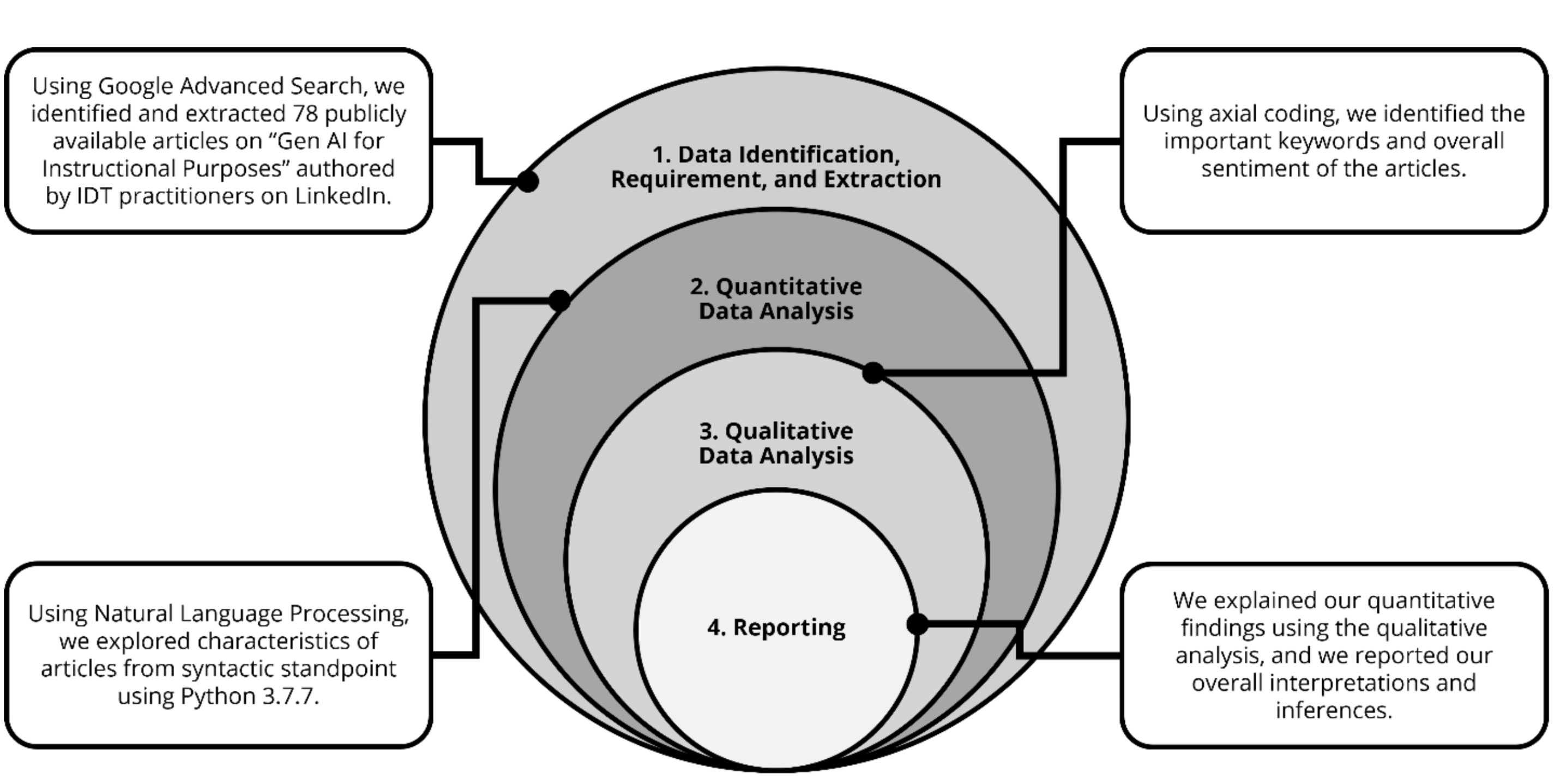
We employed a mixed-method design (Creswell & Clark, 2017) to examine IDT practitioners’ early reactions to ChatGPT, combining methods to mitigate limitations and strengthen interpretations. Following a nested explanatory sequential design, we began with a quantitative phase, using topic modeling to analyze 78 publicly available online articles and identify dominant themes. We then started a qualitative phase, building on the quantitative results using deductive coding (Saldaña, 2015), categorizing articles, and refining insights. This complementary approach, as argued by Greene (2007), allowed us to move from broad topic identification to deeper interpretation. Figure 1 illustrates the study’s four stages, from data collection to thematic categorization and analysis.
Figure 1
The Four Stages of the Study—A Nested Mixed-Method Design
Because our focus was on early reactions and perceptions, we analyzed 78 articles published between December 12, 2022, and July 21, 2023. These articles (1) explicitly discussed ChatGPT for instructional design purposes and (2) were authored by IDT practitioners or scholar-practitioners in blogs and LinkedIn posts. Such writings, in which practitioners publicly shared their views, provided a legitimate and appropriate data source for capturing early perceptions of ChatGPT and GenAI tools more broadly. Importantly, this study is not a literature review; the blogs and LinkedIn posts we examined do not constitute scientific literature but reflect professional discourse.
We used Google Advanced Search to identify publicly available online resources without requiring a login or payment. Using the query Instructional Design + ChatGPT site:linkedin.com/pulse, we collected 242 initial articles. We extracted their titles, content, and user reactions with a Python script. Some LinkedIn posts linked to relevant blogs, which we also included if freely accessible. In our initial investigation of text extracted from the articles, we noticed that a few LinkedIn articles described blog posts that explicitly discussed ChatGPT by IDT practitioners and scholars. In such instances, we extracted the text from blog posts that were freely available without registration, login, or payment. After verifying authorship and relevance, the final dataset comprised 78 articles: 70 from LinkedIn Pulse and eight from external blogs. Table 2 shows the contexts of the authors’ articles, described by the most recent professional context listed on their public LinkedIn profiles.
Table 2
Contexts of Authors’ Articles
Source | Frequency |
Higher Education | 28 |
Industry | 42 |
K-12 | 8 |
Total | 78 |
The following is a list of the blogs that we used to source the eight articles.
Re-Mediating Assessment, a blog maintained by members of the 21st Century Assessment Project at Indiana University: remediatingassessment.blogspot.com
Improving Learning: Eclectic, Pragmatic, Enthusiastic, a blog written and maintained by Dr. David Wiley: opencontent.org
Online Teaching at the University of Michigan — A site by the Center for Academic Innovation with articles and blogs on effective online teaching: onlineteaching.umich.edu
George Veletsianos, PhD, a blog written and maintained by Dr. George Veletsianos: veletsianos.com
SmartBrief’s Voice of the Educator, a website that publishes more than 200 niche email newsletters in partnership with leading trade associations and professional societies: smartbrief.com/originals/education/voice-of-the-educator
We began by analyzing syntactic characteristics—such as word frequencies, co-occurrences, and n-grams—followed by semantic aspects to uncover deeper meanings through entity recognition, sentiment analysis, and topic modeling (Leung, 2022b; Popov, 2023). In the first stage, we implemented five NLP tasks using Python 3.7.7. First, we measured character, word, and sentence counts with pandas-profiling (Pandas-profiling, 2023; WordCloud for Python Documentation, n.d.). Second, we generated trigrams with the Natural Language Toolkit (NLTK) to examine co-occurrence probabilities (Natural Language Toolkit, n.d.). Third, we extracted and linked entities with spaCy and spaCy-entity-linker (spaCy Industrial-strength natural language processing in Python, n.d). Fourth, we applied TextBlob for sentiment detection, classifying texts as positive, neutral, or negative (TextBlob Documentation, n.d.). Finally, we conducted unsupervised clustering via LDA, Top2Vec, and BERTopic, with contextual embeddings from Universal Sentence Encoder 4 (TensorFlow Hub, n.d.). Table 3 summarizes the Python packages and versions we used for the first stage of the study.
Table 3
Summary of Python Packages We Used in the Study for Data Analysis
NLP Task | Version | Python Package |
Text Characteristics | (NA) | Lambda functions to calculate average character, word, and sentence counts. |
Visualization | 2.10.1 | Pandas-profiling to visualize descriptive characteristics |
Trigrams | 3.5 | NLTK |
Entity Extraction | 3.1.1 | spaCy |
Entity Relationships | 1.0.3 | spaCy-entity-linker |
Sentiment Detection | 0.17.1 | TextBlob |
Topic Modeling #1 | 4.2.0 | Gensim for LDA |
Topic Modeling #2 | 1.0.27 | Top2Vec (training: universal sentence encoders 4) |
Topic Modeling #3 | 0.8.1 | BERTopic (training: universal sentence encoders 4) |
We applied three topic modeling methods—Latent Dirichlet Allocation (LDA), Top2Vec, and BERTopic—to analyze the dataset. After preprocessing with NLTK, we used Gensim’s LDAmulticore with an 80/20 train-test split for BoW and TF-IDF models. Hyperparameter tuning (2–20 topics) yielded the highest coherence (C_v = 0.3911) with two topics. Visualization via pyLDAvis showed BoW produced clearer results than TF-IDF (Blei et al., 2003). Top2Vec (Top2Vec 1.0.29 documentation, n.d) detected topics without preprocessing, embedding words, and clustering them with UMAP and HDBSCAN (Angelov, 2020). Deep-learn mode produced better quality but required more time, with a coherence of 0.3243. BERTopic, which combines transformer embeddings with c-TF-IDF, also used UMAP and HDBSCAN, yielding two topics with a coherence of 0.3135.
While LDA outperformed the others, coherence alone does not guarantee quality. Lower scores in Top2Vec and BERTopic likely stemmed from limited IDT-specific embeddings (Leung, 2022a; 2022b). We evaluated results through coherence and our collective human judgment, using topic and word intrusion tests (Chang et al., 2009) to confirm interpretability.
Topic modeling revealed three main categories in the articles: (1) GenAI as a design tool, (2) GenAI for student learning, and (3) Other, which included outliers. We used these categories to structure our qualitative coding. For sentiment detection, TextBlob classified all articles as positive, but this result was misleading: many texts carried multiple, sometimes conflicting, sentiments. To capture nuance, we relied on manual deductive coding guided by Saldaña (2015). We created five sentiment codes and defined them as follows (see Table 4).
Table 4
Sentiment Categories and Definitions Used in Qualitative Analysis
Sentiment | Definition |
Informative | Describes ChatGPT’s functions, how it works, and possible uses. |
Forward-Looking | Expresses optimism about current and future potential. |
Optimistic | Focuses only on present benefits, without future considerations. |
Cautious | Raises risks, limitations, or ethical concerns. |
Neutral | Provides factual information without positive or negative judgment. |
We coded each article by its dominant sentiment using the 80–20 rule (Miles et al., 2014). For example, if most of a text expressed caution but a small portion sounded optimistic, we coded it as cautious. We carefully read all 78 articles, applying multiple rounds of coding to ensure consistency. Finally, we conducted axial coding (Saldaña, 2015) to extract keywords and connect them to the three topic categories. This combined sentiment and thematic analysis provided a nuanced understanding of how IDT practitioners reacted to ChatGPT in the articles they wrote.
In compliance with LinkedIn’s Terms of Service, we did not scrape content directly[3]. Instead, we extracted articles from cached versions indexed by Google Search, which fall under fair use as established in the 2006 U.S. court ruling on Google Cache (Gelman, 2006). We verified that all articles explicitly referenced “Instructional Design” and “ChatGPT” that were authored by IDT practitioners and were publicly accessible without login or paywalls. To protect anonymity, we excluded personal authorship details from analysis.
This study did not involve human subjects; it analyzed publicly available texts, making it a content analysis rather than human subjects research. Because practitioners rarely publish in academic journals, their writings on platforms like LinkedIn and blogs provided a valuable window into early reactions to ChatGPT. We carefully verified authorship, de-duplicated search results, and reviewed authors’ most recent professional involvement to ensure reliability.
We reinforced trustworthiness through both quantitative and qualitative checks. We ran three topic modeling algorithms, selecting the highest coherence scores to confirm semantic quality. By adding human judgment, we captured practitioner perspectives that algorithms may have missed. This process enabled us to enhance the reliability and credibility of our findings regarding IDT practitioners’ early reactions to ChatGPT.
While this study relied on Google Advanced Search to access indexed versions of online articles, updated or edited posts may not have been captured due to Google’s and LinkedIn’s indexing policies. Although LinkedIn articles and blogs are not scientific literature, they provide valuable insights into practitioners’ experiences, challenges, and innovations with GenAI tools in instructional design and technology (IDT). Integrating these perspectives enriches our understanding of early applications across diverse settings. Our dataset consisted of 78 articles published between December 12, 2022, and July 21, 2023, that explicitly discussed ChatGPT for instructional purposes and were authored by IDT practitioners or scholar-practitioners. These reflections, while legitimate for capturing early reactions, carry limitations. Reliance on LinkedIn introduces potential platform-specific bias, and the non-scientific nature of the texts limits generalizability. Combined with the specific timeframe and selection criteria, these factors mean the findings should be interpreted with caution and not assumed to represent all IDT professionals or the broader AI-in-education field.
Given the study design and methods we employed, we present our findings in response to our two research questions. We present these findings using the two complementary approaches we followed—quantitative and qualitative approaches.
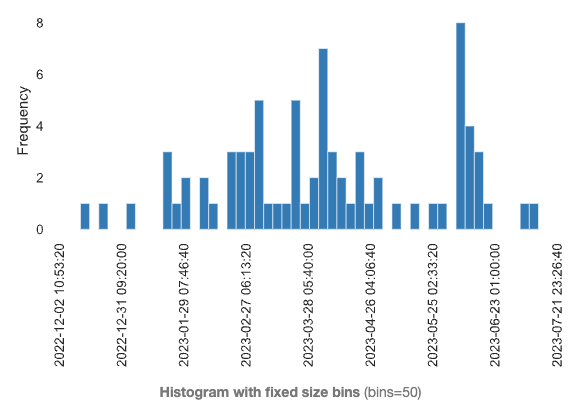
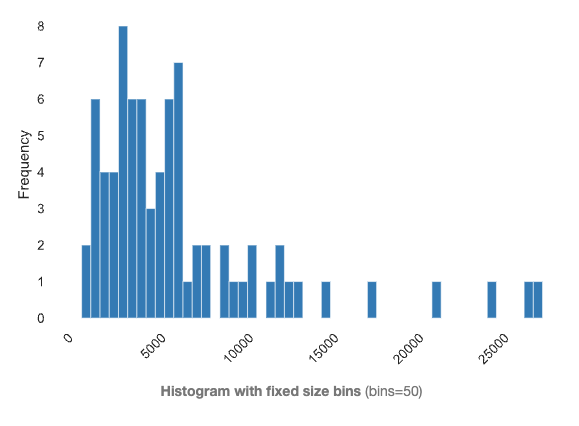
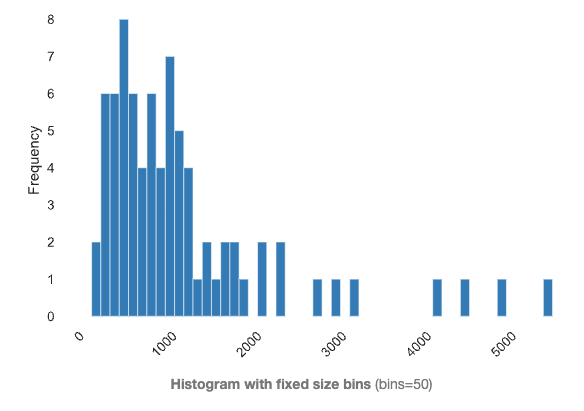
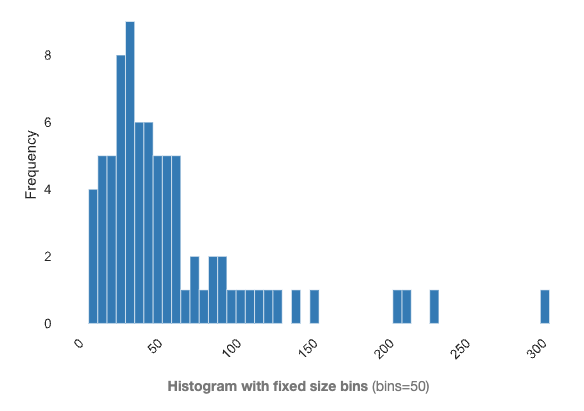
Most articles appeared between February and June 2023 and were relatively short. The majority contained fewer than 1,000 words and 50 sentences. Figure 2 displays the distributions of characters, words, and sentences of the 78 published articles.
Figure 2
Article Characteristics
Article distribution by date | Character count distribution (mean=6,586.48) |
 |  |
Word count (mean=1,219.66) | Sentence count (mean=60.5) |
 |  |
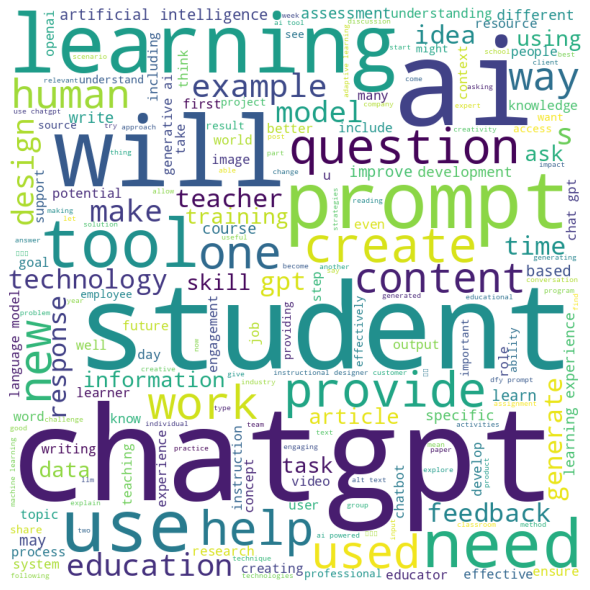
Our n-gram analysis showed frequent trigrams centered on adaptive learning, tutoring systems, implementation examples, and the use of prompts for design and student learning. Table 5 lists the most common trigram probabilities. After removing stop words and applying sentiment detection, the most frequent words reflected a generally positive tone. Figure 3 presents the most commonly used words across the articles.
Table 5
Most Frequent Trigrams
Trigram | Frequency |
(adaptive, learning, system) | 29 |
(artificial, intelligence, AI) | 27 |
(AI, machine,learning) | 18 |
(large, language, model) | 18 |
(natural, language, processing) | 17 |
(learning, experience, student) | 12 |
(generative, artificial, intelligence) | 11 |
(AI-powered, adaptive, learning) | 10 |
(communication, active, listening) | 10 |
(critical, thinking, problem-solving) | 7 |
(adaptive, learning, platform) | 9 |
(ChatGPT, instructional, designer) | 7 |
Figure 3
Word Frequency
After performing entity recognition and relationship tasks, we identified 3,741 and 68 relationships (e.g., embrace, achieve, potential, ethical, and impacting). These entities highlighted how articles encouraged the use of ChatGPT for student learning and as a design tool, while also noting ethical implications for daily professional work. Figure 4 shows the most frequent entities related to AI, generative pre-trained transformers, and OpenAI, with explanations provided below the figure.
Figure 4
Recognized Entities
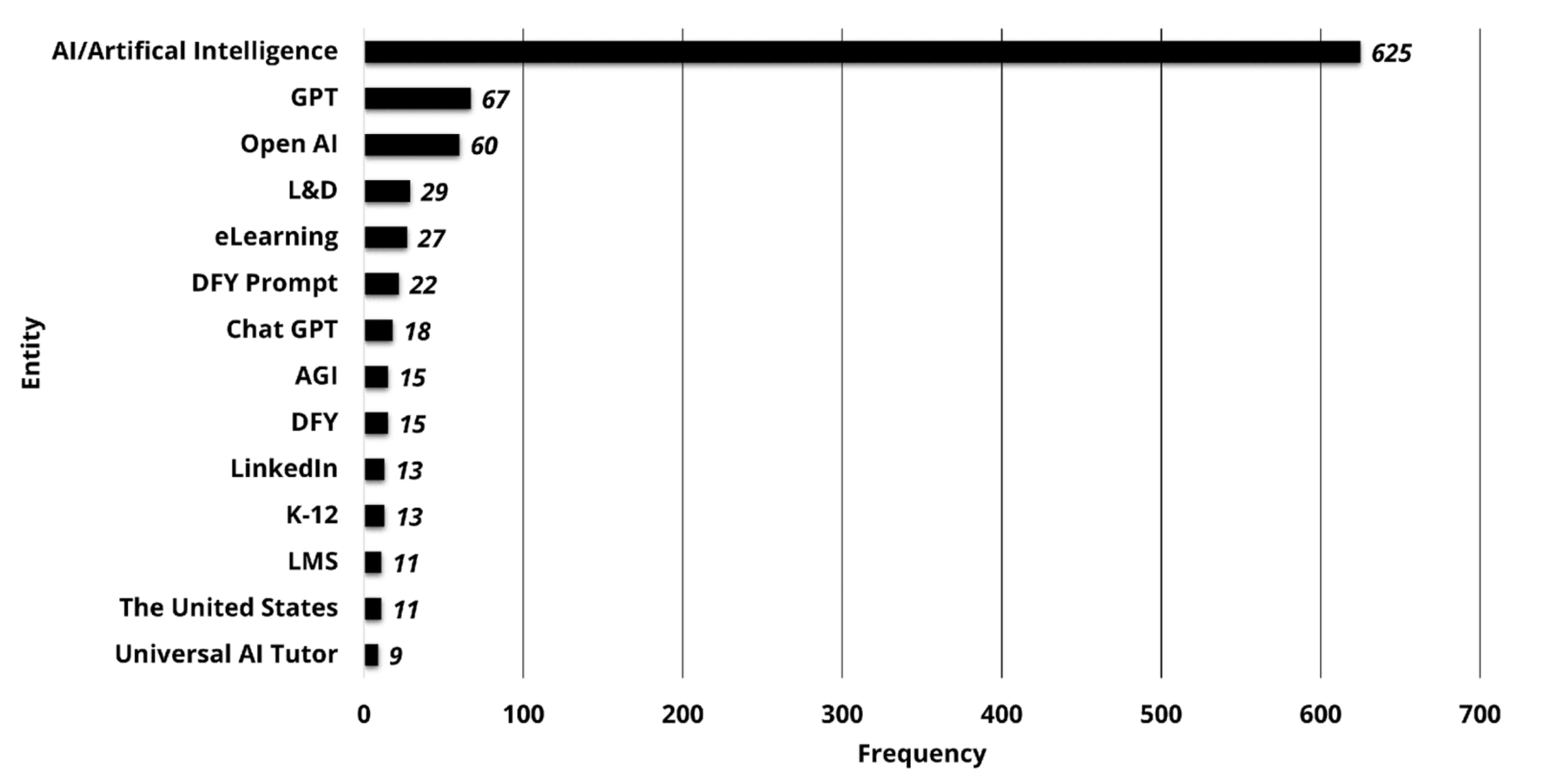
AI / Artificial Intelligence: Broad discourse on integrating AI into education and instructional design.
GPT / ChatGPT: Central role of transformer models, especially ChatGPT, in content creation and design tasks.
OpenAI: Organization behind ChatGPT, often cited for innovations in education and training.
L&D (Learning and Development): Use of GenAI in corporate and professional training to enhance workforce skills.
eLearning / LMS: Integration of AI into online learning platforms to boost accessibility and engagement.
DFY (Done-For-You) / DFY Prompt: Trend of using GenAI to auto-generate instructional materials and tasks.
AGI (Artificial General Intelligence): Discussion of future AI systems with human-like intelligence.
LinkedIn: Venue for professional discussions on AI-driven instructional practices.
K–12: Application of ChatGPT and similar tools to support primary and secondary education.
United States / Universal AI Tutor: References to geographic focus and visions of globally accessible AI tutors.
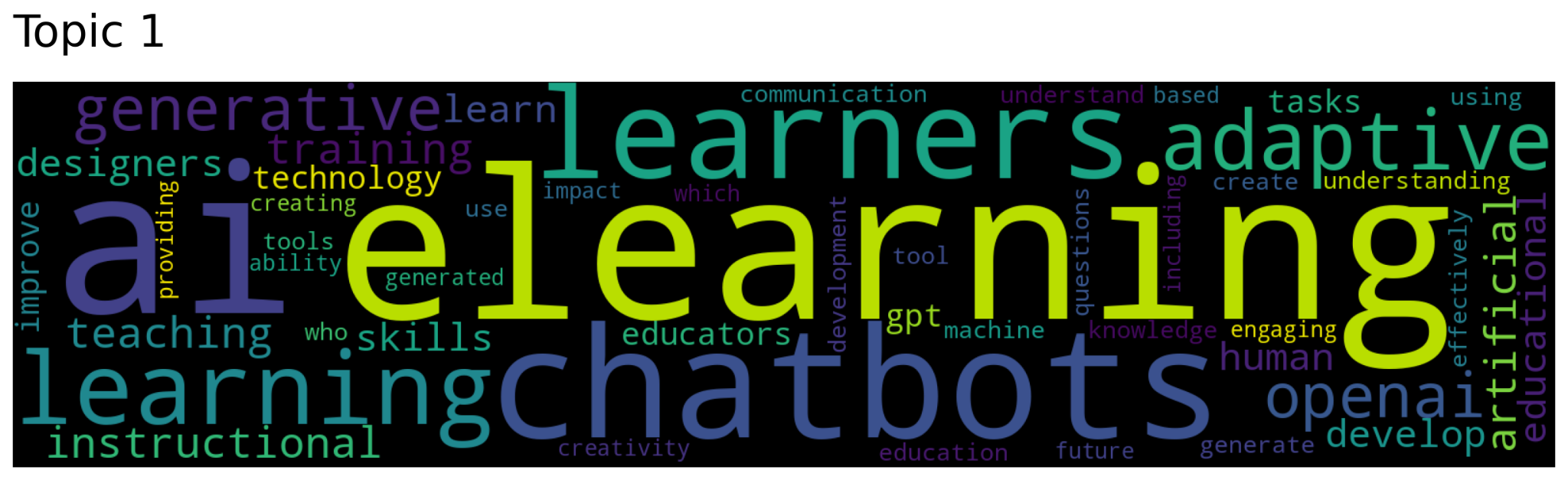
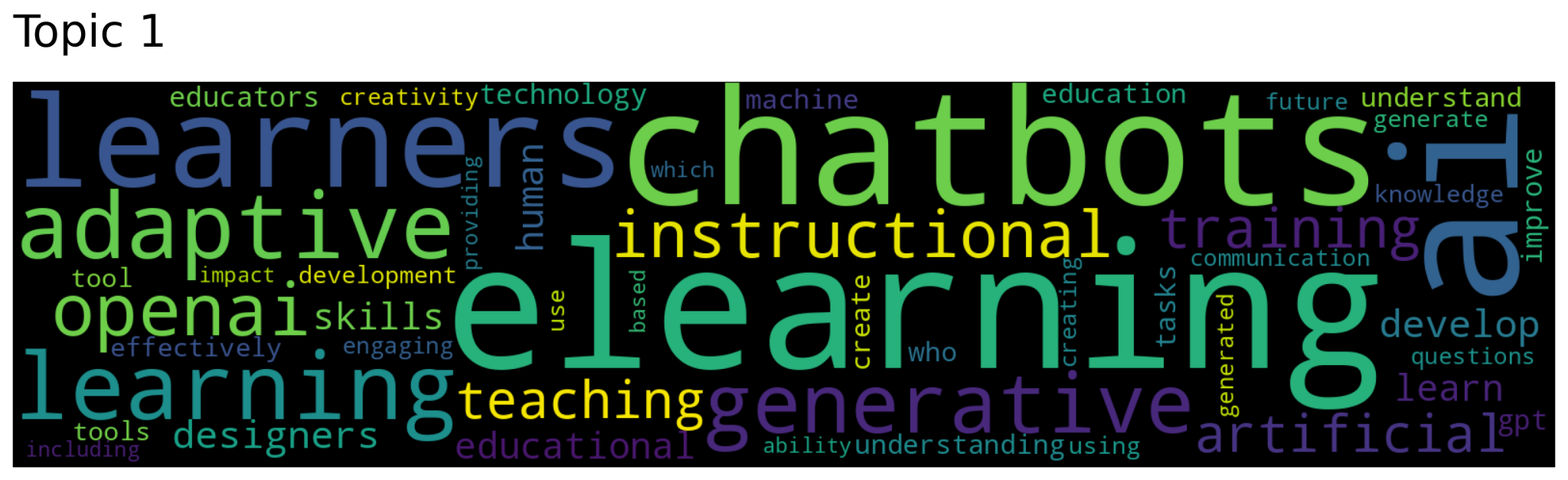
When we ran the topic modeling algorithms in an unsupervised manner to identify latent topic structures, LDA, Top2Vec, and BERTopic produced nearly identical results, yielding two main topics. The first focused on using GenAI to support student learning and training through chatbots, adaptive and personalized learning, and tutoring systems. The second focused on using GenAI to assist with design-related tasks, such as writing, content creation, and concept explanation, via Done For You (DFY) prompts for conversational agents. Examples of DFY prompts for image generation (e.g., Adobe Firefly[4] and Midjourney[5]) included descriptions of subject, style, context, and preferred output. DFY prompts for text generation (e.g., ChatGPT) involved structured tasks such as text summarization, image captioning, and audio transcription, where prompts specified format, references, and framing (Zhang et al., 2024). Importantly, chatbots appeared in both topics: as tools for learning in academic and corporate settings and as companions for design and development tasks. Figure 5 illustrates these themes in the word clouds generated by Top2Vec.
Figure 5
Top2Vec Emerging Topics
 |
 |
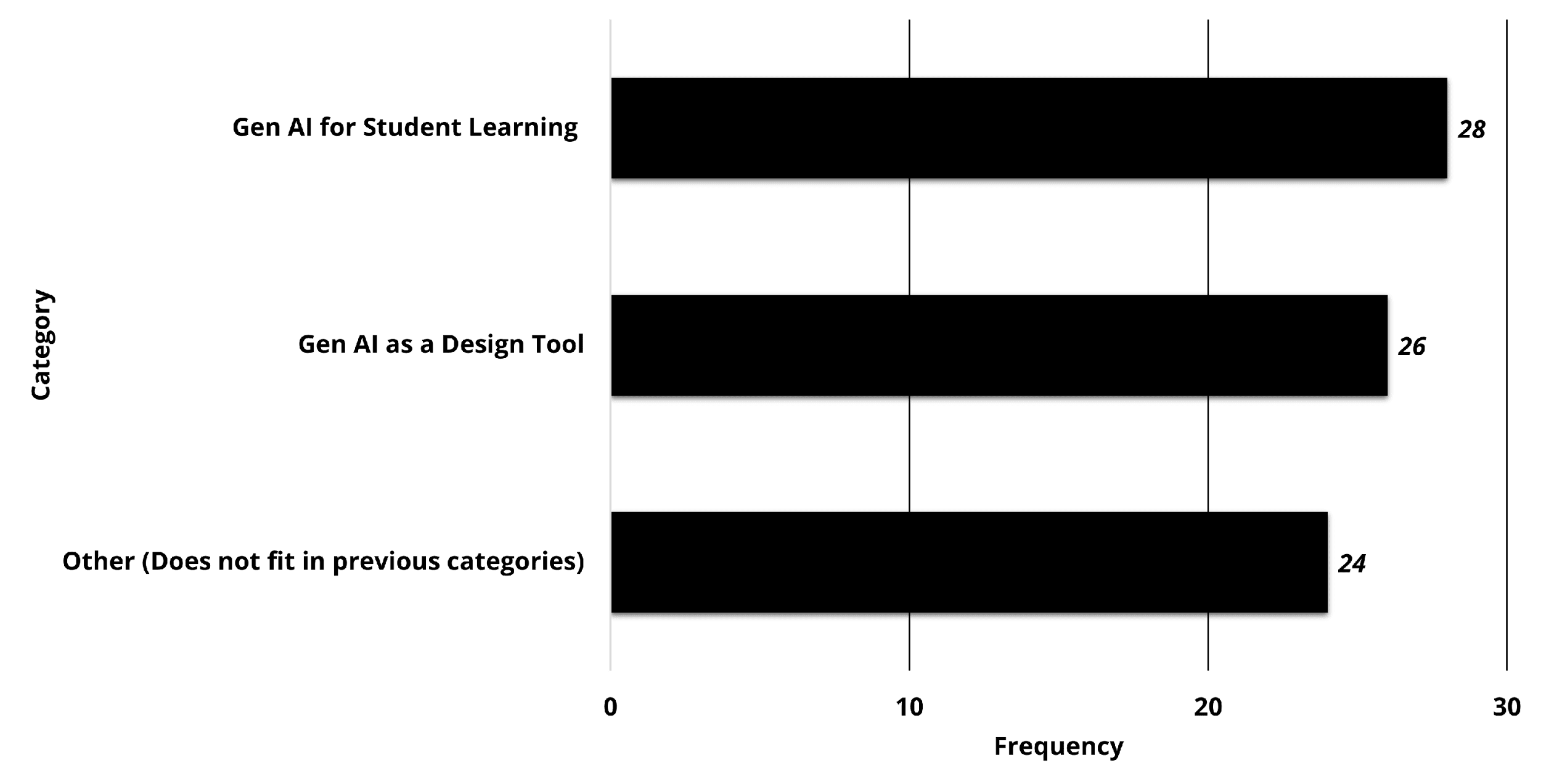
As we show in Figure 6, the most prevalent topic appeared in 28 of the 78 articles (35.9%) and focused on GenAI for student learning, with keywords such as “personalized learning,” “teaching assistant,” “tutoring,” and “adaptive learning.” The second most common topic, in 26 articles (33.3%), centered on GenAI as a design tool, reflected in terms like “corporate learning,” “micro-learning,” “e-learning design process,” and “gamification.” The third topic, found in 24 articles (30.8%), involved general descriptions of ChatGPT and broader GenAI trends in higher education and corporate learning, highlighted by keywords such as “trends and applications,” “prompt engineering,” and “customization.”
Figure 6
Online Articles Topic Category Distribution
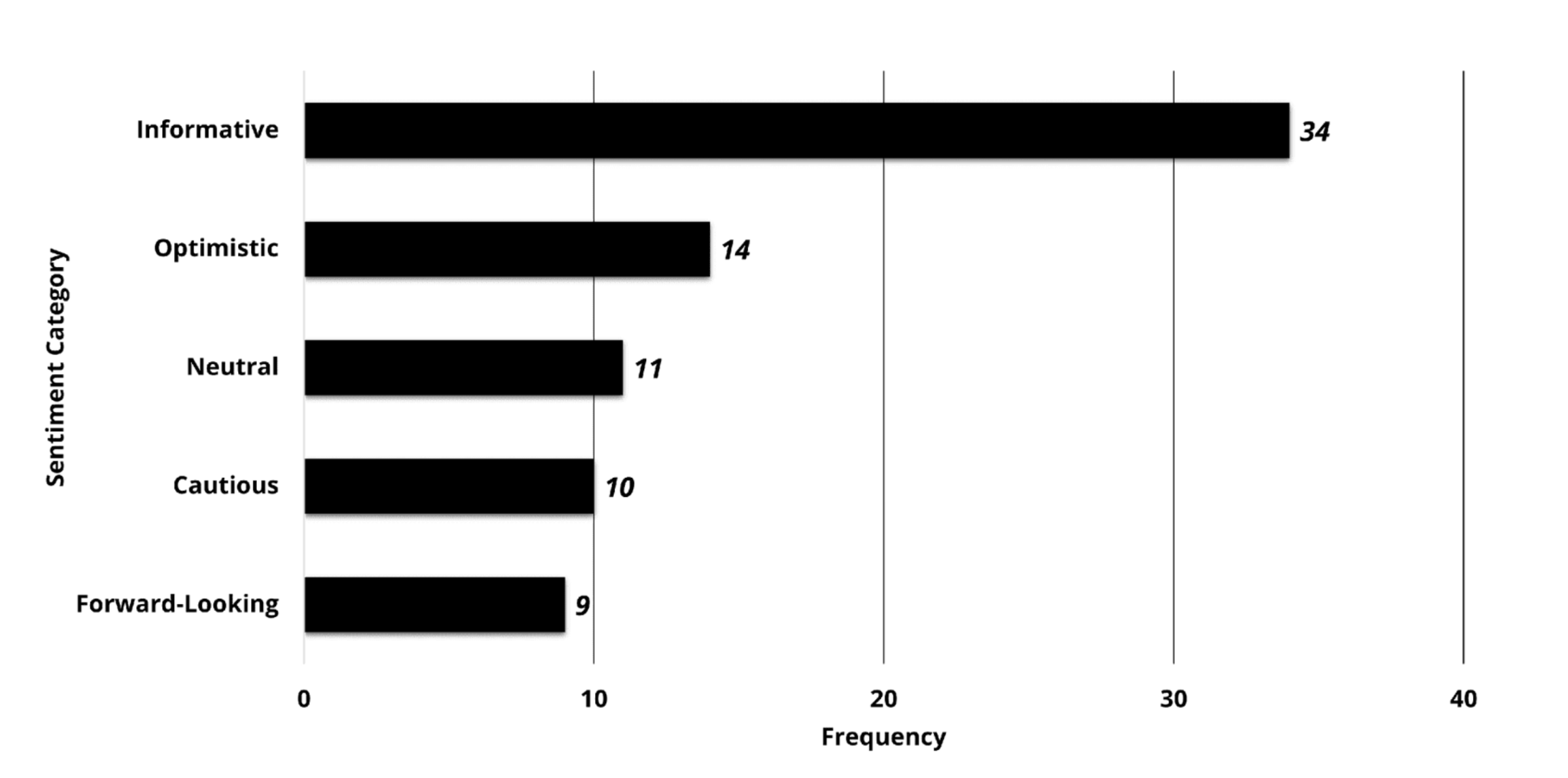
As we show in Figure 7, 34 of the 78 articles (43.6%) were informative, describing ChatGPT/GenAI tools and their use in personalized learning. Fourteen articles (17.9%) were optimistic, highlighting positive impacts on student and employee learning without addressing future implications for ID work. Eleven articles (14.1%) were neutral, offering factual descriptions of ChatGPT/GenAI in training development without value judgments. Ten articles (12.8%) were cautious, raising concerns about equity, ethics, privacy, job replacement, and challenges in online course integration. Finally, nine articles (11.5%) were forward-looking. They presented examples of ChatGPT/GenAI supporting student learning and corporate outcomes, while also emphasizing its present and future potential.
Figure 7
Articles’ Sentiments Distribution
Our study investigated IDT practitioners’ early reactions and perceptions of ChatGPT as a way to understand their views on GenAI tools more broadly. We examined the general characteristics of published articles discussing instructional design and ChatGPT, along with the emergent topics and categories. We present our findings along two key dimensions: (1) prevalent topics and categories, and (2) prevalent sentiments.
The findings of our study align with prior research on AI in education, including adaptive learning (Benhamdi et al., 2017; Cárdenas-Cobo et al., 2020), Intelligent Tutoring Systems (Nye, 2015; Yuan et al., 2021), and personalized learning (Mavroudi et al., 2017; Moreno-Guerrero et al., 2020; VanLehn, 2011). As we reported in the findings section, the most prevalent topics we identified were “personalized learning,” “tutoring,” and “adaptive learning,” which fell under the dominant category of student learning. This emphasis is unsurprising, given that IDT practitioners traditionally design with learners in mind as end-users of their work. Discussions of ChatGPT appear to continue this learner-oriented focus, countering flawed claims that frame instructional design as instructor-centered while positioning Learning Experience Design (LXD) as student-centered (Lachheb & Arashiro, 2021). In addition, the prevalent topics we identified also reflect the profession’s dual emphasis on efficiency and effectiveness (Honebein & Honebein, 2015). ChatGPT enables instructional designers to locate relevant materials quickly (efficiency) and tailor learning activities to learner needs and interests (effectiveness). The focus on personalization underscores the importance of authentic learning experiences (Baldwin, 2019; Britt et al., 2015; Herrington et al., 2010; Rule, 2006; Watson et al., 2017). One of the facets of authentic learning is personal meaningfulness, which signifies that learners should be able to find their learning path and voice in the learning process (Shaffer & Resnik, 1999).
The second major category we identified was the design tool. This highlights practitioners’ interest in leveraging ChatGPT and other GenAI tools to make their work more efficient and innovative. It also suggests that practitioners are beginning to use these tools in a designerly way (Lachheb & Boling, 2018; Stolterman et al., 2009), not as replacements for their expertise but as extensions that support professional judgment and creativity.
As we reported in the findings section, the majority of articles—34 of 78 (43.6%)—shared an informative sentiment. In these, IDT practitioners described ChatGPT and other GenAI tools in detail, illustrating their potential uses for personalized learning. This emphasis on description and exploration marks a shift away from prescriptive models. As Yanchar and Hawkley (2015) and Yanchar et al. (2010) reminded us, professional IDT contexts are complex and fluid, and prescriptive models rarely provide adequate guidance when new technologies emerge. Therefore, adopting a flexible design mindset (Boling et al., 2022) in an ever-evolving professional environment seems to be a key competency that IDT practitioners should exhibit.
The second most prevalent sentiment, which we found in 14 articles (17.9%), was optimistic, reflecting enthusiasm for ChatGPT’s efficiency, adaptability, and potential to streamline instructional design tasks. Alongside informative and optimistic articles, we also identified neutral (11 articles, 14.1%) and cautious (10 articles, 12.8%) stances. Rightfully so, the sentiment of caution is mainly related to “tech replacing humans to do work”. Although this replacement with the rise of AI technology represents a valid concern, the threat encourages IDT educators to think creatively about how to teach for IDT jobs that do not yet exist and to focus on higher-order thinking skills, real-life projects, and creating portfolios that would be needed even when more sophisticated and intelligent technology comes into existence. Regarding the cautious sentiment, our findings are consistent with other authors’ concerns, such as the violation of privacy (Trust, 2023) and the proliferation of misinformation (Hickey, 2023). As expected, along with its benefits, AI-powered technology has limitations and drawbacks.
Because our study is research on and for instructional/learning design practice, understanding the early reactions and perceptions of IDT practitioners toward ChatGPT and GenAI tools brings multiple implications for (1) ID practice, (2) AI in education, and (3) preparing future IDT practitioners.
As reported in the articles we analyzed, by and for IDT practitioners, and in the literature we reported in this paper, GenAI tools such as ChatGPT can streamline content creation, support adaptive learning, and personalize instruction. However, two pressing challenges limit their effective use: bias and misinformation. AI bias occurs when algorithms reinforce inequities related to gender, race, ability, or other factors, especially when trained on uncurated datasets. Without careful human oversight, such systems risk amplifying existing disparities. Similarly, misinformation, including deepfakes and unreliable AI outputs, poses a growing concern. Moreover, current tools for detecting AI-generated content, such as plagiarism detectors, are not consistently reliable and may disproportionately penalize non-native English-speaking writers (Chaka, 2023; Gao et al., 2022). Recognizing these limitations, some organizations, such as OpenAI and Turnitin, have disabled AI writing detection tools due to low accuracy and the risk of amplifying biases (Ghaffary, 2023; Teo, 2023). Therefore, while AI offers ample opportunities to improve someone’s learning or work processes, there are significant areas for further research regarding the ethical issues of AI.
Our findings confirm broader concerns in the literature, particularly around privacy and dark patterns in technology design (Gray et al., 2021; Lachheb et al., 2023). Instructional designers, as important stewards and leaders in the IDT field across settings, play a critical role as gatekeepers or innovators in educational advancements (Bond et al., 2023) and serve their institutions best in times of crisis (Abramenka-Lachheb et al, 2021a;2021b). As such, their perceptions of GenAI tools are critical to understanding how we (the professional members of the IDT field) might best investigate how AI technology can be integrated into education to leverage its full potential. Policy reports also echo this need. For instance, the U.S. Department of Education stresses both opportunities and risks of AI in teaching and learning (U.S. DOE OET, 2023), while UNESCO (2023) and the European Union (Tuomi et al., 2023) call for careful, ethical integration. Globally, countries such as Uruguay (Pedro, 2019) and Kenya (Eneza Education, 2023) are embedding AI into national education initiatives, stressing its growing influence.
AI/GenAI technologies will evolve and impact various aspects of our lives. The findings of our study highlight an important insight for preparing future IDT professionals: instructional designers must have an adaptable and flexible designer mindset (Boling et al., 2022), which would allow leveraging new technologies to serve their learners in the best possible way. We know that tools come and go. Eventually, it is not about a tool, per se, but how it is used. This is why design tools must be used in a designerly way, supporting rather than dictating what is created (Lachheb & Boling, 2018). Using design tools in a designerly way would serve the design and the designer’s best interests. Thus, regardless of how advanced and sophisticated AI-powered tools, such as ChatGPT, become, they will not be a substitute for the human ability to discern and make ethically driven design judgments and decisions. Designers still need to discern what’s appropriate, accurate, and equitable. To this end, we argue that designers should remain active agents of the design process in which they will critically analyze AI, assess its benefits and harms, and make an ethical analysis (An, 2023; Lachheb et al., 2023; Moore et al., 2023) to further inform their design decisions.
A critical examination of how AI systems are developed and maintained is essential to fully leverage GenAI in IDT practice, across both formal classroom learning and professional training. While IDT professionals may use GenAI for multimedia or lesson planning, these tools should also enhance practitioners’ ability to separate valid IDT knowledge from misinformation. Persistent myths, such as learning styles and the cone of experience, have already been documented in online IDT communities (Leung, 2022a; 2022b). We anticipate misinformation in AI-generated content will continue, fueled by limited fact-checking, weak knowledge discovery mechanisms, and the absence of pedagogical foundations in many communities. As seen in medicine, where domain-specific AI tools were developed, IDT training likewise requires systems grounded in discipline-specific knowledge and competencies. GenAI tools trained on IDT-specific models could support designers by recommending strategies, predicting outcomes, and generating relevant artifacts, provided they are applied with fairness, responsibility, and transparency.
In this study, we used a nested mixed-methods design to analyze publicly available LinkedIn articles and blogs with topic modeling and sentiment detection. Findings show that IDT practitioners view ChatGPT/GenAI as tools for rapidly generating instructional materials and supporting design tasks. Sentiments were largely informative (43.6%), followed by optimistic (17.9%), neutral (14.1%), cautious (12.8%), and forward-thinking (11.5%). From these results, we outlined implications for ID practice, education, and the preparation of future IDT professionals, emphasizing the ongoing importance of human agency and ethically driven design decisions. Now more than ever, we call on ID practitioners to assume their consequential responsibility to make ethically driven design decisions that impact their design work, processes, and outcomes (Lachheb et al., 2023).
AI: Artificial Intelligence
BoW: Bag of Words
Chat GPT: Chat Generative Pre-Trained Transformer
CoP: Community of Practice
GAI: Generative Artificial Intelligence
GenAI: Generative Artificial Intelligence
GAN: Generative Adversarial Network
GDM: Generative Diffusion Model
GDL: Geometric Deep Learning
GPT: Generative Pre-trained Transformers
HBDSCAN: Hierarchical Density-Based Spatial Clustering of Applications with Noise
LDA: latent Dirichlet allocation
NLP: Natural Language Processing
NLTK: Natural Language Toolkit
TF-IDF: Term Frequency-Inverse Document
UMAP: Uniform Manifold Approximation and Projection
[1] PLATO | The Grainger College of Engineering
[2] Center Explores, Experiments with Generative AI’s Potential Role in Teaching and Learning
 EdTech Archives