Generative Artificial Intelligence (GAI) has rapidly transformed various industries since the introduction of ChatGPT by OpenAI in 2022. According to Reuters's Journalism and Technology Trends and Predictions 2025 report, AI continues to advance in language comprehension, video generation, and information analysis, exerting an increasingly profound impact on mass communications (Newman & Cherubini, 2025). In the domain of media production, AI-driven innovations—such as speech recognition, noise suppression, text-to-image transformation, and video generation—have substantially enhanced both the efficiency and quality of production processes. Furthermore, these services not only enable the automated creation of materials but also facilitate the provision of customized learning resources tailored to the specific needs of individual learners (Sandhu et al., 2024).
However, these technological innovations also raise issues such as AI slops (Newman & Cherubini, 2025) and ethical concerns that warrant further discussion and regulation (Fui-Hoon Nah et al., 2023; Khowaja et al., 2024). While new GAI services are being introduced daily, it’s essential to know the attitudes and perspectives of future workforce entrants—namely, university students—and their instructors toward GAI services. This study examines their opinions and attitudes toward GAI services in higher education media production departments.
Generative AI platforms drive transformative changes in audiovisual content creation, yet the systematic acquisition of literacy related to their appropriate use remains underdeveloped. Research suggests that factors such as AI-related anxiety (Wang & Wang, 2019), gender (Hopcan et al., 2024), and self-efficacy (Wang & Wang, 2019) influence users’ ability to learn and adopt GAI technologies. This raises critical pedagogical questions: What should instructors prioritize when integrating GAI services into teaching, and what challenges must they address? Should instructional approaches be adjusted to better support students’ GAI literacy? These concerns form the core focus of this study. Moreover, how do students perceive GAI? What are their attitudes toward their role in creative work and academic performance? Do their perspectives align with those of instructors, or are there notable differences? These questions further guide the research inquiry.
This study employs a mixed-methods research approach. On the instructor side, four constructs identified by Michel-Villarreal et al. (2023), opportunities, challenges, barriers, and priorities of GAI teaching in higher education, were adopted to form the outline of the semi-structured interview questions. The interview subjects are five instructors from a media production department of a private university in northern Taiwan, with a gender ratio of 3:2. Each participant had over ten years of experience teaching film or audio theory and production courses. The interviews were conducted between April 9 and April 15, 2024, each session lasting approximately 30 minutes.
On the student side, 63 students enrolled in post-production courses participated in the AIAS questionnaire in September 2024. These students were from related programs at a private university in northern Taipei, with a gender ratio of 2:8 (male to female). The research primarily adopts a quantitative approach, utilizing a modified version of the Artificial Intelligence Anxiety Scale (AIAS) questionnaire, which was developed by Wang and Wang (2019) to assess students’ anxiety levels related to their learning of GAI services, job replacement, and societal attitudes toward GAI.
The questionnaire consisted of 28 items, with constructs measured using a 5-point Likert scale ranging from “strongly disagree” to “strongly agree.” Higher scores indicate a greater level of anxiety experienced by the respondent.
Academic performance in this study was assessed through students’ final projects. For the final assignment, students were required to produce a 3- to 5-minute music video (MV). In addition to the video, students submitted a written creative statement that not only articulated their artistic vision but also explained how they incorporated course content into their work. Furthermore, students were asked to reflect on the extent to which they utilized GAI tools in developing their projects.
The final project was evaluated using a rubric developed with expert validity, and scoring was conducted by two independent raters. Inter-rater reliability (Reddy & Andrade, 2010) was used to assess and confirm the validity of the evaluations.
For data analysis, SPSS version 27 was employed to perform statistical procedures, including factor analysis, reliability analysis, descriptive statistics, independent t-tests, and regression analysis.
The findings from the student survey are then compared and analyzed alongside the qualitative insights obtained from the instructor interviews.
Preliminary findings from instructor interviews suggest that GAI services are broadly perceived as effective assistive tools that enhance efficiency in the creative process. However, instructors consistently emphasized that these tools cannot fully replace human creativity or critical thinking. Current GAI technologies, while promising, still fall short of the quality expected in professional production contexts. Consequently, instructors have adapted their pedagogical approaches to incorporate GAI tools as part of the creative workflow. They encourage students to utilize GAI as a source of inspiration while underscoring the importance of originality, critical evaluation, and
compliance with copyright regulations.
Quantitative data from the student questionnaire revealed that the highest level of anxiety was associated with concerns about potential job displacement (M = 4.07, SD = 1.20), while anxiety related to learning how to use GAI tools was the lowest (M = 3.11, SD = 1.32). Notably, gender differences in anxiety levels were not statistically significant, diverging from findings in previous literature. This may be attributed to the relatively user-friendly nature of most GAI platforms, such as ChatGPT, compared to more complex AI systems.
Regarding students’ prior experiences with GAI services, 43% of respondents reported having never used such tools, 27% indicated they had learned through formal coursework, and 30% were self-taught. Despite the broad adoption of tools like ChatGPT, these results suggest that many students may lack a clear understanding of what constitutes a GAI service.
Figure 1
The Result of Linear Regression Analysis
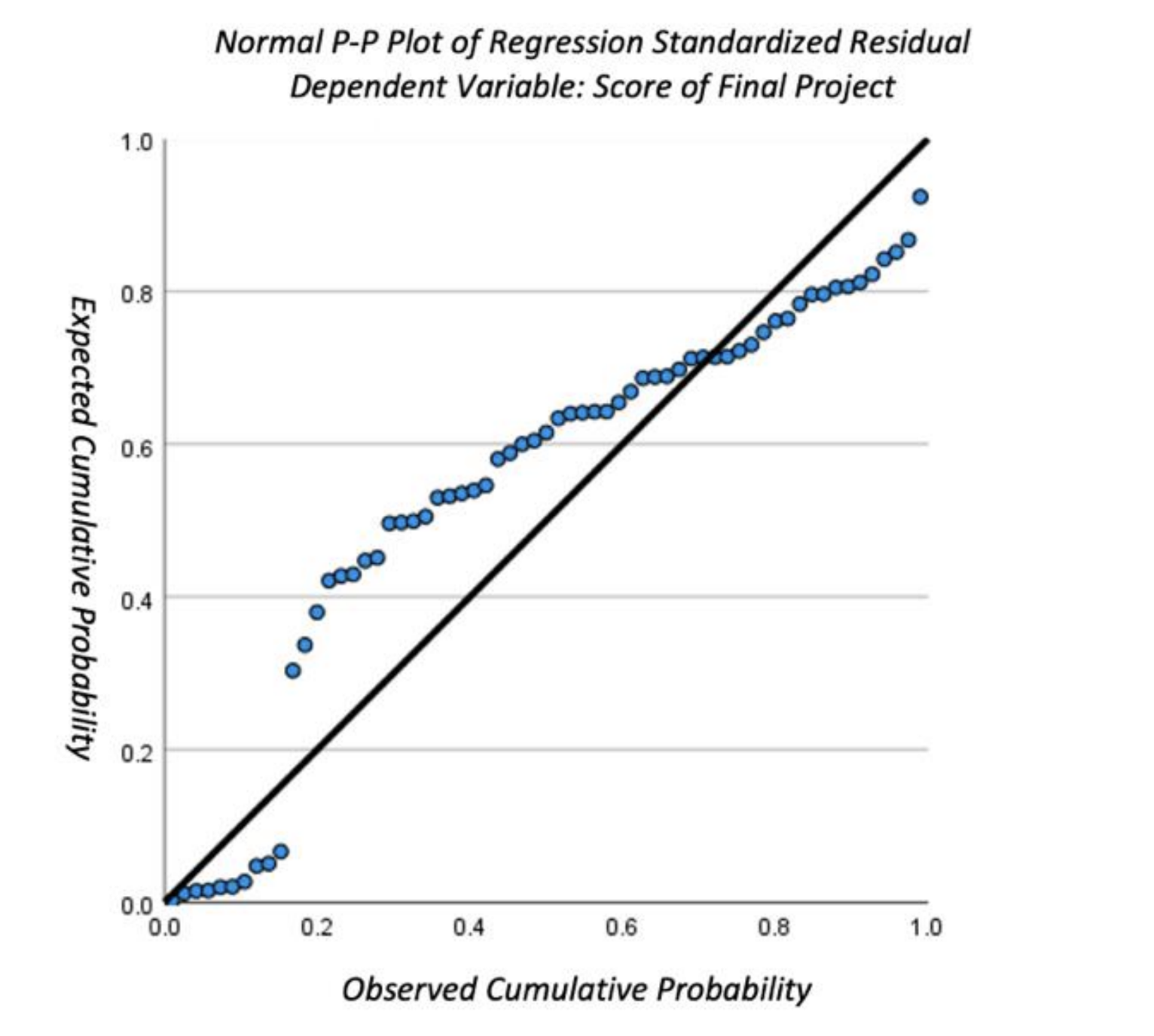
Linear regression analysis (see Figure 1) identified learning anxiety as a statistically significant predictor of academic performance, albeit with a modest explanatory power (R² = 0.08, F = 5.349, p = 0.02). The regression equation derived from the data is:
Final Score = 98.554 – 6.291 × Learning Anxietys
This indicates that students with lower levels of learning-related anxiety regarding GAI tools tend to perform better academically. Other factors—including gender, prior usage of GAI tools, and the mode of GAI learning—did not show significant predictive value for academic performance.
In summary, the study highlights that while students may express concerns about the implications of GAI for future employment, their learning-related anxiety is comparatively low. Importantly, it is this specific form of anxiety, rather than demographic or experiential variables, that significantly influences academic performance in a GAI-integrated post-production course.
By comparing the perspectives of instructors and students, the study reveals a nuanced understanding of how GAI services are perceived and experienced in educational settings. Instructors view GAI tools as user-friendly and effective for boosting creative efficiency, yet emphasize that these tools are not capable of replacing human creativity or achieving professional production quality without critical human input. On the other hand, students generally report low levels of anxiety about learning to use GAI tools, suggesting that these technologies are accessible at an entry level. However, they express significantly higher anxiety regarding the potential for AI to displace jobs in the future media workforce.
Importantly, the study finds that students with lower levels of learning-related anxiety regarding GAI tend to perform better academically in a GAI-integrated post-production course. This suggests that while ease of use may reduce barriers to initial adoption, students’ emotional readiness to engage with new technologies has a measurable impact on learning outcomes. Additionally, the findings highlight a notable gap in students’ understanding of what constitutes a GAI service, with nearly half of the respondents having never used one. This underscores the critical role of instructors in not only introducing the tools but also fostering students’ confidence, critical thinking, and ethical awareness when integrating GAI into creative workflows.
This student questionnaire is a pilot study, with a follow-up experiment planned for 2025. The findings will be presented at the conference, which is expected to enrich the existing literature and provide practical insights for educators and industry professionals.
In addressing the core research questions, this study finds that instructors should prioritize fostering students’ GAI literacy—not only in terms of tool usage but also in developing critical thinking, ethical awareness, and originality. The gap between students’ perceived ease of use and their lack of conceptual clarity around GAI tools presents a key instructional challenge. While students generally view GAI services as accessible and beneficial, their anxiety about future job displacement signals a need for educators to contextualize GAI’s evolving role in creative industries. Furthermore, the positive correlation between low learning anxiety and higher academic performance underscores the value of creating a supportive, informed learning environment. Although there is partial alignment between instructors’ and students’ perspectives, notable differences in understanding and emphasis highlight the importance of structured, reflective integration of GAI services into pedagogy.
 EdTech Archives