Artificial intelligence (AI) is reshaping how creative work is produced. Tasks that once required sustained manual effort can now be executed rapidly by intelligent systems. Schön (1983) long argued that professional practice depends on reflection-in-action rather than routine procedure. That distinction now defines the future of design work. The World Economic Forum (2020) projects continued automation of routine professional tasks, while creativity, contextual judgment, collaboration, and ethical reasoning remain resistant to mechanization (Brynjolfsson & McAfee, 2014; OECD, 2018). Across many African institutions, design education continues to reflect master-apprentice traditions centered on demonstration and imitation (Lave & Wenger, 1991). Apprenticeship preserves tacit knowledge and professional identity, yet imitation alone does not cultivate independent judgment. Dewey (1938) emphasized that growth depends on reflection grounded in experience rather than repetition. In rapidly evolving technological environments, technical competence without reflective capacity is insufficient. These pressures intensify within African higher education systems marked by uneven digital infrastructure and institutional disparities (World Bank, 2022; Cloete et al., 2015). Pedagogical reform must therefore address both learning theory and structural realities. This article advances a framework that repositions apprenticeship within a constructivist and technologically mediated model of studio learning.
Design education has long relied on apprenticeship as a primary mode of professional formation (Lave & Wenger, 1991; Schön, 1983). Expertise traditionally develops through observation, guided practice, and gradual participation in professional communities. While this model sustains tacit knowledge, it often leaves expert reasoning unspoken. Students may learn to replicate techniques without understanding the judgments guiding them. Constructivist learning theory reframed this problem by treating learning as active knowledge construction shaped through social interaction (Dewey, 1938; Vygotsky, 1978). Dewey linked experience with reflection, while Vygotsky emphasized guided participation within social contexts. In studio disciplines, these ideas strengthened critique practices and iterative dialogue, shifting attention from finished products to reasoning processes (Schön, 1983). Learning increasingly came to involve articulation and revision rather than repetition.
The professional landscape has intensified this shift. Automation now performs many routine production tasks, narrowing the value of technical replication. Contemporary workforce analyses stress adaptability and critical thinking as central to employability in technology-driven economies (OECD, 2018; World Economic Forum, 2020). Within this environment, imitation-based instruction reveals its limits. Cognitive apprenticeship emerged as a response. Brown et al. (1989) argued that knowledge is situated within activity, and Collins et al. (1991) proposed that instructors make expert thinking visible through modeling, scaffolding, and articulation. Rather than assuming that reasoning will be absorbed implicitly, this approach treats explanation and guided reflection as central to learning. Metacognitive engagement strengthens transfer and adaptive expertise (Collins & Kapur, 2014). In studio environments, structured critique enables students to internalize professional standards by articulating and revising their decisions.
Digital technologies further reshape how such learning unfolds. Collaborative platforms extend critique beyond physical studios, while AI tools accelerate experimentation and prototyping (Lockee, 2021; Holmes et al., 2022). Used intentionally, these tools can externalize thinking processes and support iterative refinement. However, rapid production without guided reflection risks privileging speed over depth.
In African contexts, technological integration intersects with uneven infrastructure and institutional capacity (World Bank, 2022). Digital adoption cannot be assumed to operate uniformly across institutions. Technology must function as a scaffold for reasoning rather than intensifying inequality. Despite growing attention to AI in education, limited scholarship examines how cognitive apprenticeship might reshape African design programs. Much of the literature centers on Western institutions and assumes stable technological access. Bridging this gap requires structured studio practice that makes reasoning visible, anchors projects in local realities, and normalizes revision as central to growth. Adaptive design expertise develops not from imitation alone, but from disciplined reasoning cultivated within contextually grounded mentorship. Existing scholarship leaves unresolved the challenge of aligning apprenticeship traditions with constructivist pedagogy and technological change in African design education. Addressing this challenge requires examination of the following questions:
RQ1: How does transitioning from master-apprentice to cognitive apprenticeship enhance 21st-century skill development in African design education?
RQ2: What role do digital technologies play in fostering cognitive apprenticeship pedagogies?
RQ3: How can African institutions address infrastructural and cultural barriers to adopting constructivist approaches?
Figure 1 illustrates the structural relationships underlying this framework.
Figure 1
The Contextualized Cognitive Apprenticeship Model
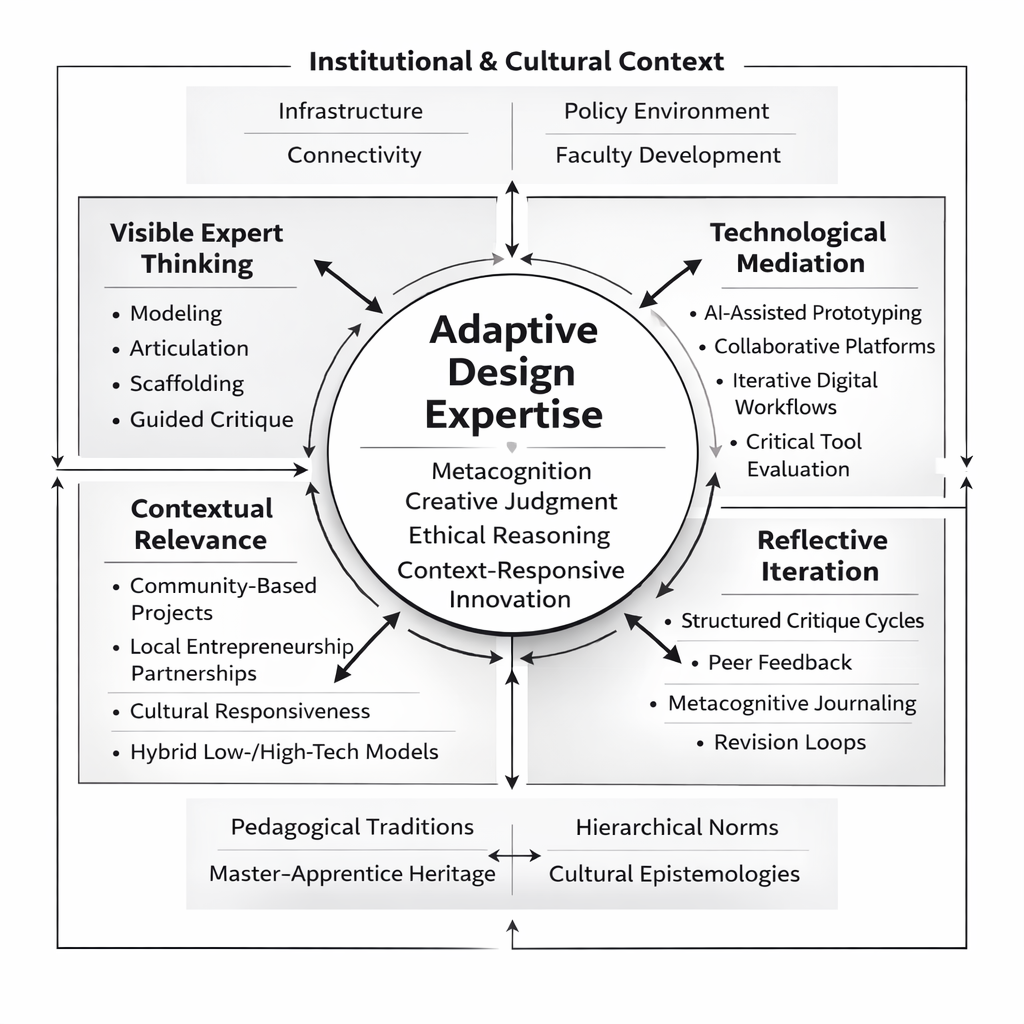
With the framework established, the discussion now examines how these interrelated dimensions respond to the three research questions.
The tension between apprenticeship traditions, constructivist theory, and technological transformation demands structured reconciliation.
Twenty-first-century skill development depends on disciplined reasoning rather than technical replication. Cognitive apprenticeship reorients studio learning by externalizing expert thinking and embedding structured reflection within practice. Articulation and metacognitive engagement improve transfer across contexts (Collins & Kapur, 2014). In technology-driven economies, creativity and contextual judgment define professional value (Brynjolfsson & McAfee, 2014). When instructors make reasoning explicit, students internalize strategic thinking rather than reproduce isolated techniques.
Technological integration enhances cognitive apprenticeship only when structured through guided dialogue and critique. Interaction, not access alone, determines depth of understanding (Lockee, 2021). Emerging scholarship underscores the need for ethical framing and reflective oversight in AI-supported environments (Holmes et al., 2022). Positioned as cognitive scaffolds rather than shortcuts, digital tools amplify iterative reasoning. Without mentorship, technological acceleration risks displacing critical engagement.
Pedagogical reform is inseparable from institutional capacity. Infrastructure, faculty development, and policy coherence shape innovation trajectories across African higher education (Cloete et al., 2015; World Bank, 2022). Transitioning toward cognitive apprenticeship requires gradual integration strategies and alignment with existing mentorship cultures. When institutional conditions support reflective practice and technological access, reform becomes both feasible and sustainable.
Preparing African designers for technology-driven economies requires disciplined reasoning rather than technical replication. Cognitive apprenticeship restructures studio learning around visible modeling, reflective practice, and guided technological mediation. The framework remains conceptual, yet it clarifies the conditions under which adaptive design expertise can develop within resource-variable contexts. Future research should evaluate scalable implementation models and examine culturally grounded strategies for integrating artificial intelligence in African design education.
 EdTech Archives