Game-based learning is a teaching method that leverages digital and non-digital games to advance the learner’s understanding of novel concepts (Grace, 2019). Game-based learning can also enhance cognitive skills and social-emotional development, resulting in a better learning experience for students (Lampropoulos, 2023). Game-based learning is considered an effective tool for the development of “Four C’s skills,” which are claimed to be the essential skills in the 21st century (Erdogan, 2019). These 4C skills consist of Critical Thinking, Collaboration, Communication, and Creativity. These skills are urgently needed to be integrated into learning so that students are ready to face the challenges of the 21st century (Hamida & Desnita, 2021).
Today, the global workforce demands individuals who not only have excellent cognitive ability but also possess other competencies, which are the 4C skills. Communication skills are closely related to collaboration skills, such as working together in group work, discussing to reach the goal, and dividing responsibilities in collaborative work (Erdogan, 2019). Van Laar et al. (2020) indicate that critical thinking skills are often developed through challenge-based tasks and inquiry-driven gameplay. Communication and collaboration skills were enhanced through cooperative mechanics and peer interaction, and creativity skills were supported by open-ended tasks and challenges (Fonseca et al., 2023).
By having high cognitive engagement and activating 4C skills, students are expected to overcome any challenges faced in their future lives. Game-based learning has emerged as a potential solution to develop these skills effectively. According to Bakan & Bakan (2018), the difficulty in the game can stimulate students to concentrate and to have a desire for success, which encourages them to work together and conduct “discovery of knowledge”.
The integration of cognitive and 4C skills in game-based learning environments has not yet been thoroughly investigated in a systematic review. One review that is available discusses 4C skills, but it is restricted to a conference proceeding and has not been widely disseminated. Therefore, a comprehensive review concentrating on 4C skills is both necessary and timely, given the growing amount of material in this field.
The review addressed the following questions:
1. How does game-based learning influence cognitive and 4C skills?
2. What are the issues and challenges of game-based learning when implemented to advance cognitive and 4C skills?
This systematic literature review focused on peer-reviewed articles published between 2017 and 2023. The timeframe of 2017-2023 was selected based on best practices for systematic reviews (Petticrew & Roberts, 2006). Since this review was conducted in 2024, the 2017-2023 window was appropriate.
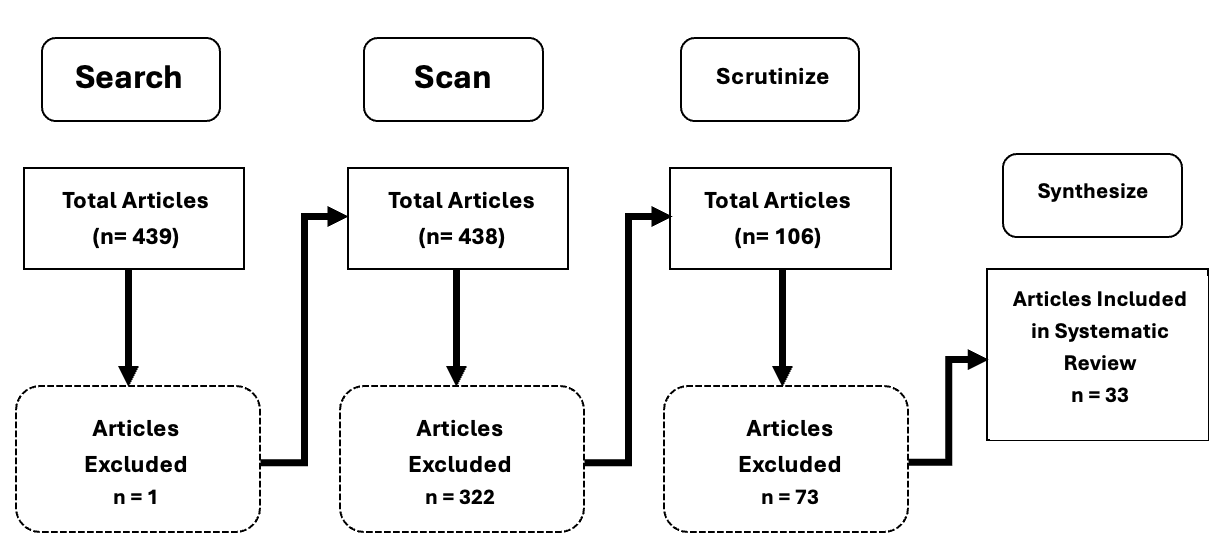
This systematic review used Academic Search Premier and Education Sources Database using PRISMA (Preferred Reporting Items for Systematic Reviews and Meta-Analyses) guidelines. The final search term combination used is “game-based” and “learn*” or “gamification” AND “cognitive skill*” or “cognitive” OR “4C skill*”, resulting in 439 Articles. The process then continued to the Covidence program to run PRISMA guidelines (see Figure 1). There was one duplicate article detected, and then 438 studies were screened by the title and abstract, resulting in 322 irrelevant articles and 106 full-review articles. After the process of full-text review, 73 studies were excluded, and 33 were included.
The inclusion criteria were that the studies had to be empirical studies involving K–12 students, and studies were considered if they employed qualitative, quantitative, or mixed methods designs and reported outcomes related to skill development.
Figure 1
PRISMA breakdown steps
Game-based learning (GBL) improves conceptual understanding and higher-order thinking when the game mechanics align with content and include scaffolds such as prompts and feedback. There are three dominant categories of games found in this systematic review: 1) simulation games which replicate real-world scenarios so students can apply knowledge contextually (Fonseca et al., 2023; Cardinot & Fairfield, 2019), 2) interactive games which provide dynamic content and immediate feedback for sustaining students’ engagement, and 3) collaborative games which emphasize teamwork to foster communication and collaboration. Cardinot and Fairfield (2019) demonstrated that students who played an astronomy board game can show significant gains in content knowledge. Building on, Fonseca et al. (2023) reported that game-based learning in cooperative learning environments promoted emotional engagement, teamwork, and problem-solving. The use of games aligned with Bloom’s Taxonomy ensured that students engaged in higher-order thinking tasks (Cardinot & Fairfield, 2019). Interactive physics games outperformed traditional and video-based instruction (Zeng et al., 2020), VR-GBL boosted STEM literacy (Widiyatmoko et al., 2023), and board games significantly raised post-test scores (Low et al., 2024; Berkinbayeva et al., 2023).
The most frequently targeted skills across game types are critical thinking and creativity, especially in problem-based digital making (Weng et al., 2020). Critical thinking was often developed through the ability to make informed choices, reflect, and skillfully judge information (Van Laar et al., 2020). Communication improves with structured roles, while communication often lags unless designs require explanation or peer critique (Ranuharja et al., 2024; Berkinbayeva et al., 2023). Creativity was supported by open-ended tasks and built-in challenges (Fonseca et al., 2023). GBL also supports constructivist learning, where students actively construct knowledge through exploration and collaboration. This was evident in studies that incorporated cooperative learning strategies, enabling students to share responsibilities, interact with peers, and work toward common goals (Fonseca et al., 2023; Van Laar et al., 2020).
Some challenges faced by the teacher in applying game-based learning are how to provide scaffolding in the form of cognitive questions to stimulate students’ initiative, and the difficulty of creating social group interaction when the learning process takes place (Nurhayati et al., 2023). Other key barriers are weak communication outcomes without discourse tasks (Ranuharja et al., 2024), constraints in the resources (Lampropoulos, 2023), conceptual confusion (Fonseca et al., 2023), and short intervention durations, which limit generalizability. Teachers also expressed concerns about the need for professional development to effectively integrate GBL into curricula for better alignment with student needs and learning objectives (Fonseca et al., 2023).
One proposed solution to solve the challenges is conducting collaborative learning. In this collaborative learning, Nurhayati (2023) indicates that the students will work aimed at the same purpose and interact with peers frequently, resulting in the encouraged participation from all students since they assume responsibilities, share tasks, help each other, and work together.
This review discussed that game-based learning (GBL) is an effective pedagogical tool for advancing both cognitive and 4C skills in K–12 education. Across the 33 reviewed studies, GBL demonstrated its capacity to engage students who promote critical thinking, collaboration, communication, and creativity skills. In line with constructivist learning theory, GBL gives students the chance to actively create knowledge through inquiry, engagement, and problem-solving. Furthermore, interactive and cooperative games foster the growth of communication and teamwork by motivating students to express ideas and strive toward common objectives, while simulation games enable students to apply academic concepts in authentic situations.
There are a number of challenges to the implementation of GBL, including how teachers provide cognitive scaffolds, stimulate learner initiative, and foster social communication when the learning process takes place. Furthermore, the scalability and generalizability of GBL approaches are limited by resource constraints, conceptual confusion, and short intervention durations. The complexity of game mechanics and the lack of professional development opportunities further impede effective implementation. These challenges can be resolved by implementing collaborative learning strategies into practice, encouraging frequent peer interaction, and providing targeted teacher professional development to build confidence while incorporating GBL into the curriculum.
The study indicates that game-based learning has high potential for improving both cognitive skills and the 4C skills (Critical Thinking, Communication, Collaboration, Creativity) in K-12 education. GBL improve active knowledge construction, problem-solving, and higher-order thinking when it is well-designed and aligned with learning goals. Simulation, interactive, and collaborative games are all effective at conceptual understanding and 4C skills development.
The effectiveness of GBL depends on design elements within the games such as scaffolding, discourse tasks, and structured roles. Challenges related to resource constraints, teacher preparation, and short intervention durations require long-term implementation strategies. Collaborative learning strategy and teacher professional development can maximize the benefits of GBL.
 EdTech Archives