Since 2022, generative AI has quickly become a familiar companion in students’ academic work—reshaping how learners read, write, study, and complete assignments (Shahzad et al., 2024; Wang et al., 2025). For educators, this development simultaneously presents new ways to conceptualize learning and new challenges for ensuring that assignments are designed to maximize student learning and growth. As learners increasingly rely on AI systems to brainstorm ideas, summarize readings, check drafts, teach them concepts, and, at times, automate the entire assignment completion process, instructors are called upon to determine how course and task designs can make the most of these new tools’ affordances while supporting students in making choices based on what is best for them as learners.
Thompson et al. (2023) state that higher education is responsible for preparing students for a world in which AI permeates all aspects of professional life. That world includes their university college careers, made up in part by the programs and coursework they undertake as part of their degrees and certifications. This paper addresses that charge and builds on our prior research (Olmanson et al., 2025) to categorize patterns of student engagement with generative AI when they use it to help them learn course-related material and/or complete course assignments. The resulting taxonomy offers a continuum of student AI use organized by level of student agency.
The speed and breadth of generative AI uptake may be explained in part by four areas of convergence between the affordances of generative AI and the values and realities associated with learning and educational environments. First, the capacity of LLM models to perform usefully across content areas (OpenAI, 2024) makes generative AI an emerging technology with wide educational impact in comparison to previous innovative technologies, such as the scientific calculator or PhET simulations. Second, while many impactful educational technologies have been designed to support students during a specific part of the learning process (e.g., Liu et al., 2023; Ritter et al., 2007; Salame & Makki, 2021), generative AI is capable of supporting students at multiple stages and for a range of learning outcomes (Mittal et al., 2024). Third, schools and instructional designers have historically focused on translating applied discipline-specific competence into abstracted activities that focus on the assimilation and production of text-based materials—the very type of artifact that generative AI tools are especially adept at interpreting and producing themselves (Floridi & Chiriatti, 2020; Illich, 2021). Fourth, generative AI has the capacity to: generate the products of learning (e.g., essays, reports, summaries); mimic the process of learning; and participate in some of the social interactions that lead to learning (Cao & Dede, 2023; Lippert et al., 2020; Vygotsky, 2012).
Gaining a better understanding of how large language model-based technologies support learning is underway across domains and grade levels (Tan et al., 2024). However, there is currently a lack of frameworks or taxonomies for understanding the spectrum of generative AI use for learning.
We used a qualitative, five-phase research design to investigate how students in higher education courses engage with generative AI in the completion of learning-related tasks and to develop a framework that categorizes the forms this engagement takes (Figure 1).
Figure 1
Five-Phase Design-Based Research Process Drawing on Two Higher-Education Contexts
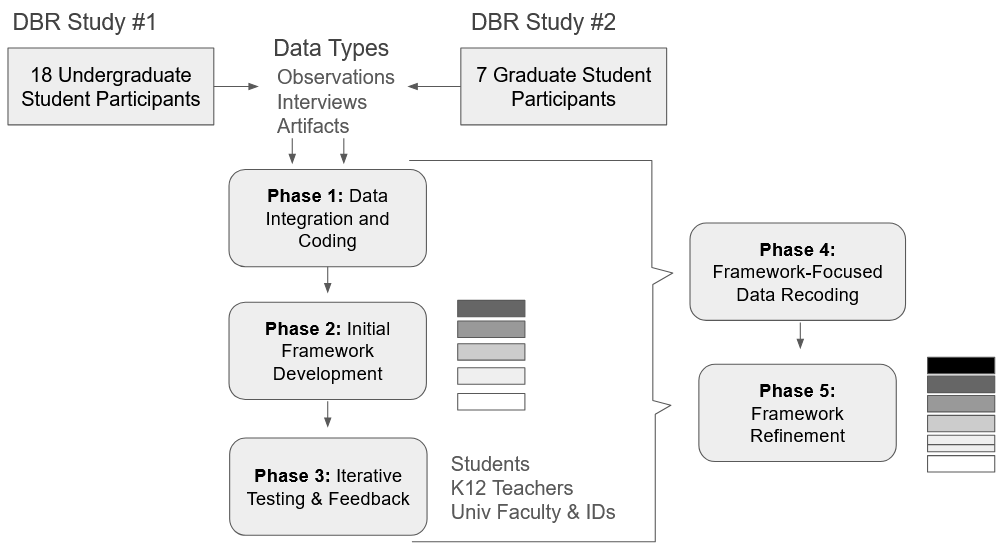
Across phases, we brought together data from two recent studies in which seven graduate and 18 undergraduate students used generative AI tools to support complex coursework. We combined observational, interview, and artifact data and conducted open coding to identify patterns in how participants engaged AI within their learning processes (Weiss, 1995). From this analysis, we abductively sketched an initial heuristic framework that organized recurring forms of AI use. We then tested and refined this early structure through instructional and professional development sessions with students and educators, gathering feedback on the fit and completeness of the categories. Next, we re-examined the full dataset, independently reviewing and reconciling coding decisions to strengthen the analytic boundaries of each category (Anfara et al., 2002). Through iterative comparison and revision, we transformed the preliminary framework into a data-grounded taxonomy aligned with observed learner practices.
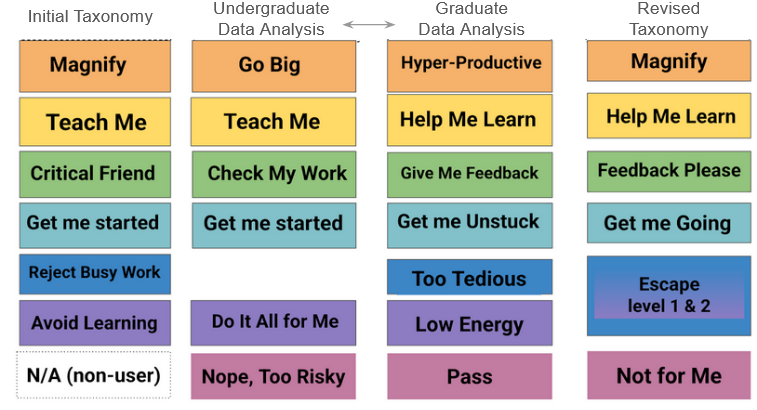
Our abductive, iterative approach meant that the taxonomy took shape as we coded and examined the data, with categories emerging from—rather than preceding—analysis. To capture differences in how undergraduate and graduate students engaged with generative AI across distinct courses and assignments, we initially built two separate taxonomies before merging them into a cohesive model (Figure 2).
Figure 2
Evolution of the Taxonomy across Initial, Intermediate, and Final Category Structures
As shown in Figure 3, the taxonomy is organized across three layers: six main categories, subcategories and motivations, and the roles AI takes on within each. These categories are arrayed vertically to illustrate how certain uses diminish learner responsibility while others extend students’ capacity and agency.
Figure 3
Integrated Taxonomy Showing How Subcategories, AI Role Descriptions, and Learner Agency Levels Align across Forms of Generative AI Use for Learning.
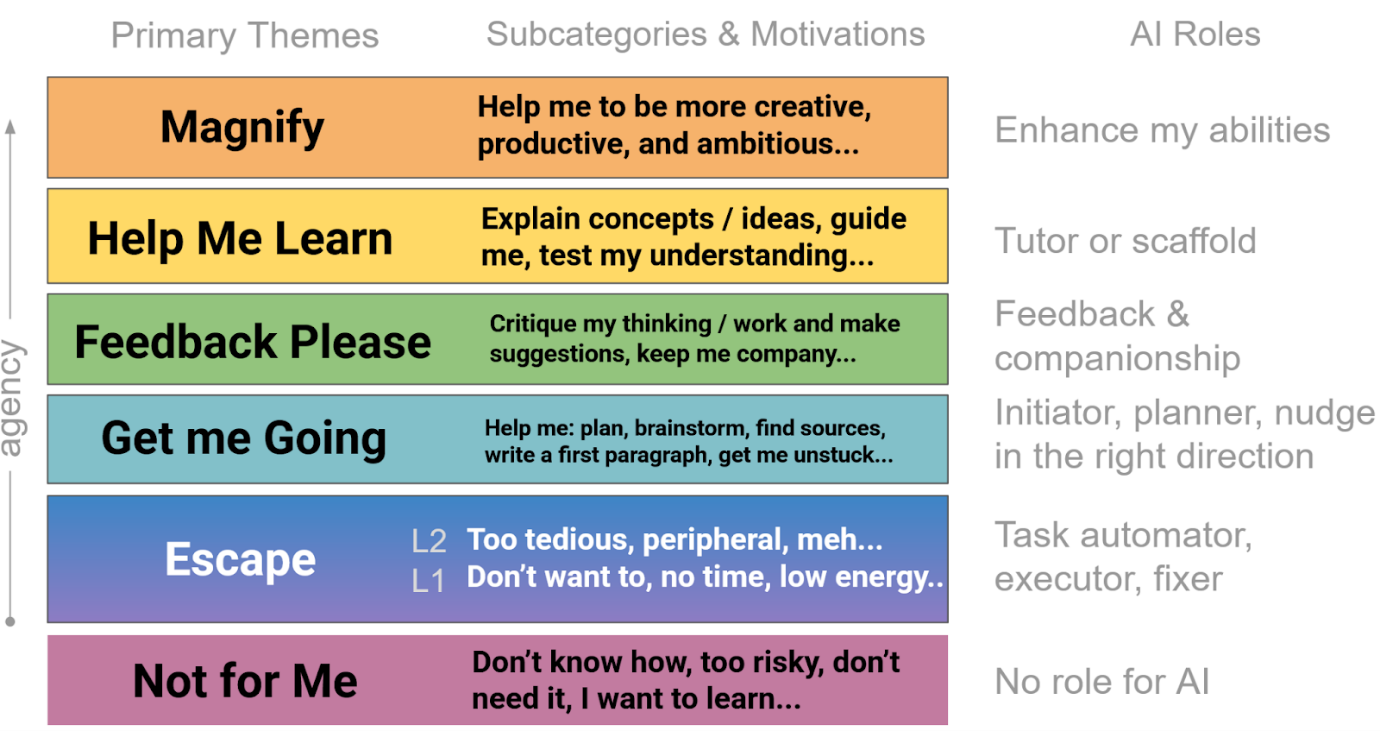
Several participants described purposefully avoiding generative AI, citing cost, ethics, or a desire to learn without technological shortcuts. Some felt that using AI would violate academic norms or undermine their confidence in their own abilities, while others simply lacked familiarity with the tools. This category captures students who consciously chose non-use, illustrating that AI-supported learning does not resonate with all learners and that their reasons are often strongly held.
Participants widely reported that they and their peers used AI to complete entire assignments, often in response to time pressure or low motivation, effectively outsourcing the full task to the model. Students also described using AI to bypass tedious or repetitive work, especially when the task felt peripheral to learning, such as debugging or summarizing readings. Together, these patterns reflect two different forms of escape: relying on AI to complete central coursework, and delegating low-value or monotonous components.
Students used generative AI to change inertia, often turning to AI when facing a blank page, struggling to start an assignment, or getting stuck mid-process. Participants described using AI to generate ideas, plan, or troubleshoot a specific roadblock in programming or a project. Rather than handing over the full task, participants used AI to gain or regain momentum so they could continue the work themselves.
For some participants, AI functioned as an always-available reviewer, offering edits, tone adjustments, or targeted critiques. Participants described prompting AI to act like a strict advisor, a language coach, or a careful proofreader, depending on their needs. These practices emulate instructor or peer feedback but with a customizable style, instant response, and no transactional or affective social elements.
Participants in this category used AI much like a tutor or study partner, asking it to explain unfamiliar concepts, walk through procedural steps, or provide adaptive practice questions. Participants described AI-generated explanations as clearer or more personalized than lectures or traditional search results, particularly when examples or analogies were tailored to their needs. These uses exemplify the types of learning that enable task completion and assessment preparation—with AI supporting conceptual understanding rather than material assignment progress.
A smaller group used AI to extend their learning beyond course expectations, exploring creative, transdisciplinary, or other ambitious directions they would not have attempted alone. Participants described AI in this role as enabling unusually productive work sessions or helping them generate or connect complex ideas that accelerated and enabled their progress. This category reflects AI use as a multiplier of creativity and capability, hinting at future possibilities for human-AI learning and course learning task design.
Our analysis shows that students relate to generative AI in multiple ways, ranging from deliberate non-use to relying on AI for momentum, clarification, critique, or creative magnification. These patterns suggest that AI’s role in learning is shaped not only by the affordances of the technology but also by learners’ goals, confidence, and constraints. The taxonomy illustrates how students can use AI to, in some instances, disengage cognitively while outwardly performing engagement, while in other cases, to deepen their understanding. For learners, the framework serves as a tool for examining their own habits and distinguishing between pathways that strengthen learning and those that avoid it. For instructors and designers, it offers guidance for shaping assignments that foster productive AI-supported work while also giving language to assignment and course-specific expectations for AI use (Olmanson, J., 2026).
 EdTech Archives