Rural secondary science teachers face the major challenge of isolation, sometimes based on their geographic location and sometimes as the only science teacher in their school (Svendsen, 2020). They also often have fewer professional learning and meaningful collaboration opportunities (Wingert et al., 2022) due to geographic distance from each other. That distance can make gathering for professional learning harder to do, and sometimes they are the only science teacher in their school for a specific discipline (e.g., physics, biology, earth science), making collaboration in the discipline difficult.
Understanding best practices in science education requires instruction designed around three-dimensional science: science and engineering practices, crosscutting concepts, and disciplinary core ideas (SEPs, CCCs, and DCIs; National Research Council, 2012). Central to these standards is students learning how to make sense of science using the three dimensions for richer learning experiences. Students integrate the three dimensions by modeling scientists’ and engineers’ actions and thought processes by highlighting that scientific knowledge should not be detached from scientists’ skills and tools (NGSS Lead States, 2013a).
Professional learning assists teachers with instruction. When professional learning is focused, ongoing, collaborative, practice-based, reflective, and connected to local contexts it is more effective for changing teaching practices (Darling-Hammond et al., 2017; Desimone, 2009; Kennedy, 2016). Professional learning specific to three-dimensional science needs to be application-based for lasting change (Marshall et al., 2016). Learning about three-dimensional science is more effective when spread over an extended period (Le, 2019). Teachers can enact better three-dimensional science elements when given time to practice these skills. Teachers also need additional support, such as collaboration with other faculty or peers (Herington & Daubenmire, 2016).
Designing a professional learning opportunity for science teachers that meet the criteria explained above as well as having a long-term impact on practice, where teachers make a change in their practice, involves knowing and meeting the need in practice. That need drives the intent behind the design and enactment, to build something that is useful in practice and supported by iterative, rich research (McKenney & Reeves, 2025).
Within a state in the United States, new science standards had been written and were expected to be adopted by the secondary science teachers across the state. In that state, the rural school districts are grouped under four regions, to provide more place-based support and professional learning activities for the teachers. Discussions among the directors of these four regional service centers, some secondary science teachers, and some researchers, pointed to the opportunities these teachers had to learn about and teach three-dimensional science and what professional learning they still needed. It became clear that the rural secondary science teachers needed more time to wrestle with three-dimensional science ideas, time to dig deeper into understanding how to teach using three-dimensional science, time to iterate on three-dimensional science in their classrooms, and an opportunity to collaborate and reflect with other teachers.
As the collaborators discussed these needs and challenges, it was expressed that being intentional as a team, to design and iterate on a meaningful professional learning program was important. One researcher was resolute that to make strides within practice and use rigorous research activities to inform design decisions, the team needed to form a research-practice partnership (RPP; Coburn & Penuel, 2016) and use an iterative approach to research using design-based implementation research (Penuel et al, 2013). The characteristics of a RPP, a long-term collaboration between educators and researchers focused on addressing persistent problems of practice where knowledge is co-created within a trust-based relationship of equitable power dynamics, and how it could be useful were presented to the collaborators.
Then the process of design-based implementation research, an iterative research methodology that involves designing, developing, and evaluating interventions in real-world settings to solve practical problems and develop theories of learning and teaching, was presented to the collaborators. Within DBIR is the process of co-design, where teams of teachers and researchers work together in defined roles to design something they determine is needed in education, implement it in classrooms, and evaluate it (Roschelle et al., 2006). Co-design can focus on many things, but one important element is teachers and researchers working together to create something the teachers feel an ownership to and they will continue to use and share with others (Westbroek et al., 2019).
The case was made to the partners that using these approaches provided a means for bridging practice activities and rigorous research. The partners eagerly accepted the ideas and put them into place as part of what would be used to tackle the problem before them.
This design case explains the design, decisions, and tensions navigated to develop and implement a professional learning program for and with rural secondary science teachers. It includes a process called technology-mediated lesson study to support the teachers capacity with three-dimensional science, lesson creation and iteration, classroom implementation, and reflection on the process. The aim of the professional learning program was to provide meaningful interactions among the teachers, opportunities for the teachers to grow in their capacity in current science teaching practices, teacher designed and implemented lessons, a leveraging of technology for communication and lesson study activities, and to be informed by rigorous data collection and iterative design.
Four main researchers participated in this program. Each person was included because they had an expertise that would contribute to and benefit the work being conducted. Their expertise was related to science content, science teaching in secondary education and higher education, professional learning and pedagogy, research-practice partnerships, design-based research, lesson study, collaboration, three-dimensional science, and research methods. Each of these areas were benefits but also had the potential for being a bias. For example, putting a priority on data collection for research purposes over designing a good experience for the teachers in the professional learning. Or, prioritizing three-dimensional science knowledge growth for the teachers and three-dimensional science lesson plans over building good relationships among the researchers and teachers. All of the different aspects of the program were important and had to be balanced.
The researchers were committed to providing a good experience for the teachers and the three intentions (see below) of the program. Biases definitely arose related to the expectations in the program and individual’s expertise. These had to be acknowledged and discussed, often with a negotiation on what the current priority was for the program and the teachers. Each researcher had a role in the program related to their expertise and everyone had something they learned through the process. The mindset to learn was shared by all of the researchers.
Responding to the new science standards in the state that were expected to be adopted by secondary science teachers, the regional service center directors supported researchers in writing and securing a federal grant to create a professional learning program for rural secondary science teachers. Written into the grant was financial support for the participating teachers (e.g., classroom substitutes, travel to the in person professional learning meetings, hourly pay for their time outside of school contract hours) as well as support for the researchers, research activities, and materials and supplies.
Knowing that each district or region was in charge of providing professional learning for their teachers and that there was not a specific or standard approach given to everyone, some teachers were given more instruction and time with building their capacity around three-dimensional science than others. So, the partnership established somewhat lofty intentions for the professional learning program and trusted that the partnership and approaches used would be successful. First, principles: design an innovative model for rural secondary science teacher professional learning via technology-mediated lesson study (TMLS) that supports translating professional learning into classroom practice by developing a social support system among rural teachers. Notably, the intention was for this model to allow teachers to interact and learn together when not co-located. It was hoped that TMLS would serve as a model for rural science teachers and any teacher in distance-learning environments. Second, people: build expertise and capacity among the rural secondary science teachers to support three-dimensional science teaching – teaching with disciplinary core ideas, science practices, and crosscutting concepts. Third, products: create and disseminate high-quality three-dimensional science lesson plans aligned with the new science standards that will be shared with teachers in the state and across the country.
The project’s intent was to addresses specific local needs for the rural teachers and a potential model for professional learning that could be broadly applicable in a variety of contexts. The professional learning program was mapped out to take place over four years, with the details of the second through fourth years somewhat unknown as action and data from the first year would drive the design for the second year, the second year driving the design for the third year, and so forth, typical when using a design-based implementation approach.
This work was intentionally designed to include data collection to inform the iterative designs within the program. Decisions for the professional learning activities and TMLS depended on data, such as observations and interviews. This also allowed for flexibility within the design and implementation of the program each year. It also opened the collaborative activities and relationships among the partners (researchers and teachers) for possibilities of great success, challenges, and tensions.
Technology-mediated lesson study (TMLS; Hudson et al., 2024) began as an idea on how to utilize lesson study with teachers who are not co-located in the same building. The success of this professional learning program depended on the creation and successful refinement and implementation of TMLS. In the beginning though, it was a rough idea and the enactment and reality of TMLS was less clear. As a partnership, the researchers and teachers developed TMLS in the first year and then spent the subsequent years refining it. As a more finished process, TMLS utilizes technology so teachers can use lesson study to connect professionally with other educators to develop and improve their teaching and pedagogical skills while physically separated.
TMLS differs from other professional development models, as it preserves the core, collaborative inquiry cycle of lesson study while extending it through technological tools that remove the constraints of time and location. Unlike traditional workshops or one-off training sessions that emphasize expert transmission of knowledge, TMLS centers on continuous, collaborative investigation of lessons, using video recordings, online meetings, and digital artifacts to support group planning, observation, and reflection of a specific lesson. This allows teachers to revisit lessons, analyze student learning, and collaborate asynchronously, which is rarely possible in conventional PD models. As a result, professional learning becomes more continuous, evidence-based, and closely tied to classroom practice rather than episodic or externally driven.
To begin the TMLS process, a small group of teachers came together with shared teaching or other pedagogical goals. The small group of 3-4 teachers is supported by the researchers. In this professional learning program, their purpose in gathering was to create three-dimensional science lessons. Once the lesson is created, one teacher records themselves teaching the lesson to students. Because the lesson is co-created and all of the teachers have provided input on the content focus, the activities for students, assessments, etc., the one teaching commits to following the lesson plan as much as possible, which helps subsequent group analysis focus on the lesson’s content, teaching tools, and classroom practices rather than a particular teacher’s unique personality or skills. After the lesson is recorded and shared with the group, all group members watch, review, and comment on the lesson’s implementation (done asynchronously). Next, the group meets via online video conferencing. These virtual meetings focus on changing the lesson plan and supporting materials and evaluating how well the lesson met the overall TMLS goals. Groups identify changes that need to be made to the lesson before it is taught again.
With a revised lesson, the next teacher in the group begins the process again by teaching it to their students while recording it. The process is repeated until all group members have taught the revised version of the lesson. One element of TMLS that differs from other forms of lesson study—even those that also use technology to help facilitate the lesson study process (e.g., Huang et al., 2019), TMLS does not use outside facilitators or outside content experts to write the lessons or run the TMLS meetings. Instead, and this was an important design decision the researchers made when organizing and planning this professional learning program, practicing teachers become group leaders and lead the TMLS process for their group.
The design of TMLS was intentional with the goals of the professional learning program from the beginning. Keeping those goals in mind as the TMLS process was created and refined were important and had to be at the forefront of everyone’s minds. In the first year, the researchers and teachers worked together in a co-design process (Getenet, 2019) to create TMLS and it was refined in subsequent years.
In the first year, teacher participants were recruited, the content and activities of the workshops and meetings with the teachers were selected and designed (where the professional learning program would be designed), and research activities were finalized.
Four teachers (one from each region) were selected by the regional service center directors to work with the researchers. These four teachers were chosen by the directors based on recommendations from superintendents, who believed they were good teachers, would benefit from the program, and were high school Biology teachers (the target teachers for the first year). The teachers agreed to participate because they were excited about the opportunity and had the bandwidth to participate.
Selection of these four teachers took time and was a bit of a stressor for the researchers because recruitment was out of their control. Waiting for teacher selection was the first test of the partnership as the researchers learned to trust that their regional service center director collaborators would be successful in finding teachers to participate. Through short discussions and check-ins, the researchers learned more about what was being done to recruit teachers and that open communication with their partners helped alleviate the stress they felt about recruiting. The stress was somewhat imposed by the researchers on themselves as they wanted to be sure to fulfill to the federal funder what they had said they would do in the program, which included having new teacher participants each year. Once the four teachers were in place, the stress of finding teacher participants disappeared in the first year.
The stress returned in the subsequent years as recruiting new teachers to the program was difficult and time consuming. Recruitment was initially done through emails to teachers from the regional service centers and the district superintendents. But emails to teachers do not always get read, so teachers who were in the program were asked to talk to colleagues in their district or region and invite them to participate. The researchers also conducted one-day workshops on three-dimensional science in each of the four regions as a recruiting tool and to provide a short professional learning opportunity for teachers in the region. Through these many efforts new teachers were recruited each year to participate in the professional learning program, and it grew. To understand the size of the professional learning program, Table 1 details the number of teachers over the years who participated. There were four main researchers each year with one to three graduate students. While not a large number of people, there were enough different people participating that there were tensions and successes to navigate.
Table 1
Number of teachers who participated in the program
Year | Cohort | Science Teacher Leaders | Teacher Participants | Total Participants |
1: 2021-2022 | Pilot | 4 | 0 | 4 |
2: 2022-2023 | First | 3 | 9 | 12 |
3: 2023-2024 | Second | 6 | 19 | 25 |
4: 2024-2025 | Third | 8 | 21 | 29 |
The researchers intent for activities with the teachers in the pilot cohort was to build their capacity on current three-dimensional science teaching practices, develop and refine the technology-mediated lesson study approach, become the science teachers leaders within the professional learning program to lead a small team of teachers in the next year, and then design the full professional learning program for the second year, where additional teachers would join the program.
In the fall of 2021, the researchers roughly mapped out what they thought the pilot year would look like. They wanted to collaborate with the four teachers throughout the year to co-design and develop the program. This meant having ideas to present to the teachers about what the professional learning program might be, while also providing some instructional content about three-dimensional science, research-practice partnerships, and lesson study so the teachers had similar knowledge in these areas. The first year, referred to as the pilot year, was a series of two-day workshops and synchronous online short meetings with the teachers and researchers.
The in-person meetings took place at a university where there was ample space to collaborate. This included a large classroom with modular furniture and multiple conference rooms for small group collaboration. There was also a digital space for collaboration in Box. This digital space was for creating and storing professional learning materials, lessons and all materials related to them, research materials and data, writing, and more. For the co-design, the researchers would present a goal for the professional learning or TMLS and discuss with the teachers ideas to reach that goal. Everyone was given an opportunity to provide input and ideas and then the best way forward was negotiated among the group. Each voice was important and had space to be heard and considered. Table 2 details when those workshops and meetings took place and the main focus of each one. During this first-year, changes were made on the fly and over time.
Table 2
Year 1 workshops and meetings
Meeting Date | Meeting Type | Modality | Main Topics |
October 22-23 | Two-day workshop | In-person |
|
November 19 | Short meeting | Online synchronous |
|
December 10 | One-day workshop | Planned for In-person, pivoted to online due to weather |
|
January 18 | Short meeting | Online synchronous |
|
February 4-5 | Two-day workshop | In-person |
|
March 23 | Short meeting | Online synchronous |
|
March 25-26 | Two-day workshop | In-person |
|
June 17-18 | Two-day workshop | In-person |
|
July 11-15 | Five-day workshop | In-person |
|
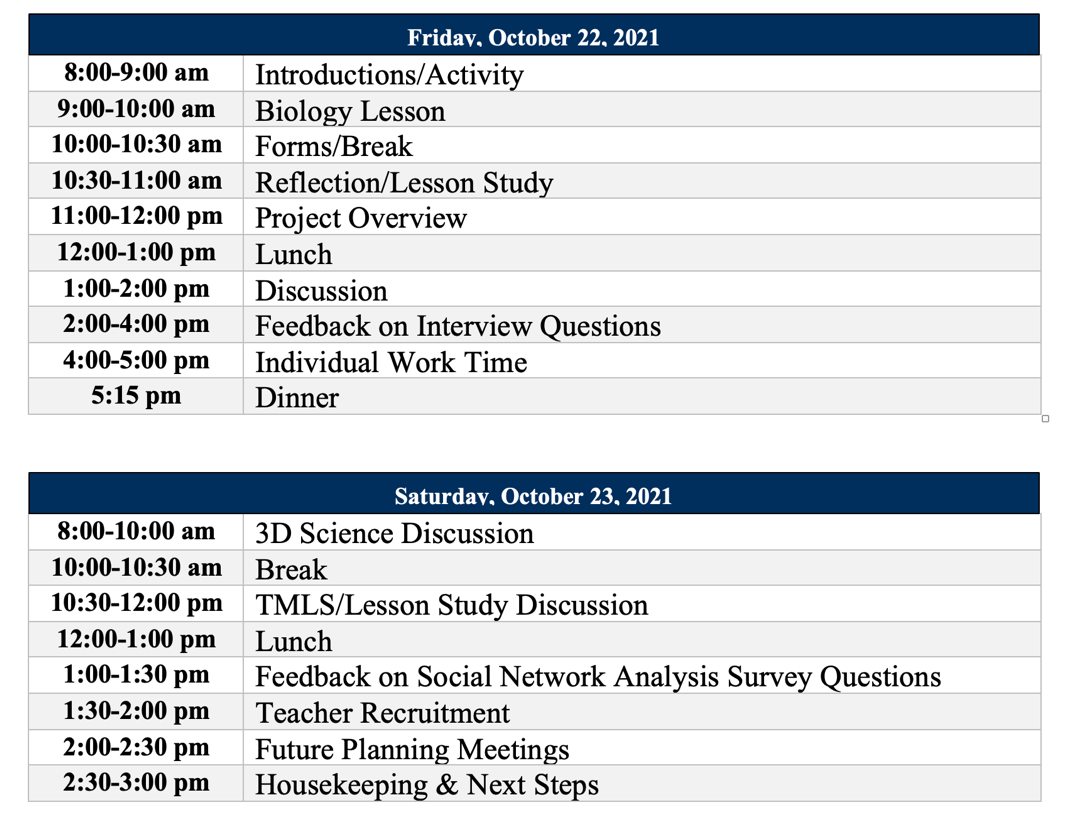
October Workshop. At the first in-person workshop, the researchers were ready to introduce the program and intent of the year, get to know the four teachers better, add to their knowledge of three-dimensional science, and co-design with the teachers what the year would look like. The teachers were excited about the opportunities and activities as well as eager to learn so they could become the science teacher leaders (STL) for the following year. The expectations of designing TMLS, being a STL, and writing lessons was exciting for the four initial teachers. They expressed to the researchers their desire to build their capacity with three-dimensional science for themselves, their students, and other teachers. Figure 1 is the outline of the topics and timing for this workshop.
Initially, the teachers were asked what their favorite science and engineering practice, or cross-cutting concept was. With their replies, it became evident that their knowledge of three-dimensional science was quite different across the four teachers. One had some knowledge and understanding while the other three were more novices. The researchers were surprised by this and had to quickly modify the activities related to three-dimensional science for that day, as what was planned was intended to go deeper into topics for teachers who had more knowledge about three-dimensional science. After a short discussion away from the teachers, the researchers decided to take a simpler and foundation-oriented approach to presenting the concepts and ideas of three-dimensional science.
Figure 1
Outline of first workshop topics and activities
Upon reflection, the researchers realized they had not taken the time before the initial meeting with these teachers to fully understand their knowledge and experiences with three-dimensional science. Asking for more information from the regional service center directors about the teachers recruited would have been helpful. Or a simple interview with the teachers or survey responses from them would have helped. This had the researchers review their data collection activities for the second year. They decided a pre/post interview with the teachers would help them identify the knowledge and experience levels of the teachers on the topic of three-dimensional science. That would help in the design of future instruction and activities for new teacher participants.
As part of good professional learning activities, the researchers believed it was important for the teacher participants to experience a good three-dimensional science lesson as a student. This was presented by one of the researchers and went over well. This element of the first workshop was a success. Everyone enjoyed and learned about the concept presented as well as how three-dimensional science can be presented in a classroom. Even more, this element of meeting together became a focal point for all of the subsequent years. Keeping to elements of good professional learning activities, each summer workshop in years two through four, some teacher participants would present a three-dimensional lesson they had created to the other teachers. This success became an important part of the program as well as a win for the partnership. It represented good practice as well as trust among the researchers and teachers, solidifying the teacher participants as more than just participants but collaborators in the program.
By the end of the second day of the workshop, everyone was more familiar with each other. People were making jokes and asking curiosity questions to get to know each other better. Camaraderie among the researchers and teachers, as partners in the program, was growing. And with that, differences among everyone were also becoming clearer. It is, of course, good to get to know people you are working with, but there were clearly differences in personalities and demeanor among the partners which would be great strengths and great challenges throughout all of the years of the program.
Things we learned. The teachers learned that working in a collaborative group is very hard, especially when you are used to being the one who just does the work and makes decisions (usually for them because they have to). And they learned that working with their peers, bouncing ideas off of each other is something they preferred, and they were willing to work through differences so the group could move forward. Not always easy, but it was worth it.
The researchers learned that many teachers could work through differences in their group and move forward once they had clear heads and could talk calmly. And there were times when a mediator was needed. Sometimes there were tensions among researcher expectations and teacher activity and growth. The researchers learned to keep expectations high, but to give time for teachers to strive toward those expectations. And in time they were met. The researchers learned they were approaching the teacher participants with a deficit model, that they were lacking somewhere and this professional learning program would fill them up. Instead, the researchers learned that the teachers had funds of knowledge and experiences that were just different from suburban and urban teachers. This realization on the researchers side changed their attitudes and approach with their language and interactions with their partnering teachers. The shift in being closer as a partnership, building trust, finding the benefits for everyone, and recognizing what everyone brought to the work was crucial to the partnership approach as well as increasing the capacity of teachers as better instructors and leaders.
December Workshop. This meeting was planned as an in-person workshop, but due to bad weather conditions it was held online in Zoom. This meeting is where the activities of the year really took off. Although the agenda for the meeting was short, the four teacher participants with the researchers began planning the lesson they would teach in their classrooms. There was an instructional component in the workshop, focused on teaching an aspect of three-dimensional science (e.g., SEPs, CCCs, or DCI). The last activity at the workshop was to begin planning what all of the partners believed should be part of the summer workshop the next year. All of the partners learned they could be flexible and adapt as needed with how they met (in-person vs. online).
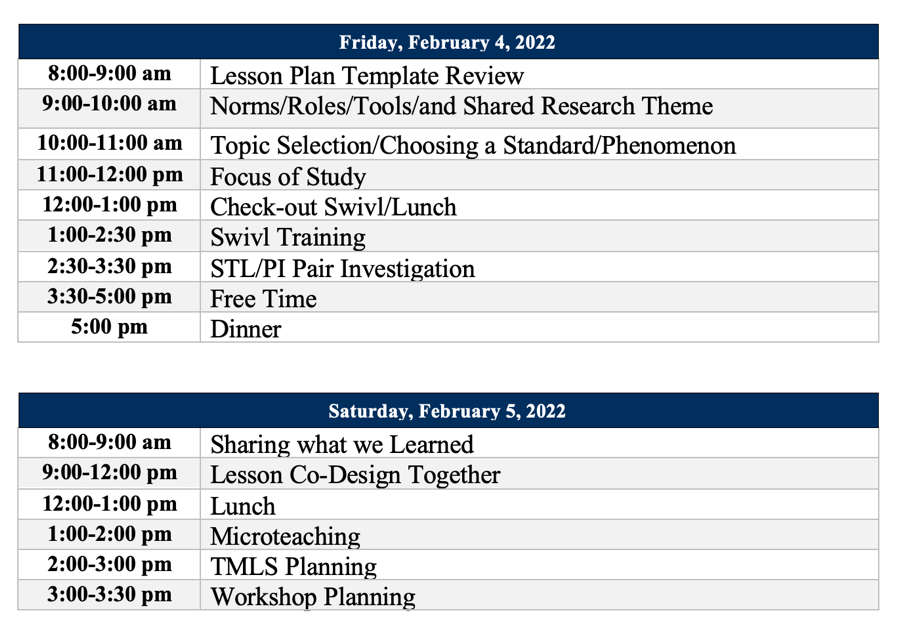
February and March Workshops. These two workshops continued the activities with the four science teachers, learning more about three-dimensional science, co-designing their lesson, learning to evaluate a lesson with the Educators Evaluating the Quality of Instructional Products (EQuIP) rubric (NGSS Lead States, 2013b), planning for the summer workshop, and more (see Figure 2). During this time, the teachers were actively doing the TMLS process with the lesson that had been co-designed with the researchers, refining the TMLS process, and refining the lesson.
Figure 2
Agendas for February and March workshops

Online Synchronous Meetings. Throughout the year, often between the in-person workshops, the teachers and researchers met online in Zoom to discuss various topics or reflect on the program activities. These meetings were usually one hour (see Table 2 for topics). These meetings were meant to build capacity on the various topics and reflect on the program when meeting in-person was not feasible. These were helpful meetings and overall accomplished what they intended.
As the meetings and design activities were conducted to meet the objectives of this professional learning program, there were challenges to resolve, tensions to work through, and successes to celebrate. As an iterative design activity with researchers and teachers, tracking and learning from these challenges and successes were important for the second year of the program. The researchers learned from the teachers what activities were helpful for them to build their capacity around current science practices and brainstormed new ideas for the coming year. They drafted the TMLS process and iterated on it as a first cycle of design, more confident the second year would be smoother. And the researchers gained more experience on how to work closely with teachers, as two of the four researchers were not experienced with collaborative partnerships. The teachers gained knowledge and experience implementing current science practices through the lesson design, reflecting with each other, and the TMLS process. The teachers learned what it meant to become a science teacher leader, and the usefulness of iterative design for growth.
As the second year began, the researcher and teacher partners had a plan for what would be the summer workshop and subsequent two-day workshops with the TMLS work between them. This co-designed professional learning program was set, and the partners were ready to iterate on the process. Additionally, the research activities were planned, and data collection had started with pre-interviews. The design-based implementation research process was guiding research and practice. The partners were relying on the RPP and DBIR approaches to assist and support them, especially when the partners might need to pivot or redesign things quickly. It was heartening in this second year that these processes did support the partners and the research. But, small tensions and challenges crept in at the workshops as interactions between people continued. To resolve these tensions, good communication and good listen skills were necessary, and sometimes a mediator assisted people to diffuse the tension.
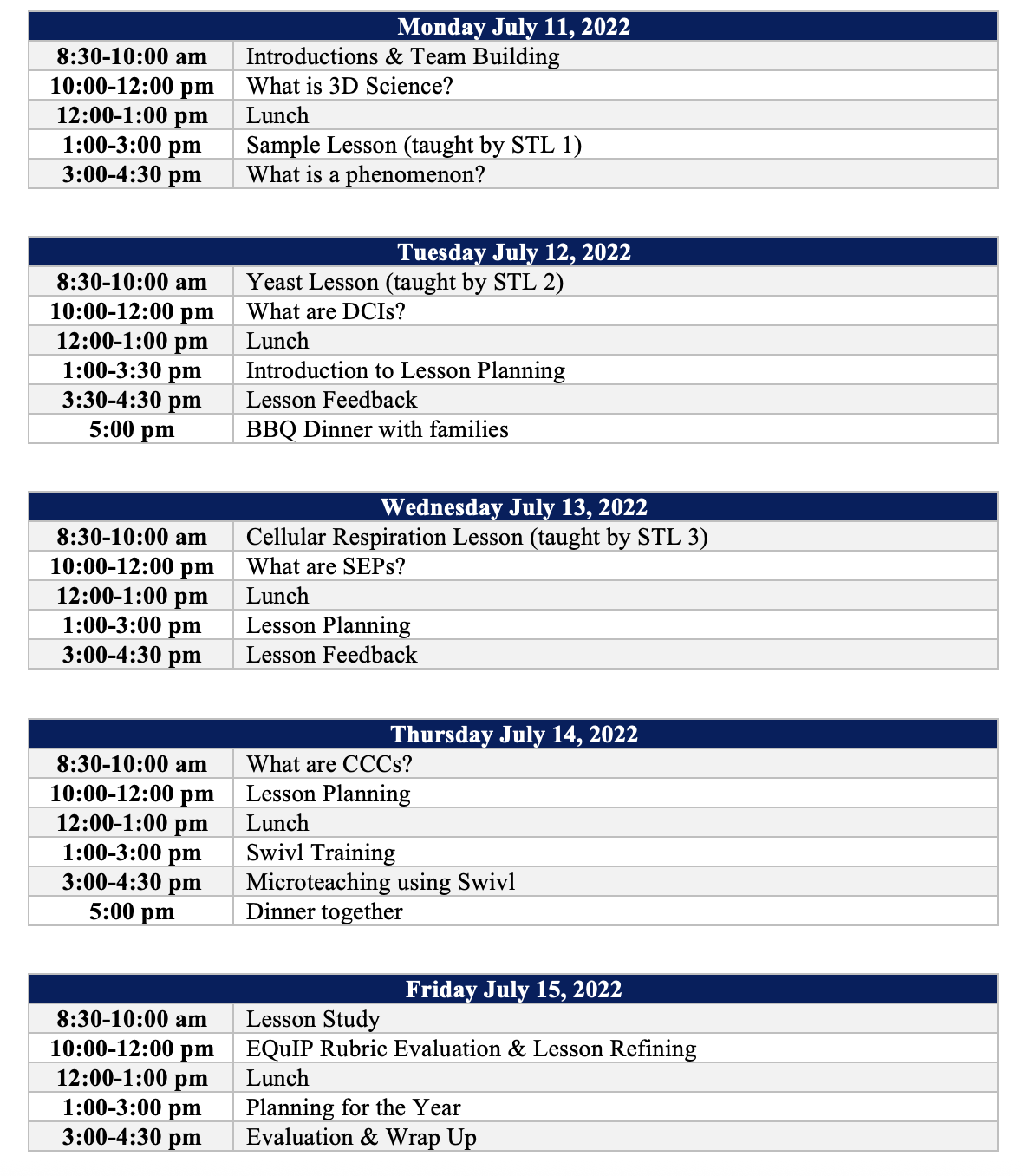
The second year kicked off with a five-day summer workshop (see Figure 3) in July and had four additional two-day workshops planned for throughout the academic year. The design of these days was intentional from what was learned in the first cohort. Three of the teachers from the first year stepped into the role of being a science teacher leader (STL) in the second year of the program, meaning they were leaders on the teacher teams knowing the TMLS process and had some experience designing and implementing a three-dimensional science lesson, and they were co-designing a lesson with their teams of Biology teachers.
Three of the teachers leaders (one was not able to return due to personal reasons) and nine additional teachers participated in the summer workshop with the researchers. In the summer workshop, the teachers experienced a three-dimensional lesson plan as if they were students (it was taught by one of the teacher leaders), they learned about the three dimensions (SEPs, CCCs, DCIs) and how a science lesson can be designed with them as an integral part of it, they co-designed new lessons for high school Biology, they did microteaching to each other of the lessons they designed, and learned how to use the Swivls. They were ready to do technology-mediated lesson study.
Figure 3
First summer workshop agenda
The partners approached the summer workshop and the weekend workshops as small design phases. The partners learned quickly that they needed to work together more closely, so they added a quick check-in meeting with the STLs and the researchers at the end of each day in the summer workshop and the weekend workshops. They also would hold online Zoom meetings between workshops if a challenge arose in a group or any of the partners had something to discuss. Adding more things for the teachers to do was a tension itself in the partnership. The teachers were happy to meet, but it was a strain on them because their time was finite, and the researchers were fully aware of this and strived to be careful with how much time they expected of the STLs (and the other teachers). Unfortunately, with a project this size, burdening the partners (teachers and researchers) crept into the work.
The researchers had many discussions in their weekly meetings about how to address this without compromising the rigor of the professional learning program or the research. This was a tricky balance that in the end was successful enough for the year, but the researchers noted in subsequent years that the attrition of the STLs was high. It is easy to look back and evaluate how something worked or did not work in a program like this. Using the RPP and DBIR approaches should have provided the means to pay attention to many aspects of the work, but this human aspect was not focused on as much. They did learn that communication and making authentic connections with each person in the program was very important. So, activities to get to know each other (teachers and researchers) was incorporated into every in-person meeting.
At the beginning of the summer workshop, three groups were created with the 12 teachers: one science teacher leader and three new teachers in each group. The arrangement of these groups was intentionally done so that they were all in a similar region of the state. In their groups, the teachers designed a high school Biology lesson in each design phase and used the TMLS process with each lesson. As a second iteration of using TMLS, the researchers and the teacher leaders learned more about how to really use this process, what worked well and what didn’t. For example, it was very important that when the teachers met in Zoom, that everyone had watched the recording of the lesson being taught in one of the classrooms. It became clear quickly that a rich conversation about improvements to the lesson and elements that worked well could not be discussed if all of the teachers had not watched the video. That required a level of commitment from each teacher that needed to be discussed at the workshops throughout the year.
In the second year, the teacher groups created four three-dimensional science lessons in each of the TMLS design phases beginning at the summer workshop and a new lesson started at three of the weekend workshops. The researchers and STLs decided that at these workshops a deep dive into a three-dimensional science topic would be presented to the groups and then they would lesson plan, microteach, and revise their lesson. They then enacted TMLS between the workshops, teaching the lessons in their classrooms, watching the recorded videos, and meeting in Zoom to make changes to the lesson based on feedback from teaching it in the classroom. This process was pretty smooth overall. The Zoom meetings often were moved as schedules changed for the teachers, and since the researchers were opening and recording those meetings, they had to be flexible so there was one of the researchers available to open and attend those meetings. That only happened with good communication.
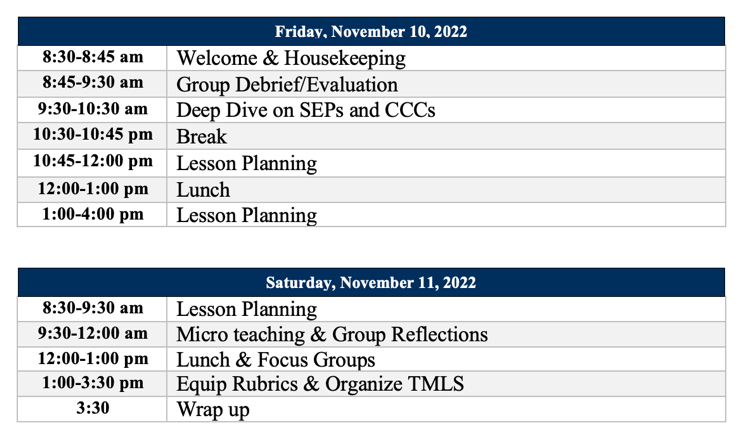
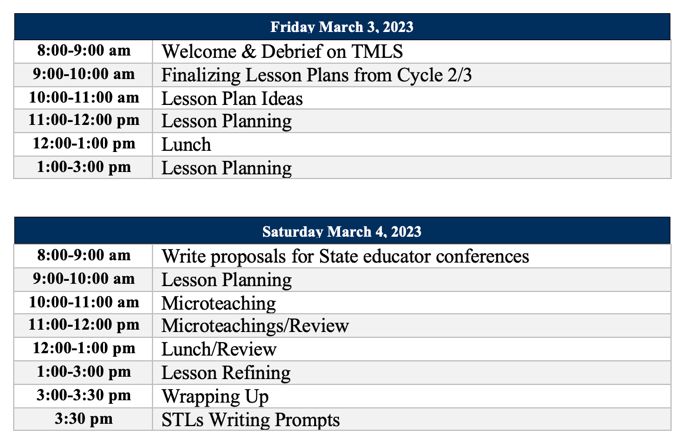
The weekend workshops and the activities for those two days were pretty typical throughout the year (see Figure 4 for a typical agenda), but the researchers added in new ideas that sometime hit and sometimes flopped. Those were related to content about three-dimensional science (usually a hit and the teachers were hungry for more), review of the lessons with a new evaluation instrument (that was a flop and added confusion), and how much the researchers observed and participated in the small group co-design process of the lessons. Sometimes it was helpful for a researcher to be there to assist with content knowledge or technology, and sometimes the researcher being present did not add to the conversations or even created tensions. The teachers enjoyed the collaborative nature of the workshops and were stressed to get their lessons ready to microteach. By the last design cycle of TMLS and creating a lesson, the teachers were faster and more efficient with the creation of a lesson. They voiced that microteaching was an essential element of this process because it helped them see holes in the lesson and they got feedback from peers about how the lesson could be improved.
Figure 4
Example agendas from two weekend workshops in year 2
The researchers had varying knowledge of science topics and professional learning practices and enactment. Together, they were a great team with different strengths and weaknesses. As a research team they were good with communication among themselves but found that sometimes communication among them broke down at workshops when each person felt the importance of checking on the teacher groups or spending time with the teacher groups. These decisions were sometimes made individually and not as a team. Now, this was not necessarily a bad thing for the program, but it highlights that communication is very important throughout design, from planning to enactment.
Navigating Within Constraints. The teachers had to navigate the TMLS process and different lessons within their varying constraints of curricular sequencing and style of teaching. For the sequencing, each group chose a standard in the curriculum that they wanted to work on. Most of the time that fit with their sequencing, but when it didn’t, they would discuss with their group how to handle this challenge and together come up with a solution. There was never just one solution, rather a collaborative approach on how to handle the situation. Additionally, with various personalities and approaches to how a classroom is handled, it would appear that co-design activities would constrain a teacher with their lesson implementation. Instead, because the lesson was co-designed, the personality of each contributor was included in the design of the lesson and what was in the lesson was agreed upon by the group. So, implementing the lesson was not a constraint to them individually.
There were many challenges and tensions that needed to be navigated and resolved throughout this professional learning program. Some of these are detailed above with the description of the design of the professional learning program. The biggest tensions were actually people related, and often related to miscommunications, differences in personalities, differences in expectations, leadership style differences, and the lack of building genuine relationships.
Among the teachers, there were tensions in some of the groups where one person thought they had the best idea for a lesson or felt they were the leader but led with an I know best mentality. Often the groups could discuss how they felt and work out the tension, but sometimes one of the researchers was asked to mediate those discussions. Some of the tensions in the groups could have been alleviated or non-existent if the teachers had been given better instruction and vision for the professional learning program, the TMLS process, and expectations about leadership (that everyone is a leader).
The researchers learned that they needed to revisit often many ideas related to TMLS, three-dimensional science, the vision of the work, and expectations. There was so much information to relay to the teachers, for the teachers to experience and learn about, and often it was like a water hose drowning them, so things were forgotten or missed. Even the researchers found themselves saying, but we discussed that with the groups only to realize it was during the summer workshop or even the year before and the current group of teachers needed the deep dive.
The researchers and teachers experienced tensions among them when personalities clashed. These tensions were sometimes related to content knowledge, or how to lead, or what was good communication, or what would or would not work in a classroom. This was not just a one-time occurrence; there were many personality differences that needed to be navigated over and over. Sometimes this was among the researchers, sometimes among the teachers, and sometimes researcher and teacher. Recognizing the tension and discussing it alleviated some of it over time. Providing opportunities for growth, to understand the people better helped too. Sometimes personality tensions were never fully resolved, but the relationship between the people would improve. Personality tensions did have an effect on design decisions. Usually when decisions needed to be made and a tension existed, it meant more time discussing and working through how people were thinking and where there were disagreements or a bias. Then, negotiating the best steps forward. Sometimes it took multiple meetings to work through these challenges and a lot of reflective activities individually on biases and assumptions. Not everyone was always satisfied, but perspectives were better understood.
Trust, although a characteristic in a RPP and in doing DBIR work, took time to build among all of the researchers and teachers. Trust was linked to personality differences (often this resulted in not having trust or slow building of trust), expectations in the program and growth, and views of other’s experiences and even funds of knowledge. Trust took time and was challenged when outcomes, instead of people were the focus. It was easy to focus on the content for the program, the timing, the recruiting, the research and data collection activities, and iterations and design cycles. This was important work and needed to be done, but when it short-changed the people, it challenged and hindered the basic work the partners set out to do. It was sometimes hard to remember that professional learning and even scholarly work with collaborators is about people. Balancing these two important ideas was not easy: sometimes done well and sometimes not so well. The partners were lucky that most people were very understanding, flexible, and willing to continue moving forward even when things were difficult. The researchers and teachers wanted this program to work and were willing to navigate challenges and tensions that were difficult to deal with so that they could be successful. That was a great attitude seen by many toward building capacity as a person, educator, and scholar.
Aiming for total agreement was a tension and not usually attainable. Talking and working with others who have a different knowledge or understanding of something was another difficult aspect of the work. Striving for a level of negotiation where all parties were ok with the negotiation between them took time, but it was never about total agreement. Being ok with negotiating together to get to a new point was uncomfortable for some partners, took time, and again, was never about total agreement. But these principles are part of RPP and DBIR work and those approaches helped the people navigate this challenge.
Another big tension was navigating time, definitely for the teachers (it helped that they were paid for their time), and time for the researchers in keeping up with the data collection and analysis to inform the iterative cycles of the program. The teachers appreciated being paid for their time, but sometime the needs of their students, their extra-curricular activities at their schools (e.g. coaching, club directors), and timing of assemblies or snow days interrupted well-laid plans for the TMLS cycle and implementing their lessons in their classrooms. This was sometime stressful for the teachers and their teams as they had only a certain number of weeks to iterate on their lessons before meeting again in a two-day workshop. As this tension occurred multiple times, the partners were better about planning when the two-day workshops would be throughout the year so there was ample time within the TMLS design cycle to handle changes.
The researchers were challenged with reviewing and analyzing the large amounts of data they were collecting (to inform the iterative design of this work), which included pre/post interviews, observations at workshops, TMLS Zoom meetings, recordings of the classroom enactment, STL meetings, focus groups, and the lesson plan artifacts. Balancing the practice side with the research side is a challenge many research-practice partnerships face. The design-based implementation research process encourages researchers to collect data, analyze it, and let it inform next steps, but putting that into practical timelines was not easy, but it is worth doing. The researchers found their stride and worked this into their timeline of to dos.
The tensions the researchers and teachers faced were not things that could not be resolved in some fashion. Doing the work to resolve them sometimes took away focus from other things, but in the end seemed to make the work and relationships better. Everyone learned quickly that the group had varying backgrounds and experiences, and it was important to take time to get to know each other as well as build toward a common understanding of language, vision, teaching practices, commitment to the professional learning program, and agreed upon norms. This highlights that working with people can be difficult as well as rewarding, but it takes time to get to know each other and build capacity together. This idea is not limited to researchers and teachers working together, but anytime any people are involved.
This complex professional learning program had limitations, including time to analyze data so it could inform the next cycle of design and navigating the challenges and tensions, as they often slowed progress in the work. The researchers did their best to review, analyze, and discuss data relevant to next steps in the iterative cycles, but sometimes the activity was slower than expected. Navigating the tensions slowed the progress among people, but usually these were made up over time.
Among the many challenges and tensions were successes. These were related to capacity building, refining processes, low attrition, building connections, collaboration, scholarly work, and good professional learning. From the data collected, there were changes over time with the growth and capacity for the teachers related to three-dimensional science, using the TMLS process, and ability to write and implement a good lesson plan. The language the teachers used to discuss three-dimensional science changed over time. Their confidence to talk to other teachers about the professional learning program and what they were doing grew too. The regional service center directors would hear from the superintendents in the various districts in their regions about the great work being done in the program, how the teachers participating were growing and doing good things in the classrooms, and how those teachers were sharing what they were doing with others.
Connecting with the people in the program was a success. There was a lot of humor throughout the time teachers and researchers were together. When there were games played at lunch or other fun competitions the banter and humor thrown around to each other was uplifting and so much fun. No one was offended or upset, it was good fun. Groups would take breaks and walk around outside together, getting to know each other and discussing what they were doing with their lessons in a different environment to mix things up. Eating meals together was an essential element that the researchers credited to the success of making connections. Gathering around food is a nice informal time to chat and be curious about other people, and that was observed with the researchers and teachers. Having formal and informal time to connect was successful.
The shift the researchers had from a deficit way or model of thinking about rural teachers was a great success. This goes back to a designer knowing their audience with accurate information and not making any assumptions. For the researchers to make this shift helped in their interactions with the teachers to see that each teacher had previous experiences and expertise to bring to the work and that should be appreciated and used. This also had an influence on trust among the researchers and teachers and goes back to the characteristic of a research-practice partnership where a goal is to intentionally shift power dynamics to ensure all partners diverse expertise is valued.
Collaboration at its best was observed among the researchers, the teachers, and the researchers and teachers together. People listening, asking questions, praising good work, and making suggestions for improvement were among the interactions. Observing people working well together is a success any group should want. This is bridging the gaps that are so often seen between researchers and teachers, this perceived idea that researchers lead and teachers follow, rather we saw teachers stepping up and leading and being the professionals we know they are. And with that, researchers not overpowering the conversations, but listening more. Again, elements of a research-practice partnership and good collaboration ideas.
In the approaches used in this professional learning program, one success that everyone is happy with is the mutual benefits to everyone who participated. The researchers were getting what they needed, connections with teachers, implementing good professional development, data to analyze and write about that led to publications, as well as opportunities to present work at research conferences and network with the larger research community. And teachers had opportunities to present at local educator conferences to share what they were doing in the program. There were even some teachers who presented at a national educator conference and research conferences with the researchers. This is a very exciting success in the program and one everyone is proud of.
One success that hearkens to the rigor and benefit of the professional learning program was the number of teachers who wanted to return each year. The attrition numbers were low each year, with the majority of teachers returning the next year to participate in the professional learning program. They returned because they saw the value it added to their knowledge and ability to make changes in their classrooms that they were observing as positive changes for their students. So, they wanted to continue to grow and improve and saw this program as an opportunity to do that. Teachers were getting what they wanted and needed from the professional learning program and all of the elements built into it; and part of that was because it was designed with them, for them. They were getting good professional learning that was encouraging change in their classrooms, they were connecting with other teachers across the state, they were given time to practice what they were learning in their classrooms, and they were participating in the development and refinement of technology-mediated lesson study (which they found valuable). Additionally, the teachers were building their capacity with three-dimensional science.
Having a research-practice partnership and using design-based implementation research as approaches to follow and guide the work were helpful. They provided a foundation for doing the work and meeting the goals of principles, people, and products in this professional development program. So, when researchers and educators are looking for how they can work together, these approaches can be used successfully and represent meaningful characteristics of practice-based scholarship. That doesn’t mean they are perfect, as this work shows, the human element is part of them, but the focus for remembering that the work is about humans gets a little lost in actual practice. This can be strengthened when the people involved remember that focusing on the partners, focusing on the human aspect is a goal that should be part of the work. This project had a focus on people, but that was mostly related to building their capacity with three-dimensional science. Focusing on communication among people, building trust, and authentic connections with them is important to incorporate into work being done. We believe when this is done, a stronger culture of practice-based scholarship will exist.
Within the field of learning design technology, that focus on people is important. The focus on the type of work being done with the people is important too. Building relationships and partnerships will encourage a stronger culture of practice-based scholarship. Working with people to build and implement interventions and build capacity of people will do this too, while handing interventions to teachers to test in their classrooms without building relationships with them or input from them will stifle practice-based scholarship.
Designing and implementing the professional learning program and the TMLS process was challenging, but very rewarding for the teachers and the researchers. As an iterative process, it took time to refine the TMLS process as well as the two-day workshops throughout the second year. Some main guiding principles that were learned included establishing norms for the whole group and the individual groups and then revisiting them, reminding everyone that they were in a safe space to make mistakes and grow, and that everyone had experiences and knowledge to bring to the table and something they could learn. As the professional learning program was designed we learned that having a lesson template for the groups to use was helpful as some teachers had never written lesson plans down, that having one assessment tool to guide the learning on three-dimensional sciences was important (so we chose to use the EQuIP Rubric), a focus on three-dimensional science language and practice was very important for establishing common language and practice, and that teachers needed to experience three-dimensional lessons as a student. We learned that collaboratively working with other people is challenging, but it can be done well if everyone is patient, listens to each other, and works through challenges and tensions respectfully. Working through challenges and tensions was one of the most important elements for having a successful program.
For anyone designing a professional learning program with teachers, we suggest that they strongly consider forming a research-practice partnership and using the design-based research approach. These two approaches helped us and provided a great lens for doing practice-based scholarship. We suggest that when working with people, that there is a strong focus on getting to know each other, listening, and respecting the knowledge everyone brings to the work. Everyone has something they bring and something to learn.
This work is supported by the National Science Foundation under grant DRL-2101383. Any opinions, findings, conclusions, or recommendations expressed are those of the authors and do not necessarily reflect the views of the National Science Foundation.
 EdTech Archives