Thailand Cyber University (TCU) is an initiative established by the Ministry of Higher Education, Science, Research, and Innovation (MHESI) of Thailand. It was originally founded in 2005 by the Office of the Higher Education Commission, Ministry of Education, to promote and support online distance education (e-learning) among Thai universities through collaborative activities and shared infrastructure.
Objectives and mission: TCU aims to establish an e-learning consortium that creates a cooperative network among Thai universities for sharing educational resources and programs. It seeks to expand educational opportunities by broadening access for general students and people from diverse educational and occupational backgrounds through distance learning, leveraging the Inter-University Network (UniNet). TCU also aims to enhance the quality of online learning through continuous research and the development of quality assurance guidelines. In addition, it serves as a centralized hub for Massive Open Online Courses (MOOCs) in Thailand through Thai MOOC, which has been providing services since 2016.
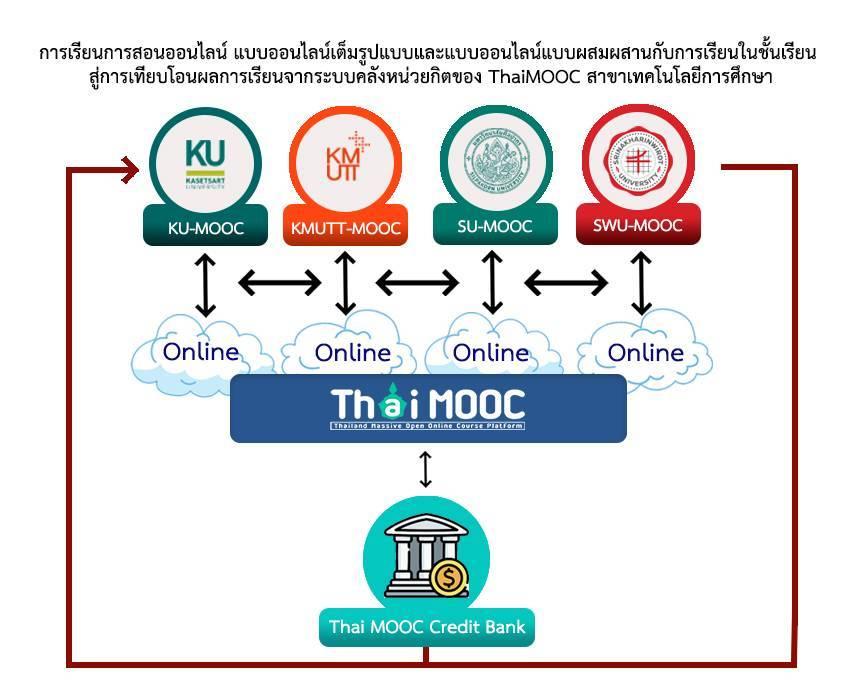
Thai MOOC and inter-institutional collaboration under MHESI, TCU recognizes the importance of fostering academic cooperation to promote MOOCs. The project supports resource sharing of learning media among higher education institutions with different areas of expertise, and it encourages collaborative development and management of open online learning for the general public. It also involves joint development of a central system for managing teaching and learning, implementing assessment and evaluation processes, and recording databases of enrolled learners, academic history, learning outcomes, course credits, and other relevant information. Furthermore, the initiative builds inter-institutional cooperation toward teaching and learning in credit bank courses, cross-institutional course registration, and credit transfer among higher education institutions.
Thai MOOC functions as a central IT architecture to support open education for lifelong learning (Lifelong Learning Space).
Objectives of Thai MOOC, Thai MOOC aims to develop an open online learning management system capable of accommodating an unlimited number of learners, supported by a learner database system, academic history, and accumulated credits through a credit bank and credit transfer, along with a credit transfer system. It also aims to develop standards and practical guidelines for managing open online learning and for quality assurance of MOOCs. Another objective is to build cooperation with and among universities to create or revise course media into MOOC formats and to coordinate credit transfer between institutions. Thai MOOC additionally aims to develop courses, including learning media and learning activities, aligned with MOOC quality standards and pedagogical processes, and to develop a test bank for measuring and evaluating learning outcomes, collecting research data, and improving the quality of teaching, learning processes, and the system.
Goals of the Thai MOOC project: The Thai MOOC project aims to establish a centralized university system with an open online learning management system (Thailand Cyber University) that includes a learner database system, academic history, and accumulated credits through a credit bank and credit transfer, supported by a functional credit transfer system and a test bank system. It also aims to develop widely accepted standards and practical guidelines for teaching and learning management and for quality assurance of MOOC education. In addition, it seeks to develop comprehensive MOOC courses across multiple content areas, including educational technology, upskilling and reskilling for career and professional development, modern teaching and learning management, and computers and digital technology. The project further aims to reach target learners such as employees, entrepreneurs, school and university students, and the general public, while supporting government policy in driving the digital economy and society.
Rationale for the study for these reasons and needs, it is necessary to design and develop the curriculum and courses in the MOOC system and to establish credit transfer guidelines using the ThaiMOOC credit bank system.
The purpose of this research was:
1) to study and collect subjects in fields related to subjects in the educational technology programs for cumulative credit learning and the system for transferring learning results from the ThaiMOOC credit bank system in the educational technology field, educational technology programs, Thailand.
2) to design and develop online MOOC courses in the educational technology programs of participating universities, cumulative credit learning, and a learning achievement transfer system from the ThaiMOOC credit bank system.
3) to the implementation and evaluation of online MOOC courses in educational technology programs of participating universities, to accumulate credits and transfer learning results from the ThaiMOOC credit system.
The sample of this research consisted of 349 students from four universities in Thailand. All participating universities agreed in principle and expressed their intention to collaborate in professional fields where the same subjects are taught across their curricula. The participating universities were Silpakorn University (SU), Srinakharinwirot University (SWU), Kasetsart University (KU), and King Mongkut's University of Technology Thonburi (KMUTT).
The research instruments used in this study included structured interviews, the ThaiMOOC development model, and ten MOOC courses in the educational technology program delivered on the ThaiMOOC platform (https://thaimooc.ac.th) using Open edX under the Thai MOOC Academy (Thailand Massive Open Online Course). Additional instruments included a learning achievement test, an expert evaluation form, and a questionnaire to collect students’ opinions.
1. Study model of MOOC courses in the educational technology program and collect subjects in fields related to subjects in the educational technology programs for cumulative credit learning and the system for transferring learning results from the ThaiMOOC credit bank system in the educational technology field, educational technology programs in Thailand by document and research analysis
2. Interview the experts on content and MOOC course design of online learning and credit bank system in the educational technology field
A focus group of lecturers from participating universities will present and select courses from all four universities to be used in designing and developing MOOC courses.


Design and development of the MOOC courses
Participating universities, through course presentations, design and develop courses for teaching MOOCs according to the steps and processes of the model specified in Phase 1.
The implementation and evaluation of online MOOC courses in educational technology programs of participating universities 4U
The results of this research are as follows:
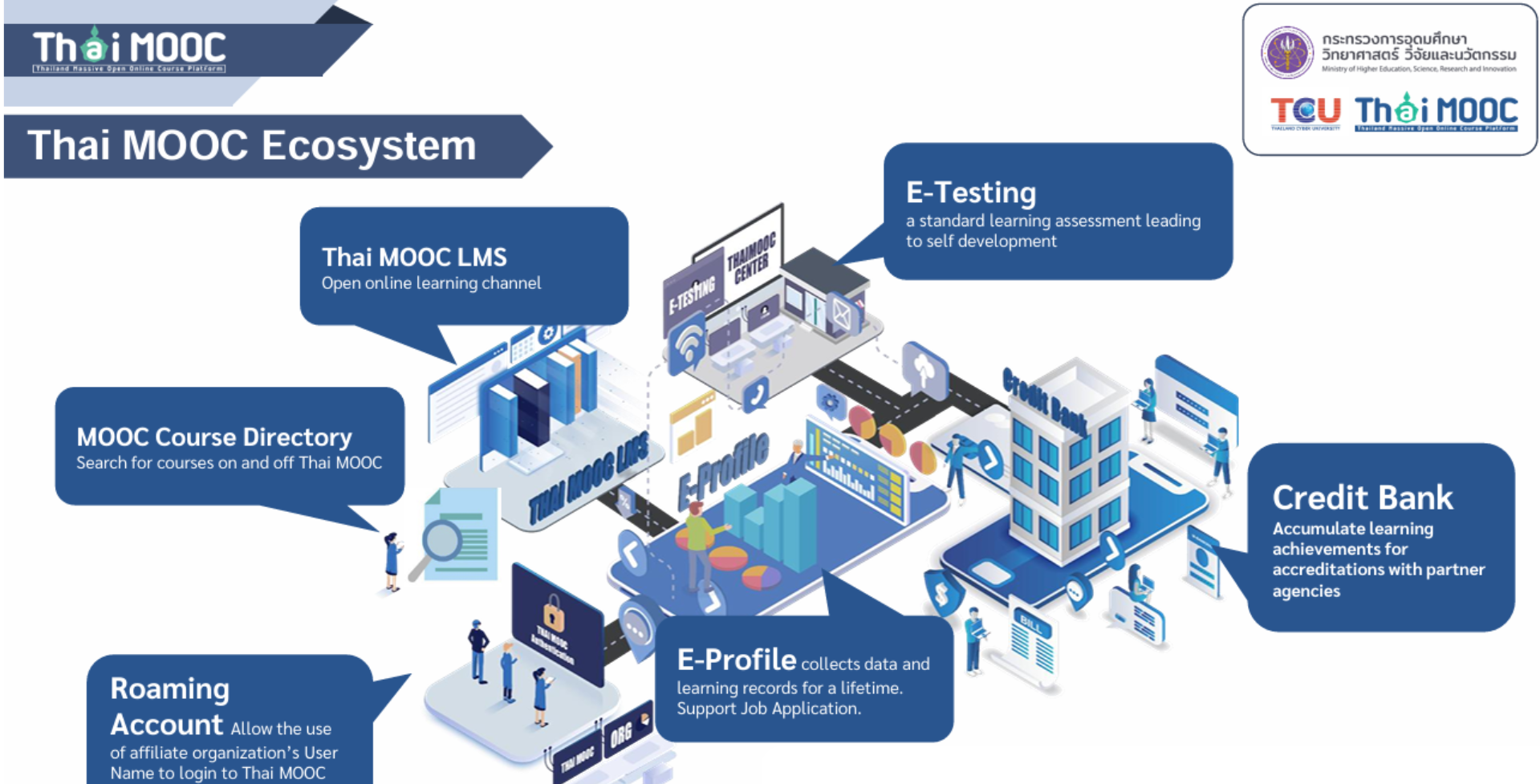
1. The model of MOOC courses in the educational technology program on the ThaiMOOC platform and the ThaiMOOC credit bank system design and development used the 3P model (presage, process, and product) and included 1) Course information: objective, learning outcome, learning hour of content, content level, assessment, evaluation criteria, staff, and support team (teacher/team support course). 2) Course design and development: instructional design, contents, media for learning, communication, copyright, and Creative Commons 3) MOOC course and implementation: student support 4) Course evaluation: learning achievement, improvement, and development.
The model of MOOC courses in the educational technology program on the ThaiMOOC platform and the ThaiMOOC credit bank system design development
Figure 1
The model of MOOC courses in the educational technology program on the ThaiMOOC platform and
The ThaiMOOC credit bank system design and development
2. Design and development of MOOC courses in educational technology programs
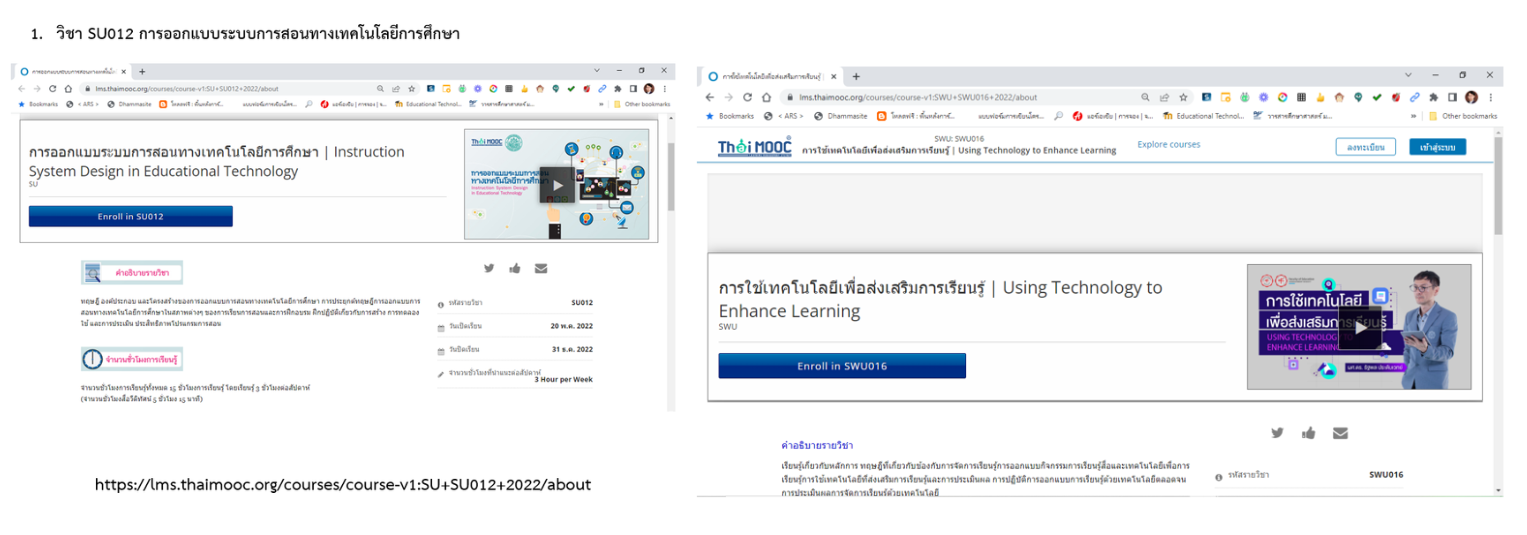
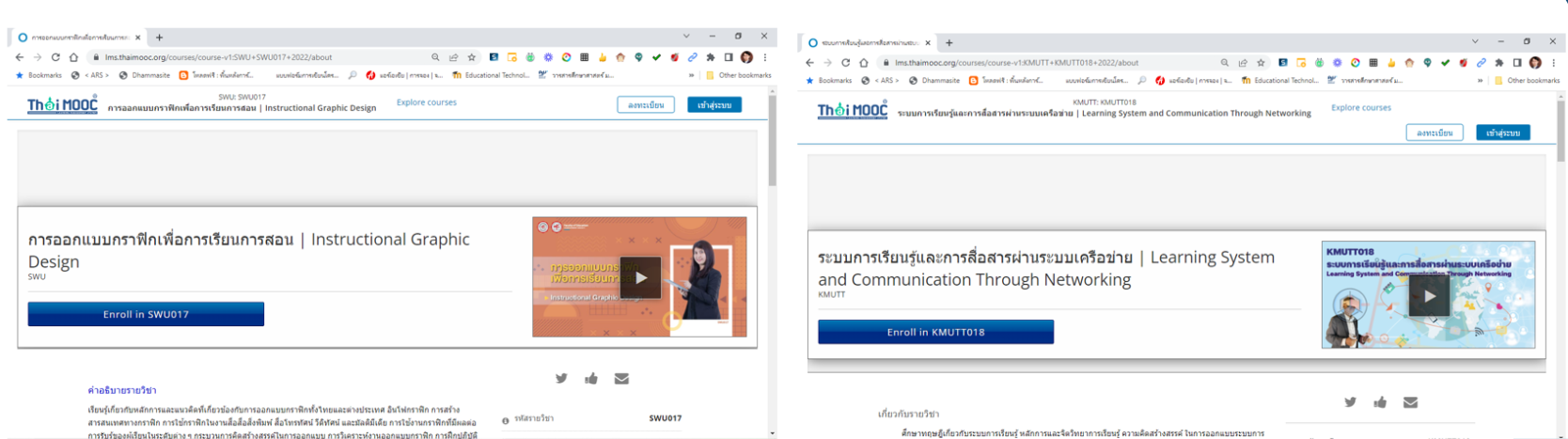
Ten MOOC courses were designed and developed for the educational technology programs, including
1) Instructional system design in educational technology, 2) Research methodology in educational technology, 3) Technology and contemporary education, 4) New media for learning, 5) Instructional innovation and media design and development, 6) Special problems of educational communication technology, 7) Learning system and communication through networking, 8) Advanced photography, 9) Using technology to enhance learning, and 10) Instructional graphic design. The evaluation results indicated that the ten courses were approved by six experts and were rated at a high quality level (mean = 4.55, S.D. = 0.44).
Figure 2
MOOC courses in the educational technology program, ten courses on the ThaiMOOC platform
https://thaimooc.ac.th: open edx Thai MOOC Academy Thailand Massive Open Online Course
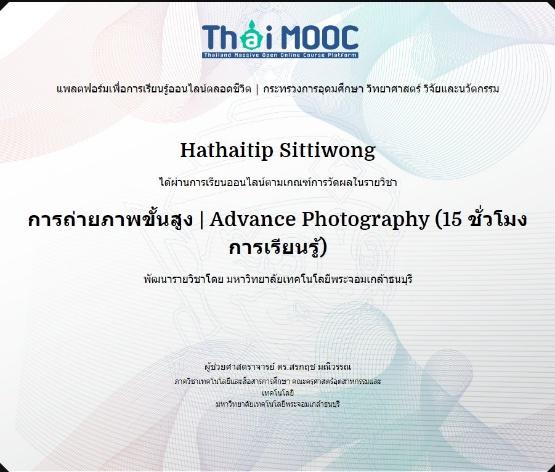
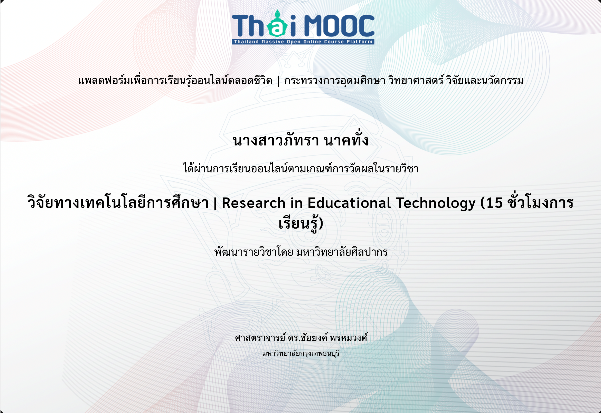
3. Implementation and evaluation of online MOOC courses in educational technology programs of participating universities to accumulate credits and transfer learning results from the ThaiMOOC credit system, students got certifications
Figure 3
Online MOOC courses and certifications for completing educational technology programs of participating universities
4. Students opinions of students who study on MOOC courses in educational technology programs have a very good level (mean = 4.50, S.D. = 0.54), and the factors in the decision to choose to study online MOOC courses and the successful completion of online MOOC courses in the educational technology programs include content, learning activities, learning design, media design, usability, benefit, and knowledge.
Table 1
Students' opinions of students who study on MOOC courses in 10 educational technology programs have a high level (N=349)
Course | Means | S.D. | Opinions |
SU012 Instructional system design in educational technology (N=69) | 4.55 | 0.22 | Very Good |
SU013 Research methodology in educational technology (N=64) | 4.51 | 0.39 | Very Good |
SU014 Technology and contemporary education (N=29) | 4.34 | 0.21 | Very Good |
SU015 New media for learning (N=30) | 4.33 | 0.26 | Very Good |
KU011 Instructional innovation and media design and development (N=22) | 4.63 | 0.33 | Very Good |
KU010 Special problems of educational communication technology (N=33) | 4.62 | 0.30 | Very Good |
KMUTT018 Learning system and communication through networking (N=25) | 4.68 | 0.24 | Very Good |
KMUTT019 Advanced photography (N=18) | 4.55 | 0.40 | Very Good |
SWU016 Using technology to enhance learning (N=20) | 4.60 | 0.28 | Very Good |
SWU017 Instructional Graphic Design (N=17) | 4.58 | 0.20 | Very Good |
Credits Transfer System
Learners should meet the admission requirements specified in the university’s graduate study regulations.
They should enroll in the curriculum with the intention of accumulating credits through a credit bank, with
the university recording earned credits in the general education service database. Learners may also take ThaiMOOC courses without intending to earn credits, but with the intention of obtaining a certificate.
In addition, prior knowledge and experience demonstrated through a ThaiMOOC course certificate may be transferred toward further study at an educational institution; in such cases, assessment should focus on previous work and typically involve a portfolio review or a comprehensive examination before courses are transferred or exemptions are granted. All course transfers or exemptions should comply with the regulations of the respective university.
This research was supported by Thailand Cyber University Project (TCU), Ministry of Higher Education, Science, Research and Innovation (MHESI), Thailand.
 EdTech Archives