Cultural learning is crucial, as it can enhance learners’ understanding of the diversity of beliefs and values around the world, which not only helps reduce their stereotypes about other cultures but also facilitates building relationships and collaborations with people from different backgrounds (Lin, 2020). In addition to intercultural learning, learning about cultural heritage is an important aspect of cultural learning, as it can deepen learners’ knowledge of history and traditions and foster awareness of identity preservation (Achille & Fiorillo, 2022).
Traditional cultural learning through travel is costly and time-consuming, while books and videos can be boring (Gao et al., 2021). Extended Reality (XR) has emerged as a popular technological solution, gaining widespread attention in cultural education (Gonzalez Vargas et al., 2020). XR uniquely enables experiential engagement, allowing learners to explore cultural content in authentic-like contexts (Ma et al., 2025), though its integration into cultural learning remains underexplored and fragmented. While previous systematic reviews have explored technology in cultural contexts, none have comprehensively addressed XR in broad cultural learning. For instance, Rodriguez-Garcia et al. (2024) focused solely on VR, excluding AR and intercultural communication, while Li & Othman (2024) and Silva & Teixeira (2022) limited their scope to XR within museum exhibitions. Conversely, Shadiev et al. (2024) analyzed cross-cultural learning but did not focus specifically on XR tools. Consequently, this review distinguishes itself by exclusively examining XR technology across all cultural learning contexts. Therefore, this systematic review intends to determine the cultural aspects, instructional strategies, and XR’s influence on learners’ cultural competence.
The research questions are:
What cultural aspects are explored in previous studies related to cultural learning with XR?
What instructional strategies are applied when using XR for cultural learning?
How does embodied learning through XR environments influence learners' cultural competence?
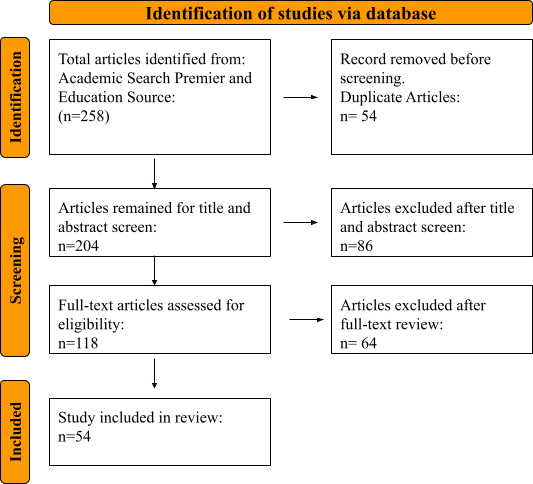
This systematic review was conducted on peer-reviewed articles published between 2015 and 2024 that focused on the application of XR technology in cultural learning, following the Preferred Reporting Items for Systematic Reviews and Meta-Analyses (PRISMA) guidelines (Liberati et al., 2009). The databases selected for this systematic review include Scopus, Web of Science, Academic Search Premier, and Education Source, with the following search strings: “VR” OR “AR” OR “XR” OR “MR” OR “Virtual Reality” OR “Augmented Reality” OR “Extended Reality” OR “X Reality” OR “Mixed Reality” AND “cultural learning” OR “cross cultural communication” OR “cultural education” OR “cultural competence” OR “cultural education” OR “cross cultural learning” OR “foreign culture”. This initial search yielded 258 studies, and we removed 54 duplicates. After screening the titles and abstracts for appropriateness and removing an additional 86 articles, 118 articles remain for full-text review. The full-text review follows the following inclusion criteria: empirical study; published in English; lists a specific XR tool/software/app; lists a specific XR-based instructional method; related to cultural learning; explores a specific cultural aspect; and available in full text. And finally, 54 articles are included for data extraction. The PRISMA process is summarized in Figure 1.
Figure 1
PRISMA chart for the screening process
The 54 reviewed studies examined diverse cultural themes within XR-based learning environments. Cultural heritage emerged as the predominant focus, featuring in 22 studies across multiple dimensions. These investigations addressed tangible heritage (including historical architecture and physical artifacts), intangible heritage (encompassing traditional customs, culinary practices, and festivals), and digital heritage representations within museum contexts. A distinctive characteristic of these studies was their emphasis on spatial and contextual reconstruction, enabling learners to engage with artifacts and rituals through immersive virtual museum experiences (e.g., Bekele et al., 2021; Cabanillas-Carbonell et al., 2023). Cross-cultural competencies constituted another substantial research area, with 15 studies examining intercultural dynamics—8 investigating cross-cultural learning and 7 specifically targeting communication competencies. These investigations frequently employed XR technologies to simulate intercultural encounters and facilitate role-playing scenarios between participants from diverse cultural backgrounds (e.g., Aziz et al., 2024).
Additional cultural domains received more limited attention, including art (n = 5), urban environments, literature, and local traditions or culinary practices. These themes were typically embedded within language and culture curricula to foster cultural empathy and awareness. This thematic diversity demonstrates XR technology's versatility in addressing varied culture-based educational objectives.
The analysis of instructional strategies revealed a predominant emphasis on experiential and constructivist pedagogical approaches within XR-based cultural learning environments. Experiential learning emerged as the most prevalent strategy, implemented in 19 studies, emphasizing direct interaction with and manipulation of digital cultural artifacts and environments. This approach leveraged XR's capacity to transform passive observation into active participation, enabling learners to construct knowledge through embodied experiences rather than abstract instruction. Situated learning constituted the second most common approach, appearing in 14 studies. These implementations frequently integrated contextual storytelling and embedded cultural cues, positioning learners within authentic cultural scenarios that mirror real-world contexts. The co-occurrence of experiential and situated learning strategies suggests a complementary relationship, where immersive environments facilitate both active engagement and contextual understanding. Task-based learning (n = 8) and game-based learning (n = 6) represented structured approaches that incorporated goal-oriented activities and gamification elements. These strategies leveraged XR's interactive capabilities to create mission-driven experiences in which cultural learning objectives were embedded within purposeful activities and narrative frameworks. Project-based learning, though less frequent (n = 4), demonstrated XR's potential for supporting extended, inquiry-driven cultural investigations.
The analysis revealed that XR technologies were employed to deliver a range of pedagogical and experiential functions across cultural learning contexts. The most frequently implemented function was the creation of an immersive context, noted in 29 studies. This function included simulating real-world environments or cultural settings, allowing learners to explore spaces that are physically distant or historically reconstructed. Learners were reported to have better knowledge recall since they could experience the nuances of the environment (DeWitt et al., 2022) and better comprehend cultural values through direct engagement in a virtual environment (Iasha et al., 2023).
To serve better emotional engagement and spatial presence, XR studies also integrated other activities related to 3D environments, virtual reconstructions of historical landmarks, and narrative-driven experiences. For example, Lee et al. (2021) integrated 3D assembly-making, an AR quiz game, and a museum visit to provide a blended learning experience for children, in addition to using the VR app.
Other widely adopted XR functions included situated information delivery (n = 11), where learners received embedded cultural knowledge contextualized within the XR environment. Simulated interaction and learner-to-learner interaction were reported in 9 studies each, showing that XR is increasingly used to support social presence and dialogic engagement. Less frequently mentioned were gamification features (n = 5), multi-modal interaction, and contextual relationship enhancement, which suggest evolving trends in the design of XR learning systems.
This review highlights the expanding role of XR in cultural learning across diverse educational contexts. By synthesizing XR tools and associated pedagogical strategies, the study provides a practical foundation for educators and researchers seeking to design experiential and culturally responsive learning environments. The findings illustrate how XR’s immersive and embodied affordances can enrich cultural learning experiences. However, there are several limitations of this review. First, the review includes only English-language publications, potentially excluding impactful work conducted in other regions. Second, few studies address the challenges of XR use, such as physical discomfort, accessibility barriers, and technological inequities, which may affect learning effectiveness and warrant more systematic examination. Third, current research largely focuses on university learners, with limited attention to K–12 contexts despite XR’s potential value for early cultural learning. Finally, cultural themes remain concentrated in limited geographic regions, underscoring the need for broader representation of underexplored areas such as Africa and South America. Future research should investigate XR’s negative impacts, expand its use in K–12 settings, and incorporate more diverse cultural perspectives to ensure equitable, culturally inclusive XR-based learning.
 EdTech Archives