Science education has become a cornerstone of society, and there is a pressing need for everyone to be scientifically literate. Science is often perceived as a niche field for scientists and STEM professionals, but it has become an essential skill in the 21st century, akin to reading and writing (Committee on the Call to Action for Science Education et al., 2021). There is a lack of motivation in science education as students progress through secondary and postsecondary levels. In postsecondary public education, students typically enroll in science courses regardless of their major. Courses include biology, chemistry, geography, geology, and physics. Regardless, science literacy amongst college students is only marginally higher than that of their non-college peers (Impey et al., 2011). Persistence in STEM education depends on the overall quality of the program and the student experience (Xu, 2018). Also, it has been shown that students experience a decline in motivation from the beginning to the end of the semester (Reece & Butler, 2017). Additionally, many undergraduate STEM programs struggle with student persistence. Motivation has been shown to enhance engagement and retention.
Differentiated instruction has been shown to increase engagement (Smale-Jacobse et al., 2019), yet few practical tools are available to assess the motivational makeup of STEM courses and to inform differentiated instruction, enabling teachers to support students' motivation. Additionally, the literature calls for more research on the link between differentiation practices and students’ engagement (van Geel et al., 2019).
Self-Determination Theory (SDT), developed by Ryan and Deci (2000), is one of the motivational theories applied in science or STEM education. SDT views motivation along a continuum from amotivation (lack of motivation) through various forms of extrinsic motivation to intrinsic motivation (fully self-determined and driven by inherent interest and enjoyment). The Academic Motivation Scale (AMS, Lim & Chapman, 2015), a validated instrument based on SDT, measures five motivational sub-dimensions: motivation, external regulation, introjected regulation, identified regulation, and intrinsic motivation.
This study utilized the AMS dataset gathered from a study on STEM motivation (LaPaglia, 2023), including Likert-scale data and an open-ended question in which students provided text responses to the AMS prompt.
The question was added to validate the datasets and was found to offer additional valuable insights into the students’ motivation. To further investigate how that survey with open-ended questions can be utilized by instructors, the dataset was reevaluated to provide a differentiated view of motivation and student-individualized voices through descriptive analysis and recoding of the text responses.
The dataset was the outcome of an explanatory sequential mixed-methods study that combined quantitative and qualitative phases to investigate motivation for science education in relation to STEM career orientation. Students enrolled in science courses in four institutions participated in the first survey phase of the study (LaPaglia, 2023, Appendix A). 235 undergraduate college students completed the survey, with an average completion time of seven minutes and responses for all 21 AMS questions. Survey data screening included checks for plausible range, missing data, normality, homogeneity of variance, outliers, and linearity to ensure appropriate statistical analyses. Confirmatory factor analysis was conducted to investigate the factor structure of the modified AMS instrument and confirmed that the survey questions loaded onto their respective motivational constructs; thus, the survey questions can be assumed to measure their respective motivational factors.
For this analysis, the dataset was narrowed to the 220 datasets that included an answer to the open-ended question. For the descriptive analysis of AMS levels, the average level for each motivational factor was calculated. This resulted in five data points per student, one for each of the constructs AMOT, EMER, EMIN, EMID, and IM. The responses to the open-ended question were coded to the motivational factors AMOT, EMER, EMIN, EMID, and IM utilizing the loci of motivation cause and regulation of the Self-Determination Theory as a priori codes (Ryan & Deci, 2000). Coding was done using the actual terms and language used by the participants, a method called in vivo coding (Saldaña, 2016).
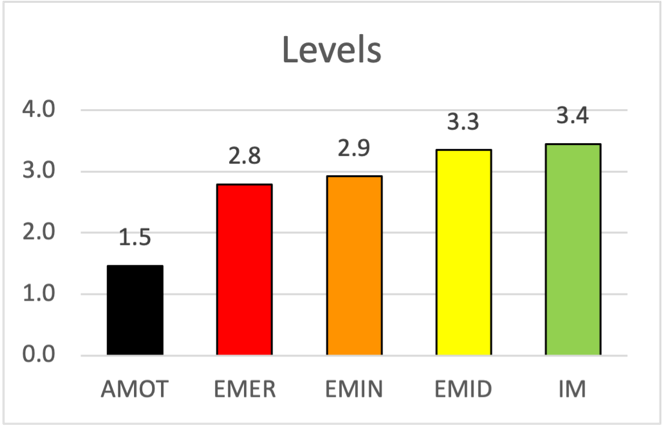
The overall average for each motivational factor was calculated for the group of 220 students (Figure 1, Levels). A few students had low motivation. Overall, motivation increased from externally regulated (EMER) to introjected (EMIN) and identified (EMID) extrinsic motivation, and finally to intrinsic motivation (IM), with a score of 3.4 out of 5. The responses to the open-ended question, in which students volunteered their reasons for engaging in science education, highlight what they felt motivated them (Figure 1, Importance). The figure shows that very few students report a lack of motivation (AMOT). Externally regulated motivation (EMER) was named most often as the driving motivation; some named intrinsic motivation (IM), less identified motivation (EMID), and some mentioned introjected motivation (EMIN).
Figure 1
Levels and Importance of Motivation
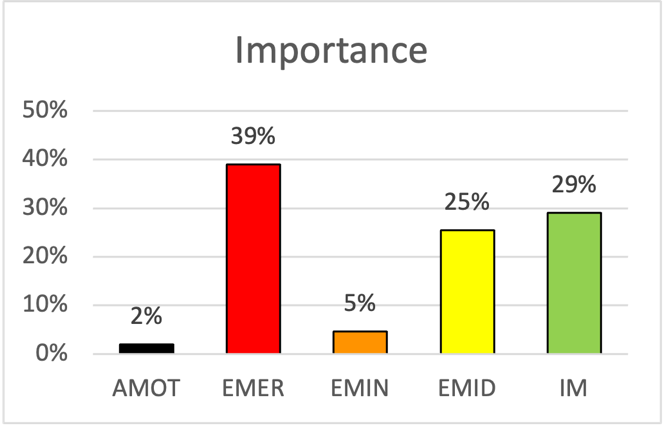
Students often cite several motivations in their text responses. The responses of some students could be coded to only one motivational factor: 3 for AMOT, 70 for EMER, 2 for EMIN, 44 for EMID, and 28 for IM. Two students combined AMOT with one or two other motivations (EMER, EMIN, and EMID). 37 combined EMER with one other motivation (29 with IM, 6 with EMID, 2 with EMIN) and 8 combined it with two other motivations (3 with EMID and IM, 1 with EMIN and EMID, 4 with EMIN and IM). 20 combined EMID with IM, 2 combined EMIN and IM, and 1 combined EMIN with EMID. These combinations did not necessarily match the quantitative levels. This made sense when considering that they are what students highlight as their motivation, which may not necessarily align with all their motivational levels. Table 1 provides examples of student voices and the motivational factors they were coded to. The sections coded to factors were either the whole response or response fragments.
Table 1
Student Voices by Motivational Construct
Motivational Factors | A Priori Codes | Response Fragments |
|---|---|---|
AMOT Amotivation | Lack of motivational states (motivation not located in person, regulation non-valuing, lack of control). | I don't have time or motivation anymore; sometimes I lose the motivation to study because of times when I just don't understand the material |
EMER Externally regulated extrinsic motivation | Driven by outside outcomes, e.g., class or program completion, good grades. (motivation is externally located, regulated by compliance, reward, and punishment). | I have to for a grade; I needed additional science credit to complete my degree |
EMIN Introjected extrinsic motivation | Motivated by external factors that are internally meaningful, e.g., being able to connect to others on what is learned, to family values | I want to make my parents proud; I feel excited to share my knowledge with others. |
EMID Identified extrinsic motivation | Values learning internally, e.g., gaining competence by learning (somewhat internal locus, personal importance, and valuing). | I like knowing how it applies to my everyday life, to further my knowledge in the science field |
IM Intrinsic Motivation | State's interest and joy, motivated by learning for its own sake (fully internal locus, interest, enjoyment, inherent satisfaction). | It is always interesting learning about new things and what’s out there to explore, because I enjoy it and want to learn more about it |
Overall, integrating qualitative data from the open-ended question significantly enhanced the researchers' understanding of the motivational landscape of undergraduate students in science education. It underscores the utility of an open-ended question in educational research, particularly in understanding complex constructs such as motivation. By providing both quantitative and qualitative insights, the investigation deepens understanding of how motivation operates in educational contexts and offers practical implications for instructional design to enhance student engagement and learning outcomes in science education. The study's findings call for a more nuanced recognition of student motivations, encouraging educators to cultivate environments that support intrinsic motivation while acknowledging the diverse pressures students face in their academic journeys.
This survey tool allows instructors to obtain a descriptive snapshot of their science classroom, along with student-specific responses that contextualize their motivation. By reviewing the motivations, instructors can understand whether some students struggle with motivation and how high or low overall and individual motivation levels are. Students who cite external factors, such as grades, as their primary motivation can benefit from clearly explained expectations at the beginning of the course, while students with mostly intrinsic motivation may enjoy authentic projects.
 EdTech Archives