Online learning environments are known to engender isolation (Phirangee & Malec, 2017), contribute to higher dropout rates, and lead to perceptions of inferior educational experiences (Liu et al., 2009). The future of higher education necessitates a refocus on human connection to foster a sense of belonging and connectedness (Carter et al., 2018; Pelletier et al., 2024) requisite for equitable and inclusive online learning environments (Pelletier et al., 2024). The PPP Framework of Online Teaching and Learning advocates for online learning to center on the concept of sense of place as a means to achieve this connection.
Sense of place describes the meanings we associate with places and the degree to which we become attached to those meanings (Stedman, 2002). Research indicates that fostering students’ sense of place enhances self-identity (Keegan, 2017) and strengthens community belonging (Carter et al., 2018; Johnson et al., 2020). Sense of place is particularly important in Indigenous communities like Hawaiʻi, where land plays a significant role in defining one’s culture, language, and identity (Kanaʻiaupuni & Malone, 2006).
This paper presents the findings from a case study (Yu, 2024) that investigated how students develop their sense of place in an online place-based learning environment, and how students’ senses of place influence their behaviors online. The case consisted of the instructors, students, and learning spaces of a specific place-based Master of Education program cohort. The 13-month program offered in-person and online synchronous classes in both summer semesters and synchronous and asynchronous online classes in the fall and spring. The case study used Yin (2014) and Merriam’s (1998) perspectives and the constant comparative method (Corbin & Strauss, 1990) to analyze survey data, interview data, class recordings, and course documents from nine students and one instructor.
The PPP Framework of Online Teaching and Learning (Figure 1) identifies the elements of person, process, and place that were important to shaping students’ sense of place in the online learning environment. This new framework builds upon the study's conceptual framework that explains the elements of physical places that contribute to our sense of place. It draws upon Scannell and Gifford’s (2010) Person-Process-Place Framework, Stedman’s (2002) operational definition of sense of place, and Tuck and McKenzie’s (2015) Critical Place Inquiry.
Figure 1
The PPP Framework of Online Teaching and Learning
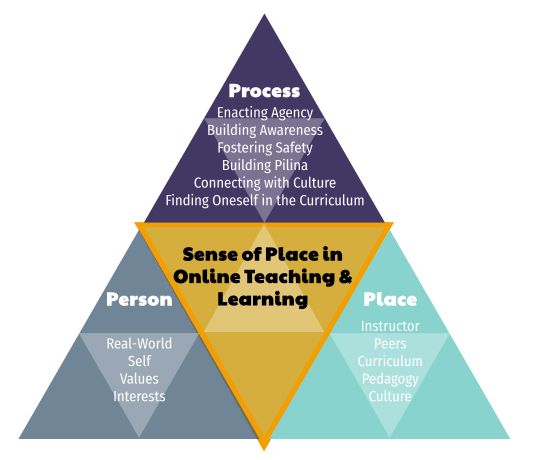
This paper focuses on the process dimension that highlights six practices that fostered students’ sense of place in the online learning environment. I refer to these six practices as the Online Sense of Place Nodes because they function like the nodes in a mesh network, creating multiple pathways for students to connect with the online learning environment. In the following sections, I describe each node as action-oriented verbs, underscoring the active engagement necessary to establish, nourish, and sustain the nodes and the connections between them.
This node illustrates the ongoing process in which students recognize themselves, their interests, and their values within the curriculum. Instructors fostered students’ connection with the curriculum by facilitating self-exploration, validating student identity, and reflecting students’ values in learning activities and assignments. “Lance” noted that their advocacy project, unit plan, and master’s thesis asked students to think about and build on their identity. “Isaac” saw his passion for social-emotional learning (SEL) reflected in the class openings.
The second node illustrates the ongoing process in which students recognize their values in the instructor, pedagogy, and classroom culture. This node aims to create a classroom culture that embodies students’ home cultures by including student voice, valuing their contributions, embracing diverse perspectives, and building community by sharing stories.
The third node illustrates the ongoing process in which students built deep relationships with both peers and instructors. From a Native Hawaiian worldview, pilina describes an unseverable relationship that is better understood through action than translation (Ikeda, 2020). The meaningful practices that supported their pilina included the intensive summer in-person learning experiences, cohort structure, class openings, the use of breakout rooms, and the cultivation of trust, respect, and empathy in instructor-student relationships.
The remaining nodes serve to strengthen connections of the first three nodes, offering alternate paths of connection. The fourth node, fostering safety, was facilitated through three meaningful practices. Students and instructors engaged in open communication, provided support to each other, and cultivated trust, respect, and empathy. “Lopaka” noted that instructors were free of judgment and provided positive feedback and encouragement. Their collaborative effort and sense of safety fostered deep connections, ultimately reinforcing the Building Pilina node.
The fifth node illustrates the ongoing process in which students developed an awareness of their sense of place. Like many place-based programs, the sense of place functioned as content to be learned and a pedagogy. Students continued building awareness for themselves through introspection and adaptation. Reflecting on his sense of place helped “Logan” realize that he needed to log on to class from a different location to promote his engagement. It also helped him find his own intrinsic motivation for pursuing the program, bringing more personal relevance to the curriculum.
The final node elucidates how students enacted agency by making choices and taking actions in various aspects of their educational journey to support their learning. Instructors created space for students to lead class activities and provide input using Google Docs and Google Slides. These tools also allowed students to engage with course materials at their own pace. Instructors also allowed students to personalize their assignments, so they could pursue their own interests.
Based on these findings, I offer four recommendations detailing the practices students cited as most impactful to their online experience. Each recommendation serves to strengthen multiple nodes.
Students most frequently reported that the class openings fostered their sense of place. This practice originated during their summer in-person classes with the Native Hawaiian practice of ʻoli or chant, which became difficult to maneuver on Zoom. In the online environment, students took turns each week to set an intention and open the online class session. Instructors modeled the first session and allowed students flexibility in leading an activity of their choosing. Student-led openings often included sharing stories, SEL learning check-ins, or other activities they typically used to open their own classrooms.
Technology can also be used to support the development of the nodes. Zoom breakout rooms strengthened four sense of place nodes, connecting with culture, building pilina, fostering safety, and enacting agency. Commonly used to facilitate small group discussion, the breakout rooms offered opportunities to hear each other’s diverse perspectives. The breakout rooms were also used for critical friend groups and partner work, which provided opportunities to share safe, constructive, and collaborative feedback as they worked on projects. These projects and discussions facilitated exploration of their identities, values, and interests. Students also valued the Zoom breakout rooms as a place for them to check in with each other. This suggests that instructors should be mindful of creating opportunities in breakout rooms for both meaningful dialogue and casual social interactions, so students can build relationships that support each other’s learning and well-being.
Collaborative documents afforded students more control to engage with course materials at their own pace and the ability to actively contribute and collaborate. The documents afforded instructors a way to collect ongoing feedback and incorporate students’ ideas into the class. For example, Google Docs facilitated reading discussions similar to a discussion board in an LMS, but instructors gave more flexibility in when and what to post. Students could choose from six different guiding questions, and readings were grouped into three sets of deadlines, even though the assignment was meant to be a weekly asynchronous critical reading discussion.
A second example involved the sharing of links to the slides instructors used during class, and embedding activities that asked students to contribute ideas directly onto the slides. On the first day of class, each student had their own slide to write a reflection. Their responses then served as a starting point for small group discussions. Students appreciated the ability to follow the slides at their own pace and valued seeing their input incorporated into class discussion. Using collaborative documents in this way reinforced the culture of the learning environment while providing students with opportunities to enact agency in their learning.
Even if the concept of sense of place is new, rephrasing the meaningful practices to serve as student-centered reflection prompts (http://go.hawaii.edu/mgA) can help students become more aware of their relationship with the curriculum, pedagogy, instructors, and their peers. Students often forget about their ability to shape the online learning environment. Providing structured opportunities throughout the semester for students to reflect on their engagement with the nodes will create opportunities for them to validate their identity through the learning activities, build awareness of their sense of place in the online learning environment, independently explore, and enact agency in decisions supporting their learning.
By refocusing on the human element within digital spaces and providing practical strategies for cultivating identity development, connection, and belonging, the PPP Framework of Online Teaching and Learning serves as an invitation to lean into culturally responsive (Ladson-Billings, 1995), progressive (Dewey, 1916), and critical pedagogies (Freire, 1970; hooks, 1994), which are currently under attack. How will you practice the online sense of place nodes to shape and reshape meaningful places of learning where everyone feels valued and empowered?
I would like to convey my deep appreciation to the people and places who made my dissertation possible, especially Moʻiliʻili, Anahola, Mānoa, Dr. Leong, Dr. Paek, Dr. Hoffman, Dr. OʻNeill, and Dr. Bhawuk, and Cohort Holomua.
 EdTech Archives