Distance education is transforming education in Ghana, with a focus on added flexibility and continuity, especially due to the COVID-19 pandemic (Abu Talib et al., 2021; Palvia et al., 2018). The switch to platforms such as Learning Management Systems (LMS), video conferencing, and web-based information literacy programs has hastened access, but digital inequalities continue to define participation in education (Martey, 2004; Owusu-Ansah, 2018; Adarkwah, 2020; Amanor-Mfoafo, 2020; Abubakari, 2021; Amadiok et al., 2024). The local context in Ghana presents unique obstacles, including infrastructure limitations, electricity access, high data costs, and a lack of broadband access; these challenges affect how both students and teachers can critically engage with required platforms during lesson periods (Sarpong et al., 2021; Quaicoe & Pata, 2020). The obstacles mentioned above are most problematic in rural and lower socio-economic areas, which not only compound the issue of lack of access to devices but also those related to literacy and information skills (Owusu-Ansah, 2018). As a result of the COVID-19 pandemic, students and teachers often report difficulties transitioning to remote learning due to professional inexperience, limited technical support, and limited institutional readiness (Adarkwah, 2020; Amanor-Mfoafo, 2020; Dramani et al., 2022). A study at the university and basic school levels shows that socioeconomic status, location, and individual skill levels often reinforce the digital divide (Abubakari, 2021; Quaicoe & Pata, 2020). The integration of distance education and learning is uneven across the country, with some schools making greater efforts than others (Amankwa et al., 2022).
Existing studies indicate that digital solutions, such as web-based information literacy programs, promote research and critical thinking skills, foster self-paced learning, and ultimately positively affect learners' academic performance (Amadiok et al., 2024). Sarpong et al. (2021) and Dramani et al. (2022) also indicated that learners appreciate flexibility, and that ways digital platforms expand access are frequently noted issues of connectivity, skill gaps, and high data costs. In response to these issues, this study examines the characteristics and implications of digital inequality within Ghana's evolving distance education landscape. Relying on Digital Divide Theory (van Dijk, 2005; van Deursen & Helsper, 2015), a handful of recent studies in Ghana and internationally have provided insight into the main characteristics of access, skill, and outcome gaps. The intention is to identify gaps, suggest interventions, and inform policy initiatives to support equitable and inclusive participation in online learning in Ghana.
What patterns of access, skill, and outcome inequalities emerge from existing research on distance education?
What institutional and infrastructural factors contribute to or mitigate the virtual divide in distance education?
What evidence-based strategies can bridge digital inequities and promote more inclusive participation in online learning?
This study is grounded in Digital Divide Theory, which characterizes digital inequality in three interrelated levels: access, skills, and outcomes (van Dijk, 2005; van Deursen & Helsper, 2015). The framework is particularly useful for understanding how technology shapes educational equity, particularly in developing countries such as Ghana.
At the access level, the focus is on differences in physical access to devices, the reliability of internet access, and the availability of infrastructure. In Ghana, continued inequality results from limited broadband access, unreliable electricity, device affordability, and the distribution of technology (Martey, 2004; Owusu-Ansah, 2018). The skills level refers to the differences in digital literacy, confidence, and training that impede the effective use of technology. Studies indicate that many Ghanaian students and teachers in rural and low-income settings lack the digital skills needed to engage with online education, a gap further compounded by insufficient training (Adarkwah, 2020; Amanor-Mfoafo, 2020). The outcomes level captures differences in how groups leverage digital technology for educational attainment, learning engagement, or other social or economic advancement.
In Ghana, limited access to devices and skills has led to unequal educational attainment, reinforcing previous social inequalities (Abubakari, 2021; Amadiok et al., 2024). This framework allowed the study to investigate how infrastructural, policy, and socioeconomic factors contribute to the digital divide in Ghanaian distance education. This has been demonstrated in the literature: bridging the digital divide requires action across three levels: access to supporting infrastructure, devices, and reliable internet access; enhanced digital skills; and equitable educational outcomes through targeted support and inclusionary policies.
This study employed a systematic literature review approach to gather existing evidence on the digital divide in Ghanaian distance education. The review process adhered to the Preferred Reporting Items for Systematic Reviews and Meta‑Analyses (PRISMA) framework, which guided methodological rigor, transparency, and reproducibility at each step. A comprehensive search was conducted in four major academic databases: ERIC, Scopus, Web of Science, and Google Scholar, using a targeted search approach as follows: “digital divide,” “distance education,” “online learning,” “LMS,” “video conferencing,” and “Ghana.” Search focused specifically on peer-reviewed publications, institutional surveys, and datasets from national studies from 2018 to 2025. Inclusion criteria focused on studies that examined Ghanaian distance or online learners, as well as studies examining inequalities in access to digital technology, skills, or digital learning outcomes. After systematic screening, coding, and appraisal of the quality framework, we identified 41 studies from 121 records that met quality and relevance standards for inclusion. Selected studies’ data were analytically categorized and thematically analyzed through the Digital Divide Theory framework, using levels of access, skills, and outcomes (van Dijk, 2005; van Deursen & Helsper, 2015), to further ensure that the findings accurately evaluated the study aims. This SLR approach provided a comprehensive and context-specific understanding of the structural, institutional, and experiential dimensions shaping Ghana's digital education landscape.
Figure 1
PRISMA Flow Diagram
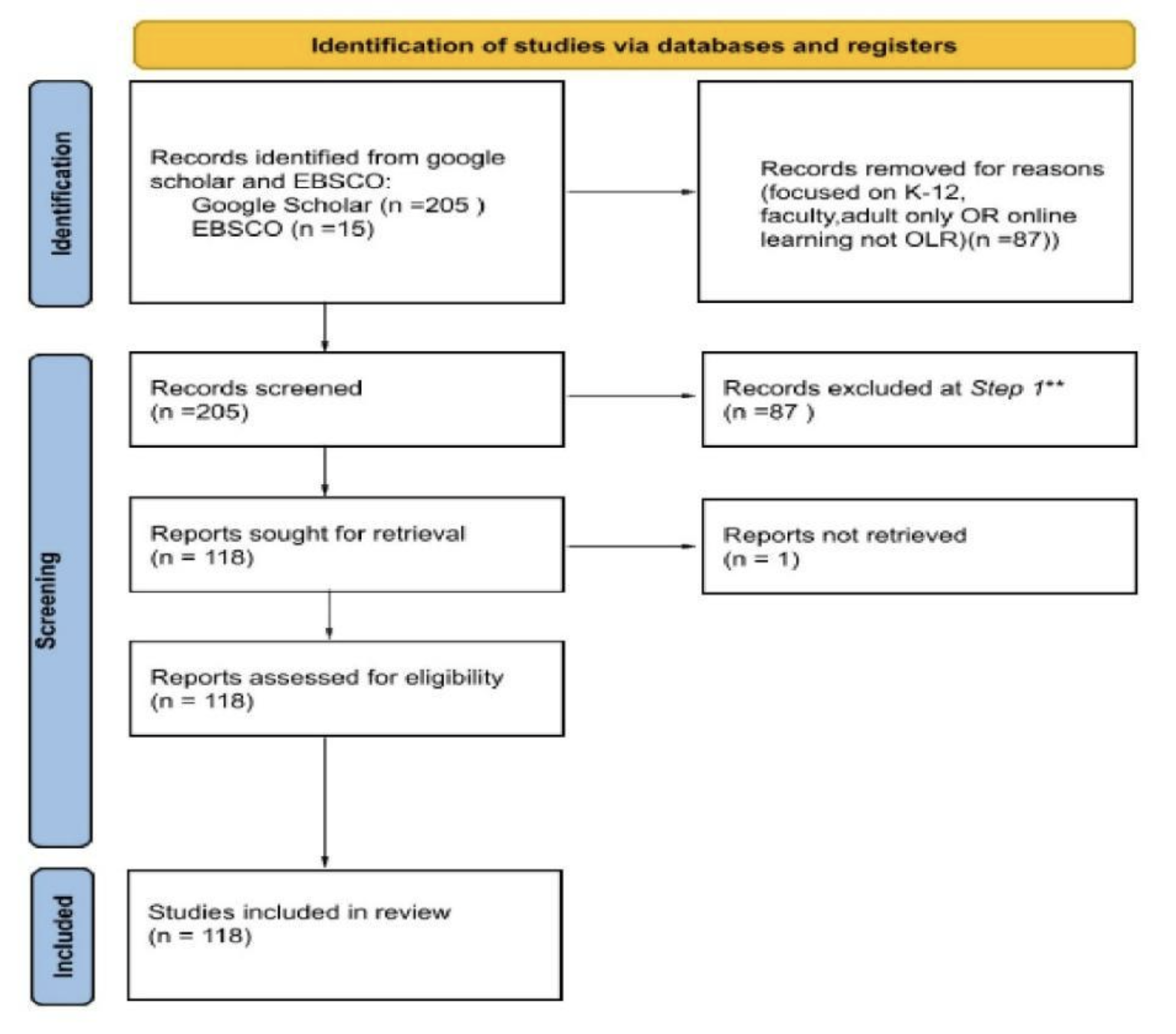
Note. Constructed by the authors following the PRISMA 2020 guidelines (Page et al., 2021).
The analysis of the current literature and datasets reveals four major themes that shape the digital divide in Ghanaian distance education. These themes reflect distinct patterns of access, skills, and learning outcomes across regions and socioeconomic groups.
Fifteen studies highlight that Learning Management Systems (LMS) such as Moodle and Blackboard support structured learning, course management, communication, and assessment in Ghanaian distance education. However, their effectiveness depends heavily on stable internet access, adequate digital devices, and sufficient digital literacy. Students in rural and low-income communities frequently face challenges interacting with LMS platforms, accessing course materials, and submitting assignments due to connectivity issues, power interruptions, and limited access to personal devices.
Twelve studies show that video conferencing tools (Zoom, Google Meet, Microsoft Teams) significantly enhance real-time interaction, peer collaboration, and social presence in virtual classes. Despite these benefits, participation is highly dependent on bandwidth availability and data affordability. Learners from regions with unstable broadband or high mobile data costs often struggle to attend live sessions consistently. This pattern exposes deeper technological and economic inequalities affecting Ghanaian distance learners.
Six studies report that virtual labs and simulations, especially in science and engineering courses, offer hands-on, exploratory learning without requiring physical infrastructure. While these tools expand flexibility and promote deeper engagement, they remain resource-intensive. Their deployment requires reliable internet access, up-to-date software, institutional ICT investment, and technical support. These conditions are often unavailable in under-resourced institutions, widening gaps between urban and rural programs.
Eighteen studies demonstrate that socioeconomic status and location continue to shape levels of digital participation and academic achievement in Ghana. Learners in rural and low-income settings are less likely to have access to devices, stable connectivity, digital skills, or supportive home environments. Even when technologies are introduced, disparities in teacher preparedness, digital competency, and institutional support contribute to uneven learning outcomes. These patterns reflect broader structural inequalities and highlight the need for targeted infrastructural and training interventions.
The results highlight that stable internet connectivity and access to appropriate digital devices remain foundational barriers, particularly for rural and low-income learners. Studies conducted during and after the COVID-19 pandemic consistently demonstrate that students in disadvantaged households faced limited participation in online learning due to unreliable connectivity and a lack of devices (Abubakari, 2021; Tsevi, 2021). Similar patterns were observed in other Sub-Saharan African contexts, where digital exclusion during school closures exacerbated educational inequality (Azubuike et al., 2021). Even broader global evidence from Vogels (2021) reinforces the persistence of income-based digital disparities, suggesting that Ghana’s experience reflects wider structural challenges. At the institutional level, research indicates uneven readiness and adoption of e-learning systems. While universities increasingly deploy LMS platforms (Amadiok et al., 2024; Dramani et al., 2022), effective utilization is shaped by contextual and organizational factors. Emergency e-learning adoption during COVID-19 further revealed gaps in preparedness and infrastructural resilience (Amankwa et al., 2022; Sarpong et al., 2021). Earlier work on ICT in Ghanaian distance education (Martey, 2004; Owusu-Ansah, 2018) shows that these challenges predate the pandemic, suggesting that COVID-19 intensified rather than created systemic digital inequalities.
Digital literacy gaps among both students and educators also emerged as critical barriers. Teachers’ digital competence has been shown to significantly influence the effectiveness of technology-mediated instruction (Quaicoe & Pata, 2020). Similarly, teachers expressed concerns about the exclusionary effects of online instruction when institutional support was inadequate (Adarkwah, 2020; Amanor-Mfoafo, 2020). These findings reinforce van Dijk’s (2005) argument that access to skills constitutes a second-level digital divide that directly affects the quality of participation. Moreover, even where platforms are available, acceptance and perceived usefulness influence learning outcomes, as explained by Technology Acceptance Model studies in online education contexts (Bailey et al., 2022). Importantly, this review confirms that resolving access and skills gaps alone does not eliminate educational disparities. Broader structural inequalities, such as differences in home learning environments, parental educational backgrounds, and school-level support, continue to influence learning outcomes (González-Betancor et al., 2021). Evidence from distance learners in Ghana also highlights the importance of institutional support mechanisms, including information literacy programs and structured LMS integration (Turnbull et al., 2020). These patterns align with international comparative findings showing that digital inequality persists in both the use of and the benefits derived from e-learning systems (Xavier & Meneses, 2021). From a policy perspective, the findings resonate with broader educational reform discussions in Ghana. Just as large-scale policies such as the Free Senior High School initiative require sustained systemic support to achieve equitable outcomes (Ameko et al., 2025), digital education reforms must similarly integrate infrastructure, training, and equity-oriented implementation strategies. Without such coordinated efforts, digital transformation risks deepening stratification rather than democratizing learning opportunities.
This literature review found that Ghanaian distance education is meaningfully shaped by four core factors: access to reliable internet and digital devices, digital literacy gaps among learners and teachers, the resource-intensive nature of advanced technologies like virtual labs, and persistent socioeconomic and geographic disparities in participation and academic outcomes. While innovations such as Learning Management Systems, video conferencing, and Ghana Learning TV have created new pathways for engagement, their benefits are unevenly distributed, and barriers remain especially pronounced for rural and low-income groups. To achieve equity, sustained investment in digital infrastructure, affordable data and devices, ongoing digital skills training, and targeted support for marginalized regions are needed. Future policy and research should focus on inclusive strategies that bridge these divides, ensuring that technology fulfills its promise for all distance learners in Ghana.
During the preparation of this work, the authors used Gemini 2.5 (Google) to proofread and improve grammar, clarity, and readability. After using this tool, the authors reviewed and edited the text, and we take full responsibility for the content of this publication.
 EdTech Archives