The widespread integration of generative AI in education is increasingly framed as nothing short of a paradigm shift, comparable to the disruptive force of industrial revolutions in previous centuries. Unlike earlier educational technology, GenAI is capable of doing creative and intellectual tasks previously thought to be exclusive to humans, such as writing cohesive essays, responding to open-ended inquiries, providing tailored and instant feedback, and developing instructional materials. It also enhances administrative efficiency and affords educators novel instructional design opportunities (Kaufman et al., 2025). Yet ethical challenges and insufficient educator preparedness continue to hinder the responsible incorporation of GenAI in classrooms, underscoring the urgent need for AI literacy (Hossain et al., 2025; Nasr et al., 2025).
English language educators are at the front lines of the AI transformation and urgently need strong GenAI literacy, as the technology is reshaping language learning at a pace that directly influences writing, communication, and meaning-making. No other subject feels this impact as deeply. The affordances are real: students gain access to a tireless, non-judgmental conversational partner and receive immediate textual feedback that stretches practice well beyond scheduled class time (Minnillo et al., 2024). Yet these same affordances generate pedagogical tensions that cannot be bypassed. When AI translates or drafts composition passages replacing the students, the authentic productive struggle that builds their linguistic competence is quietly diminishing, along with the creativity that language learning is meant to cultivate (FengTeng, 2024). Additionally, academic integrity has become a concern; Barrot (2023) coined it “high-tech plagiarism” to capture a form of dishonesty that current detection instruments remain poorly equipped to address. These concerns are further combined by systemic risks, misinformation in model outputs, reproduced bias, and unresolved questions of data privacy and data colonization, each with distinct implications for language classrooms (Hockly, 2023; Nasr et al., 2025).
These risks increase when educators themselves are underprepared. Research has concentrated heavily on learner behavior while leaving largely unexamined how educators conceptualize, direct, and critically evaluate GenAI (Tan et al., 2024; Sperling et al., 2024; Chen, 2024), a gap with tangible consequences for ethical practice, task design, and responsible student guidance (Barrot, 2023; Kohnke et al., 2023; Moorhouse & Kohnke, 2024; FengTeng, 2024; Holmes & Tuomi, 2022). To address this, the present study developed four training modules comprising ten micro-learning videos, each targeting one interrelated dimension of GenAI literacy: functional, ethical, rhetorical, and pedagogical.
This study uses Media Literacy Theory to explain how individuals access, analyze, evaluate, and create media (Hobbs, 2010). GenAI outputs, texts, images, videos, and prompts, are powerful new media that teachers must analyze, examine, and utilize appropriately. We used Selber's (2004) digital multiliteracies and the UNESCO AI Competency Framework for Teachers (Cukurova & Miao, 2024) to apply this theory in action. Media Literacy Theory explains why teachers must critically evaluate and mold AI-mediated knowledge. Selber and UNESCO supply the what and how, the literacies and development teachers need to use GenAI. Selber provided functional, critical, and rhetorical literacies, whereas UNESCO provided a clear sequence of AI competences (acquire, deepen, create) and responsible pedagogy. We added ethical and pedagogical literacy to Selber's critical literacy to connect the two models for language educators with UNESCO's goal on safe, transparent, and learner-centered AI inclusion. Together, Media Literacy Theory and these two competency models shaped the design of the four GenAI literacy modules and guided the structure of the AI literacy survey used in this study.
The training has four stages (see Figure 1): First, functional literacy introduces educators to what GenAI is and how it works, its possibilities and limitations, and what teachers should know before using it, so they become informed knowledge creators. Second, the ethical literacy module prepares them to be critical inquirers of AI use. Second, in the ethical literacy module, they become critical inquirers of AI use. They investigate GenAI challenges such as academic integrity, bias, hallucination, privacy, environmental implications, and the double-sided effects on creativity and critical reasoning. This prepares them to reflect on the ethical questions surrounding GenAI and to create a code of ethics for fair, transparent, and responsible use within a human-in-the-loop approach. Research-informed solutions are introduced through the application of critical thinking steps (Figure 2), which connect these systemic risks directly to the realities of individual classrooms. The goal extends beyond problem identification: educators are guided to develop practical, principled responses that position AI as a support structure for human-centered learning rather than a displacement of it. Central to this module is instruction in how to become a collaborative, active AI user. This process follows a four-phase inquiry cycle: educators begin as questioners, initiating dialogue with AI by posing questions; they then explore the AI’s responses by following up with targeted probes and requesting concrete examples; next, they integrate by comparing and contrasting the AI’s claims against prior knowledge and other authoritative sources, actively situating the generated content within the broader disciplinary conversation; finally, they move toward resolution, a reflective moment of synthesis in which they decide how to apply, adapt, or set aside the AI’s contribution, contextualizing it with their own scholarly voice and judgment as the indispensable human in the loop (Nasr et al., 2025).
Figure 1
GenAI Literacy Training Conceptual Framework
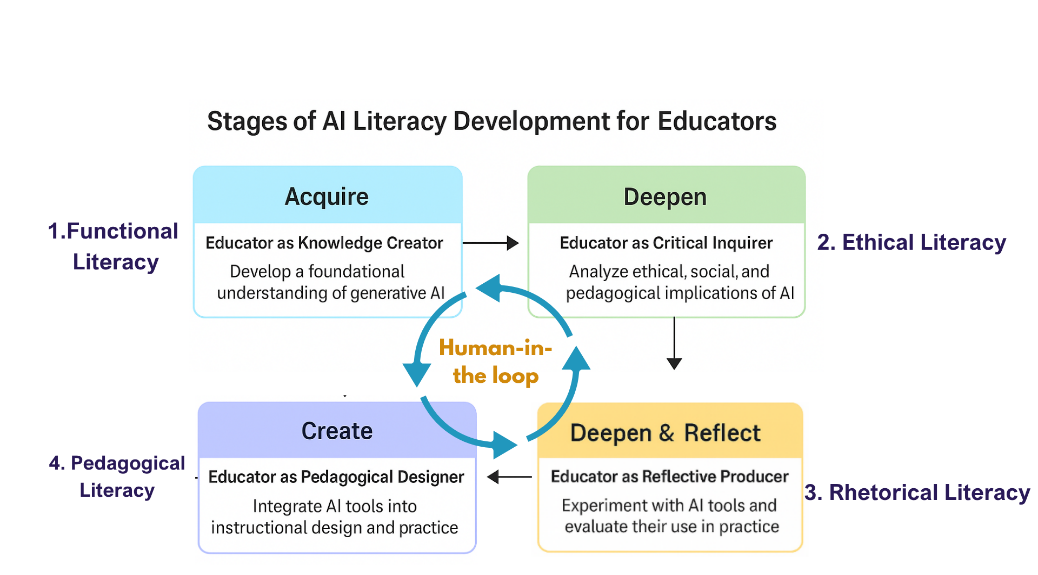
Figure 2
Critical Thinking Steps to Use GenAI responsibly and ethically
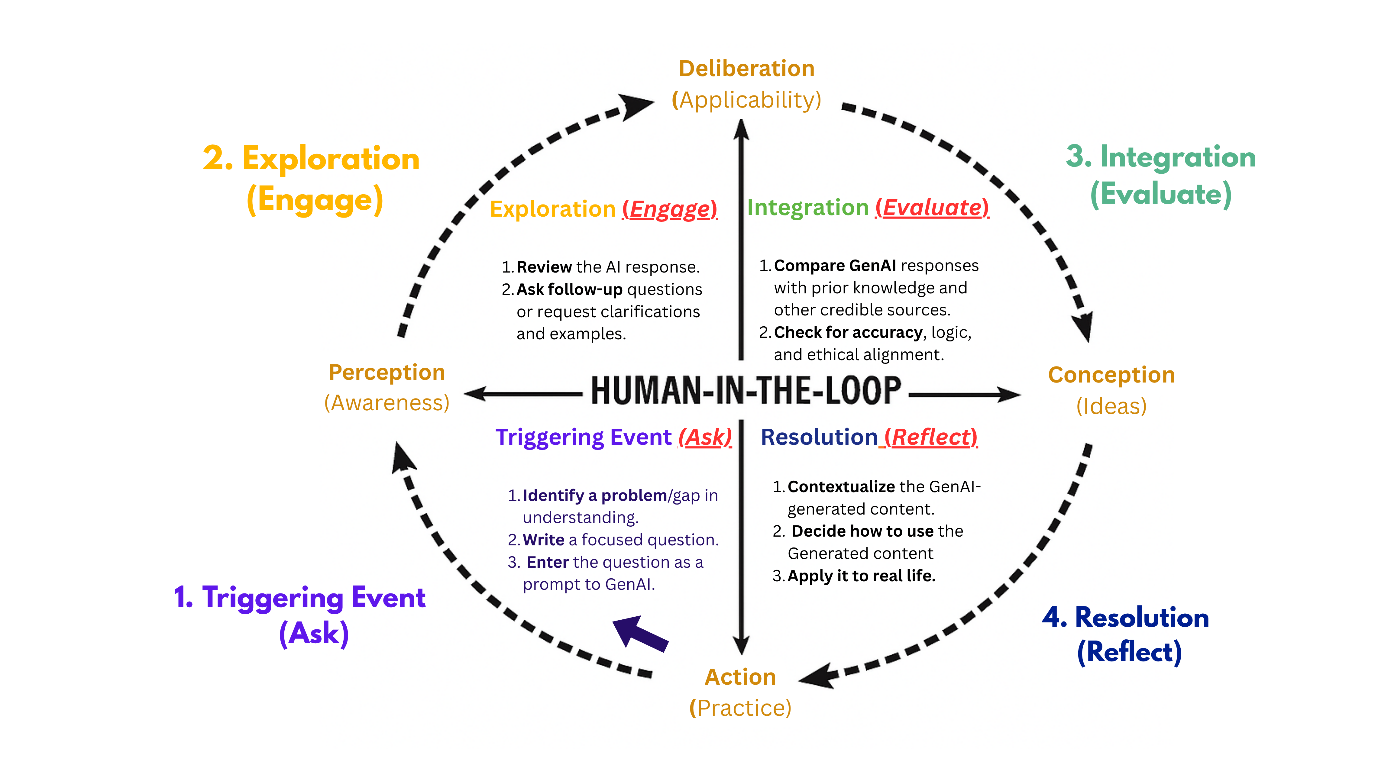
Note. Adapting the Practical Inquiry Framework to support critical thinking in a GenAI context. Note. Adapted from Garrison et al. (1999) and informed by Nasr et al. (2025).
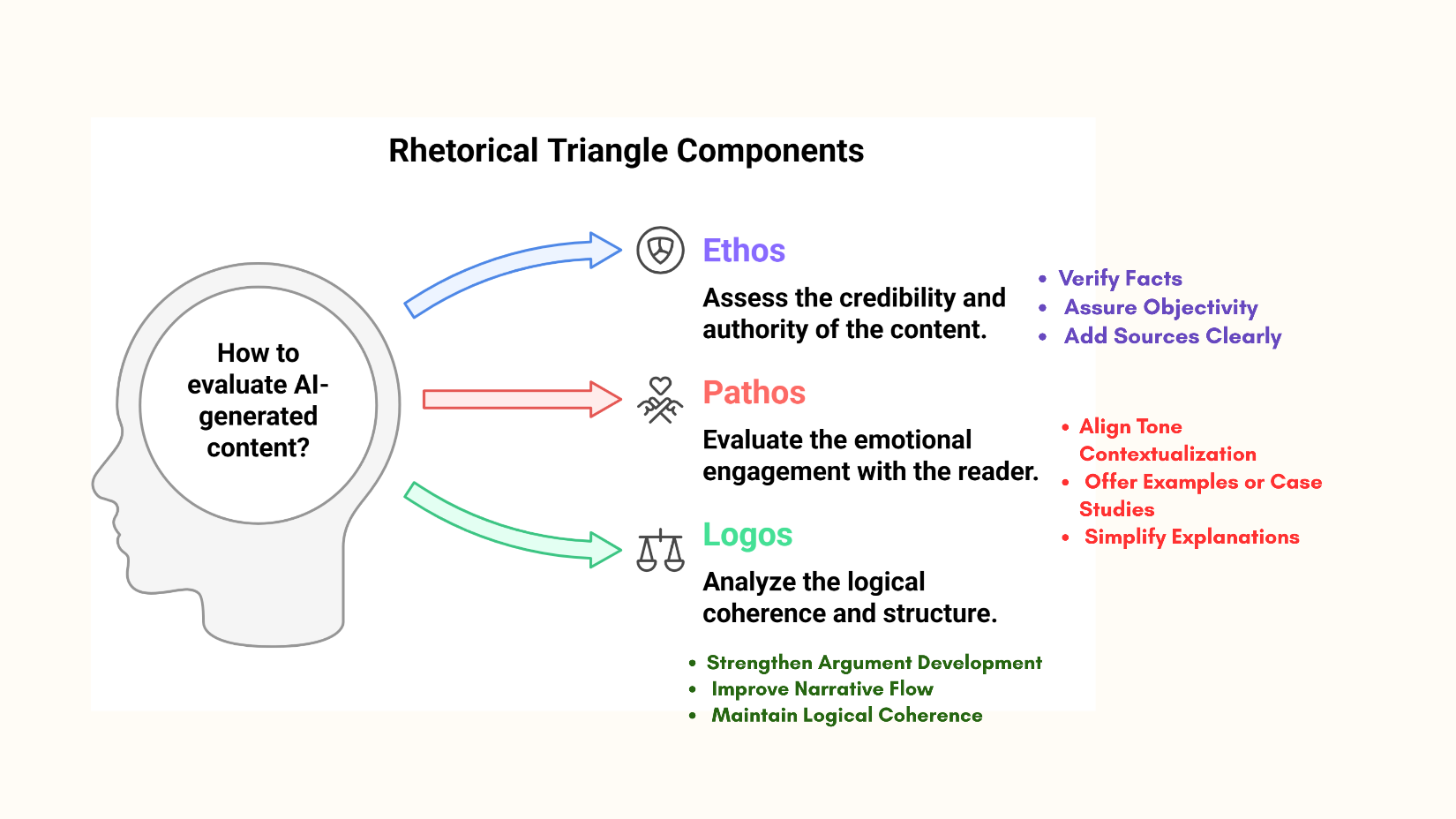
In the third module, rhetorical literacy (prompt engineering), educators improve their AI prompt writing (see Figure 3) for lesson plans and classroom activities to become reflective producers. Many times, educators’ prompts result in generic outputs that do not meet the unique needs of classrooms or their expectations for the activities. This module prepares them to be reflective users and to develop more effective and contextualized prompts that integrate the rhetorical situation, including writer, audience, tone, purpose, genre, and context. They use the rhetorical triangle, ethos, pathos, and logos, to critically evaluate generated AI content (see Figure 4), resulting in more contextualized and communicative outputs that support a human-in-the-loop approach.
Figure 3
Applying the Rhetorical Situation to Write Effective AI Prompts
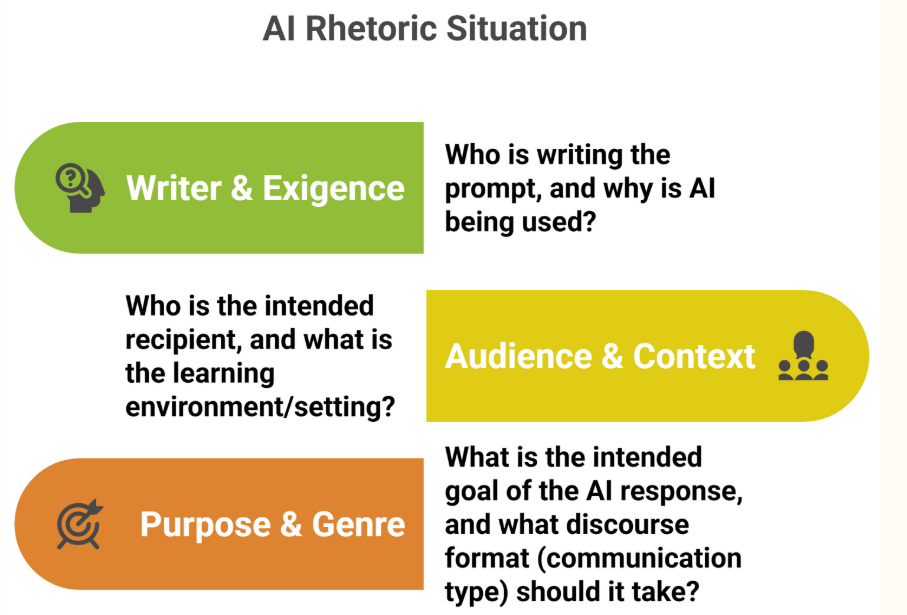
Figure 4
Apply Rhetorical Triangle Strategies for Evaluating the AI-Generated Content
In the final pedagogical literacy module, educators take on the role of instructional designers who create with AI through the lens of learning theory. They investigate how GenAI tools might enhance learning by creating inclusive and engaging activities. They are also introduced to a variety of effective GenAI tools and implement them to apply strategies that guide learners’ responsible use, diversify teaching approaches, and integrate AI without fostering overreliance. The module further prepares them to evaluate AI’s impact on learning and to propose strategies that promote authentic student assessment in AI-mediated classrooms.
The primary purpose of this study is to examine the impact of the training on language educators' functional, ethical, rhetorical, and pedagogical GenAI literacies necessary for responsible and effective AI use in English teaching contexts. In addition, the study seeks to understand educators’ immediate perceptions after completing the training and how the experience shapes their views of GenAI’s role in classroom practice. To address this aim, the following research questions guided the study:
1. How does GenAI literacy training influence language educators’ GenAI literacy across the four dimensions (functional, ethical, rhetorical, and pedagogical)?
2. What are language educators’ reflections on their experiences and immediate perceptions of GenAI use following the literacy training?
This pilot study employs a convergent mixed-methods design. Quantitative data were collected through a pre- and post-training 5-point Likert-scale AI Literacy Survey, which was administered to 82 participants to measure internal reliability. A total of 82 valid responses were analyzed. The internal consistency reliability of the survey was good, with Cronbach’s α = .97. The survey was administered to 34 teachers in the USA who teach English/Humanities/ESL before and after they completed ten micro-learning videos embedded in Canvas within an online course over six weeks. The survey investigated changes across the four literacies, and a paired-samples t-test was used to compare pre- and post-scores. Qualitative data were collected through four open-ended questions in the post-survey and analyzed using thematic analysis (Braun & Clarke, 2006), enabling participants to reflect on their training experience and their immediate perceptions of GenAI in language instruction.
Results indicated a statistically significant difference between the pre- and post-AI literacy survey mean scores, both overall and within each of the four dimensions, suggesting that the AI literacy training positively influenced teachers’ AI literacy levels, as follows:
Table 1
Paired-Samples t-Test Results for GenAI Literacy Dimension (N = 34)
AI Literacy Dimension | Pre-Training M (SD) | Post-Training M (SD) | t(33) | p |
Functional | 2.60 (0.72) | 4.26 (0.63) | 12.36 | < .001 |
Ethical | 3.16 (0.88) | 4.42 (0.62) | 7.62 | < .001 |
Rhetorical | 2.73 (0.77) | 4.33 (0.61) | 11.19 | < .001 |
Pedagogical | 2.16 (0.69) | 4.30 (0.70) | 14.97 | < .001 |
Overall GenAI Literacy | 2.66 (0.74) | 4.33 (0.62) | 13.32 | < .001 |
Note. All differences are statistically significant. p < .05*, p < .01**, p < .001***
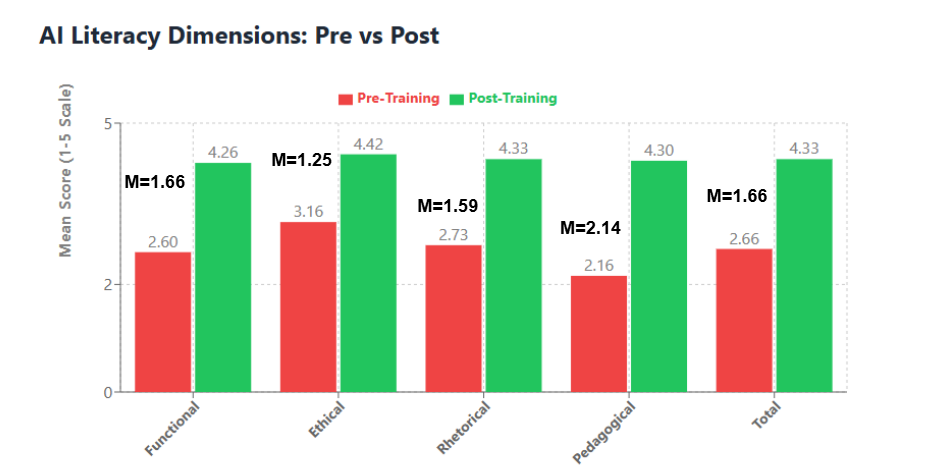
There was a significant increase in overall GenAI literacy from pre-training (M = 2.66, SD = 0.74) to post-training (M = 4.33, SD = 0.62), t(33) = 13.32, p < .001, d = 2.28. This large effect size confirms a substantial development in the educators’ GenAI literacy (see Figure 5), demonstrating the positive impact of the training modules. Also, substantial enhancements were observed across all dimensions of AI literacy: functional (t(33) = 12.36, p < .001, d = 2.12), ethical (t(33) = 7.62, p < .001, d = 1.31), rhetorical (t(33) = 11.19, p < .001, d = 1.92), and pedagogical (t(33) = 14.97, p < .001, d = 2.57).
On the other hand, preliminary qualitative results supported quantitative outcomes, revealing a clear transition from GenAI uncertainty to confidence and competence. Course participants said it transformed their understanding and practical skills. One teacher expressed," I now understand how it can make classes more creative, save time, and let students learn in their own way (Bri). Participants indicated increased AI confidence and ethical awareness, with one stating, “I came into these modules with no knowledge of GenAI, but it helped me grow professionally and become more confident as an educator” (Deid).
Figure 5
Pre- and Post-Training Differences in AI Literacy Dimensions
What the pilot training demonstrated, above all, is that GenAI literacy is neither an abstract competency nor a self-evident skill; it is something that can be meaningfully cultivated through well-structured learning experiences. Statistically significant gains across all four dimensions, functional, ethical, rhetorical, and pedagogical, confirmed that the training moved educators from positions of uncertainty and limited confidence toward demonstrably stronger understanding and confidence in how to use GenAI ethically and effectively in educational practice. Qualitative findings reinforced this trajectory; participants recognized the modules for their practicality, describing them as making complex AI literacies genuinely comprehensible. These results, however, call for careful interpretation. The sample was small (n = 34), and for a substantial proportion of participants, this may well have been their first sustained encounter with GenAI tools; both factors likely amplified the large effect sizes observed. The fully online delivery format, embedded within a Canvas course over six weeks, may have shaped engagement patterns in ways that a face-to-face or hybrid design would not replicate. Future iterations will recruit a larger, more diverse cohort to assess whether these gains translate into sustained professional development.
 EdTech Archives