Second language acquisition (SLA) is a challenging process, requiring sustained effort and effective instructional strategies. Learning a second language (L2) necessitates learning hundreds of new words, grammar, pronunciation, listening comprehension, cultural information, and often verb conjugation patterns and new alphabets, with each of these demanding classroom time. Game-based learning has great potential for SLA, as games for things like vocabulary practice outside of class can be designed to remove some of the tedium from memorization. However, gaming platforms are expanding at a breakneck pace—from the myriad of standalone consoles to the different “reality” options (virtual reality, augmented reality, etc.) to games on laptops, tablets, and phones—it is hard to know where to begin when creating an educational game. We assert the importance of keeping the learner at the center of the design process and take student preferences into account when designing new educational games.
Game-based learning (GBL) can boost motivation and engagement in language learning (Alfadil, 2020; Reinhardt & Sykes, 2012; Shintaku, 2023). However, the playing of educational games does not guarantee the player will learn the language (Xu et al., 2020). Scholars have investigated commercial learning games (Koçak, 2023; Peterson, 2016; Sundqvist, 2019), researcher-created learning games (Matthews & Lange, 2024; Yang et al., 2024), and games co-designed with teachers (Ding et al., 2024). Studies that directly involve the learner in the game design, like Agbo et al.’s (2023) work with university students co-designing a VR game to learn computational thinking concepts, are rare.
The goal of this study was to better understand university-level language learners to inform our work on SLA games, with the following research questions framing our work:
How do university students enrolled in language courses already engage with video games?
What game styles and characteristics do university students enrolled in language courses want in an educational L2 game?
To answer our research questions and better understand the video gaming preferences of our target audience, postsecondary students learning a language, we created a 25-item survey and asked language instructors to distribute it to their students at our large, public, high-research activity (formerly R1) university in the southeastern United States (no compensation was offered to students or faculty). The survey includes multiple-choice, multiple-selection, and free-form response items aiming to understand students’ language learning contexts, gaming motivations and habits, and attitudes toward SLA games. The motivation questions on our survey were selected from the motivational categories described in Sherry et al. (2006), This study was approved by our university’s Institutional Review Board (IRB).
We received 117 valid, complete responses from participants over 18 years old and enrolled in at least one language course at our university. Respondents were 68 female (58%), 36 male (31%), 2 non-binary (2%), 1 queer (1%), and 10 (9%) chose not to respond. Eighty (72%) participants identified as Caucasian, 20 respondents (18%) as Hispanic, 11 (10%) as Black or African American, 10 (9%) as Asian or Pacific Islander, 5 (5%) as Middle Eastern or North African, 1 (1%) as Indigenous, Native, American Indian, or First Nations, 1 (1%) as Afro-Caribbean, and 6 (5%) chose not to respond.
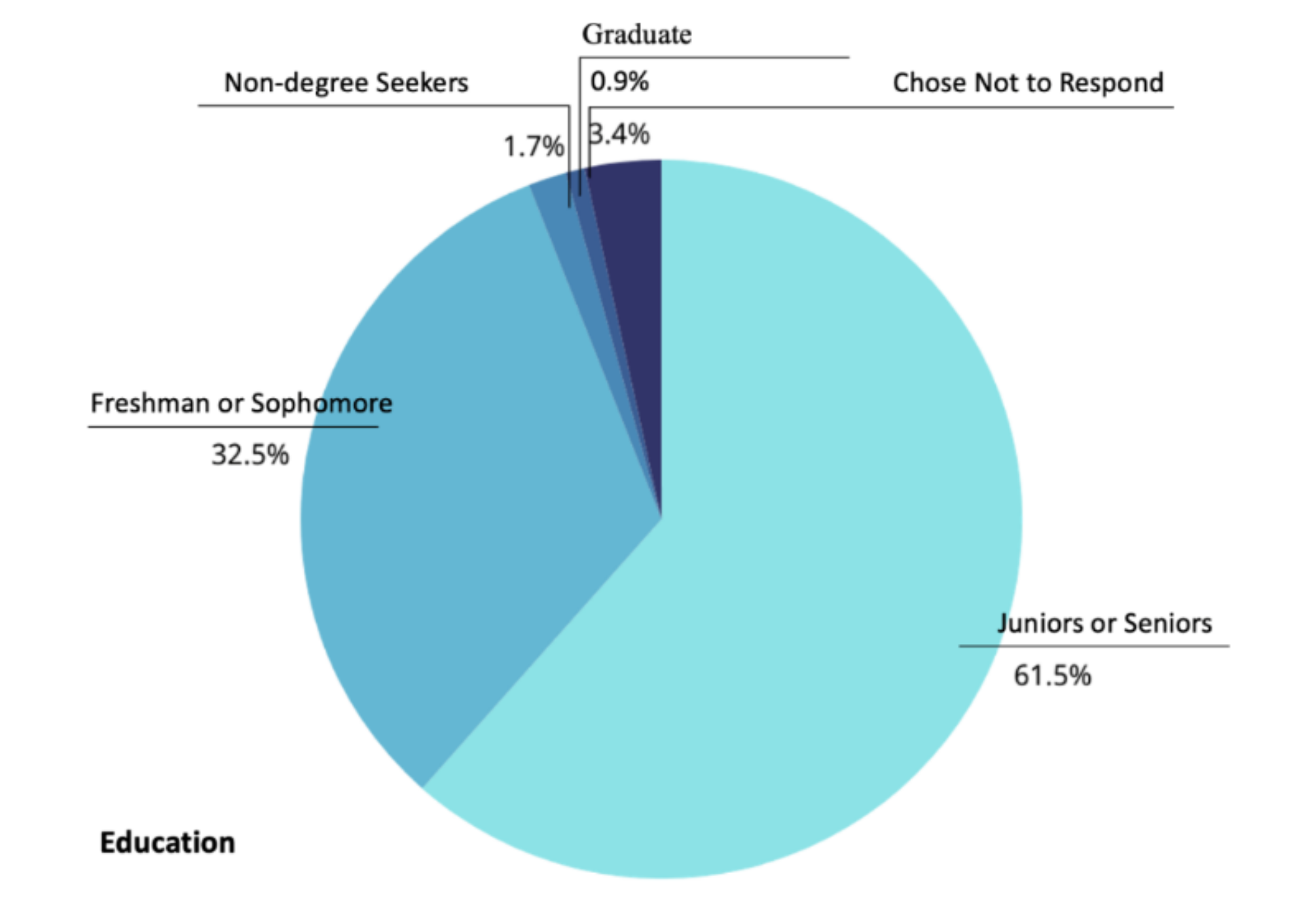
We did not collect age beyond being 18 or older, instead asking participants’ class standing at the university, where 38 (32.5%) reported being either a freshman or a sophomore; 72 (61.5%) were juniors or seniors; one (0.9%) at the graduate level; two (1.7%) non-degree-seeking; and 4 (3.4%) chose not to respond (see Figure 1).
Figure 1
Educational Level of Participants
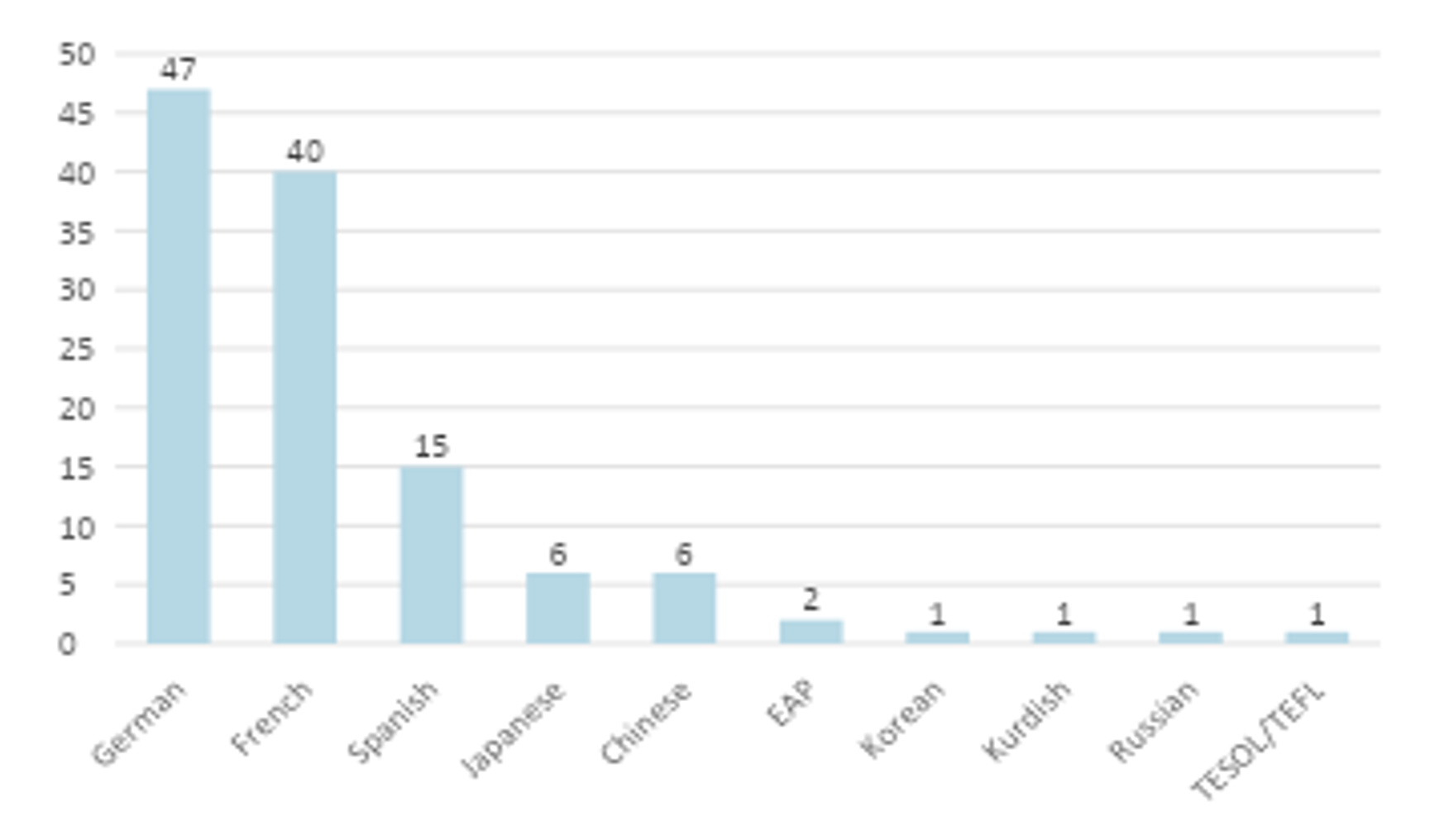
Additionally, participant majors spanned a wide range of fields, with 39 different majors (four dual majors, counted separately), and their language course enrollment spanned 10 different language concentrations, predominantly German (42%) and French (35%). Respondent language course enrollment is reported in Figure 2.
Figure 2
Participant language course enrollment
A majority of participants were avid video game players, with 75% (87) stating that they currently play video games, 72% (84) that they have been playing video games for several years, and 14% (16) that they used to play but were not currently playing. Gaming time ranged from less than a few hours per month to 40 hours per week.
Of the 87 current video game players, 66% play on PCs, followed by mobile devices (62%) stand-alone consoles (e.g., Xbox) (54%), handheld consoles (e.g., Nintendo Switch) (49%,), and VR headsets (13%). The survey asked students to select all game genres they enjoy playing. Of the 86 respondents to this item, the top three genres were action-adventure (71%), first-person shooter (52%), and puzzle games (51%). The full list of results is reported in Table 1, below.
Table 1
Video Game Preferences
Video Game Types | Percentage | n |
Action-adventure games | 71% | 61 |
Shooter games | 52% | 45 |
Puzzle games | 51% | 44 |
Strategy games/Turn-based strategy (TBS) | 47% | 40 |
Action role-playing games (RPGs) | 43% | 37 |
Survival games | 42% | 36 |
Board games | 38% | 33 |
Platform games | 36% | 31 |
Fighting games | 35% | 30 |
Sandbox role-playing games (RPGs) | 34% | 29 |
Simulation games | 33% | 28 |
Massive multiplayer online role-playing games (MMORPGs) | 30% | 26 |
Tactical role-playing games (RPGs) | 30% | 26 |
Racing games | 23% | 20 |
Visual novels | 22% | 19 |
Roguelike games | 20% | 17 |
Multiplayer online battle arena (MOBA) | 17% | 15 |
Sports games | 13% | 11 |
Other: (please list) | 7% | 6 |
Of the 86 participants responding to six uses and gratifications on Sherry et al.’s (2006) scale, 84% (72) reported playing video games because they are exciting, matching Sherry et al.’s arousal category. The next most popular motivation at 50% (43) was social. Tied for third were diversion and challenge, both being selected by 45% (39) of participants. Less popular were playing video games “because they let me do things I can’t do in real life” at 34% (29), and competition at just 6% (14). Eleven participants (13%) selected “other,” and ten of them elaborated: games were relaxing (3), a form of escape (3), a means to be creative (2), a way to visit real or fictional worlds (1), and to improve their decision-making speed (1). These results are displayed in Table 2 below.
Table 2
Participant Motivations for Playing Video Games
Motivation | n | Category |
I play video games because they are exciting. | 72 | Arousal |
My friends and I use video games as a reason to get together. | 43 | Social Interaction |
I feel proud when I master an aspect of a game. | 39 | Challenge |
I play video games to avoid other things I should be doing. | 39 | Diversion |
I play video games because they let me do things I can’t do in real life. | 29 | Fantasy |
I like to play to prove that I am the best. | 14 | Competition |
Other (write-in): To relax A form of escape A means to be creative A way to visit real or fictional worlds To improve my decision-making speed Chose not to elaborate | 11 3 3 2 1 1 1 | - Diversion Fantasy Diversion Fantasy Challenge - |
Turning to SLA more specifically, 27.4% (32 of 114) reported that remembering vocabulary was the most difficult aspect; followed by listening comprehension (23.9%); tense (9.7%); and pronunciation (9.4%). Finally, students held positive attitudes regarding the potential of games augmenting SLA, with 74% (of 114) responding that they would be “very enthusiastic” or “pretty enthusiastic” about assigned educational games. Participants were also asked what aspects of the L2 they would like an educational game to help them learn (selecting all that applied). Listening comprehension ranked highest at 76% (86) of the 113 responding to this item, followed by tense at 72% (81), and pronunciation at 53% (60). Just under half also selected reading comprehension, 49% (55), as well as improving spelling, 46% (52). Ranking lowest at 22% (25) is improving alphabet letters and/or accent markings. Notably, the option for vocabulary was inadvertently omitted in the survey. However, a total of 11 participants (10%) chose “other” and wrote in: vocabulary (3), grammar (4), and “everything” or “all of the above” (3), and “speaking” (1).
Returning to our first research question, it is clear that most of our students are interested in and/or actively playing video games for entertainment purposes. They play a variety of game genres, with popular genres including action-adventure games, shooter games, and puzzle games. To answer our second research question, results indicate learners would like video games that help with vocabulary retention, listening comprehension, and tense. Students’ genre preferences align with the best practices of Reinhardt and Sykes (2012): games with dynamic, learner-driven goals and individualized feedback to aid with the aspects of the language they find most difficult. Relevant narrative and context, also recommended by Reinhardt and Sykes, can be implemented in the top game genres of our participants: action-adventure, puzzle, and first-person shooter games, with careful design.
This study’s findings inform the designers of SLA games. By better understanding learner preferences and gaming behaviors, educators and developers can craft more targeted, impactful learning experiences. Additional work is underway, implementing several author-designed games in university language courses to further inform learner study habits with computer and VR games. Future work should investigate ways to further centralize the learner in the design process through co-design or highly customizable games.
This work was funded in part by the U.S. Department of Education, PR/Award Number P017A230010. Opinions expressed do not represent the views of the U.S. Department of Education.
 EdTech Archives